BY ISSAH OLEGOR
Thirty ambulances that have remained at the centre of one of the most contentious public procurement controversies have been handed over to National Security for refurbishment, more than a decade after their procurement and years after questions were raised over whether the vehicles were ever fit for their intended purpose.
The vehicles which came without the medical fittings and had been parked at the Ghana Air Force Base at Burma Camp in Accra, are expected to undergo refurbishment before being integrated into the national emergency response fleet.
The development effectively reopens debate over the controversial ambulance procurement and the competing accounts that have emerged over why the vehicles were never deployed as intended.
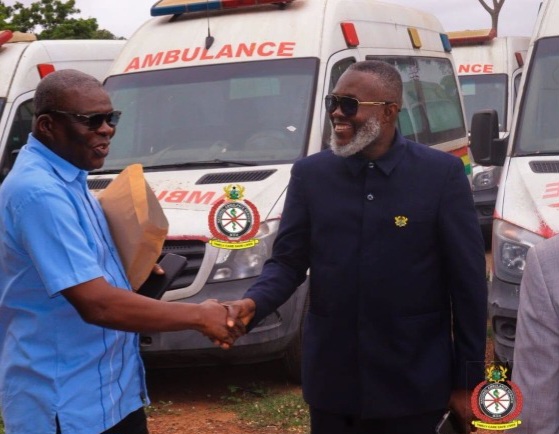
The Ministry of Health, working with the National Ambulance Service (NAS), handed the 30 vehicles to National Security at the weekend.
The National Security is expected to oversee the refurbishment process, after which the vehicles will be subjected to technical and roadworthiness assessments before any decision is taken on their operational deployment. Incidentally Richard Jakpa who was awarded the multimillion euro contract and ended up importing empty vehicles described as not fit for purpose is now working with the National Security as a director, raising conflict of interest situation.
The case eventually landed in court with Ato Forson and Richard Jakpa standing f trial for the importation and payment of 3.5million Euro without functioning ambulances.
The handover follows legal clearance from the Office of the Attorney-General and Ministry of Justice, which reportedly authorised the Ministry of Health to retrieve and assess the vehicles for possible operational use.
The National Ambulance Service said an initial assessment had already been conducted by the State Transport Company (STC), with further technical examinations expected to establish the condition of the vehicles and determine the extent of refurbishment required.
The history of the 30 vehicles stretches back to a procurement arrangement initiated around 2011 and covered by a contract dating from 2012. The vehicles formed part of an anticipated first batch of 200 vehicles intended to strengthen the ambulance fleet and improve emergency medical transportation.
The 30 vehicles were reportedly acquired at a cost of about €3.5 million.
However, when the vehicles eventually arrived in Ghana, their condition and configuration became the subject of intense disagreement.
Former Health Minister Kwaku Agyeman-Manu, who took office in 2017, maintained that the vehicles lacked critical equipment, accessories and safety features required for them to function as proper ambulances. His position was that they were essentially Sprinter buses that had been imported without the necessary fittings.
That position subsequently became part of a criminal prosecution surrounding the transaction.
In court, Agyeman-Manu testified that the vehicles imported for the National Ambulance Service were defective and improperly fitted, describing them as Sprinter buses rather than fully functional medical emergency vehicles.
But that account was disputed by his predecessor, Alex Segbefia, who served as Health Minister under the previous administration.
Alex Segbefia argued that the vehicles could have been made fit for purpose if the accessories and equipment that were allegedly being held at Tema Port had been cleared and installed.
Richard Jakpa, another key figure in the ambulance case, also challenged the assertion that the vehicles were simply unfit for purpose.
In earlier proceedings, Jakpa argued against the characterisation of the ambulances as defective, maintaining that it was inaccurate to describe them as unfit for their intended use.
His explanation of the circumstances surrounding the vehicles became a subject of considerable courtroom attention and added another dimension to the long-running dispute over what was actually procured, what was delivered and what remained to be done before the vehicles could operate as ambulances.
The government is now taking a different approach by seeking to recover the vehicles as potentially usable public assets.
According to the National Ambulance Service, the handover forms part of an effort to recover and restore available emergency-response assets to strengthen the Service’s operational capacity.
However, the vehicles will not automatically enter service following the refurbishment. NAS says they must first undergo the necessary technical inspections and roadworthiness assessments before they can be cleared for deployment.
The formal handover was attended by the Legal Adviser to the Minister for Health, Abubakar Mutiu-Rahaman; the Board Chairman of the National Ambulance Service, Nana Baffour Kotei Kutin Sraman II, the Bremanhene; NAS Chief Executive Officer Dr George Kojo Owusu; and representatives of National Security and the Ghana Armed Forces.
The keys to the 30 vehicles were formally presented to a representative of National Security, which will oversee their refurbishment.