By Issah Olegor
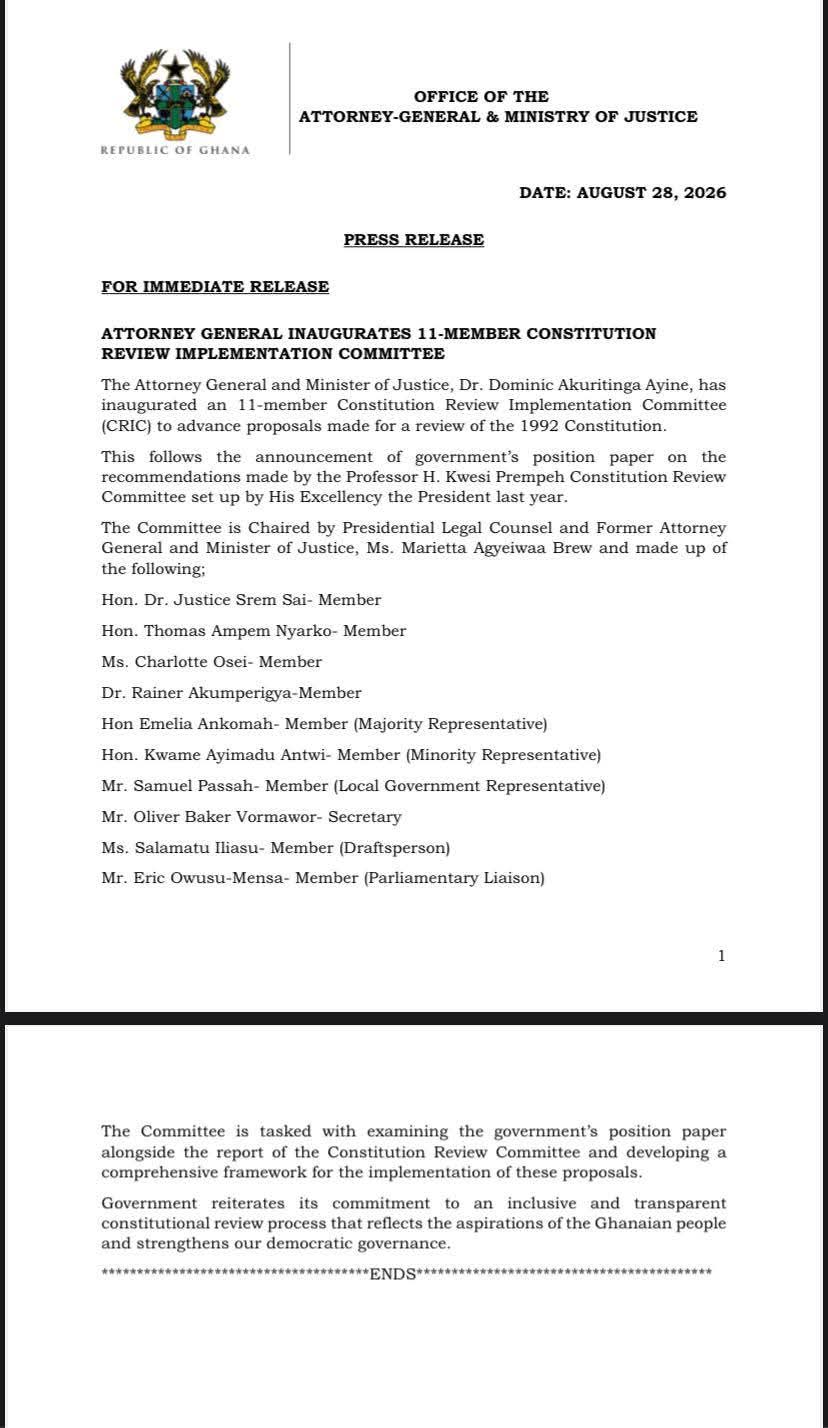
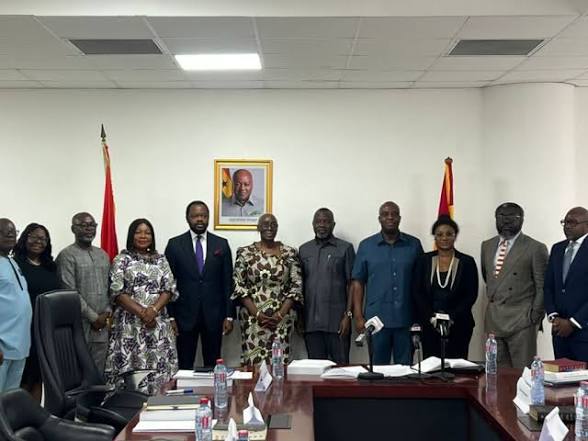
The National Democratic Congress government has taken a major step towards translating proposed reforms to Ghana’s 1992 Constitution into concrete action with the inauguration of an 11-member Constitution Review Implementation Committee (CRIC) by the Attorney-General and Minister of Justice, Dr. Dominic Akuritinga Ayine.
The committee has been established to advance the proposals arising from the latest constitutional review process following the government’s publication of its position on the recommendations contained in the report of the Professor H. Kwesi Prempeh Constitution Review Committee, which was constituted by President John Dramani Mahama last year to examine areas of the 1992 Constitution requiring reform.
The inauguration, according to a press release issued by the Office of the Attorney-General and Ministry of Justice on Friday, August 28, 2026, signals a transition from the consultation and recommendation stage of the constitutional review exercise to the more complex phase of determining how approved proposals can be implemented.
The newly constituted committee is chaired by Ms. Marietta Agyeiwaa Brew, the Presidential Legal Counsel and a former Attorney-General and Minister of Justice.
Her appointment places an experienced constitutional and legal practitioner at the head of the body responsible for helping government move the reform proposals forward.
Other members of the committee include Hon. Dr. Justice Srem Sai, Hon. Thomas Ampem Nyarko, Ms. Charlotte Osei and Dr. Rainer Akumperigya. The membership also includes representatives of key political and institutional interests, reflecting the government’s stated commitment to making the implementation process broad-based.
The Majority in Parliament is represented by Hon. Emelia Ankomah, while Hon. Kwame Ayimadu Antwi serves as the Minority Representative. Mr. Samuel Passah represents the local government sector.
The committee further includes Mr. Oliver Baker Vormawor, who will serve as Secretary, Ms. Salamatu Iliasu, who has been designated as the member responsible for draftsmanship, and Mr. Eric Owusu-Mensa, who will serve as the Parliamentary Liaison.
The composition brings together legal expertise, political representation, local government perspectives and parliamentary experience, areas considered important to the eventual implementation of constitutional amendments.
From Review To Implementation
The establishment of the CRIC comes after the Constitution Review Committee completed its work and submitted recommendations for changes to the country’s constitutional framework. Government subsequently considered those recommendations and issued a Position Paper outlining its position on the proposals.
The implementation committee has now been tasked with examining the government’s Position Paper together with the original report of the Constitution Review Committee.
Its principal responsibility will be to develop a comprehensive framework that sets out how the proposals accepted or supported by government can be translated into actual constitutional and institutional reforms.
This stage is particularly important because recommendations emerging from a constitutional review do not automatically become part of the supreme law.
Depending on the nature of each proposal, some reforms may require parliamentary action, constitutional amendment procedures or, in certain circumstances, approval through a national referendum.
The committee will therefore have to consider the legal, institutional and procedural requirements associated with each proposal before determining the appropriate path towards implementation.
A Broader Constitutional Reform Process
The current exercise forms part of the continuing debate over the effectiveness of the 1992 Constitution, which has governed the country’s Fourth Republic since January 1993.
Over the years, concerns have been raised by politicians, constitutional experts, civil society organisations and citizens about various aspects of the constitutional system, including the distribution of powers among state institutions, decentralisation, accountability, the functioning of independent constitutional bodies and aspects of the electoral and governance framework.