Daniel Bampoe
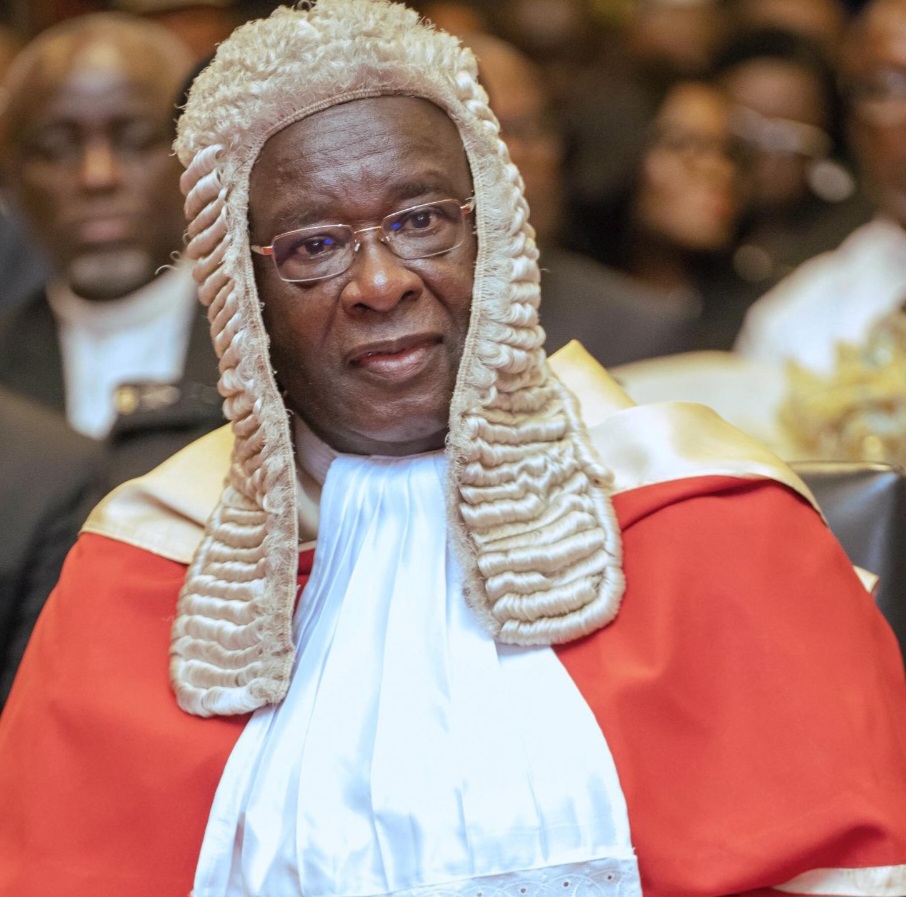
Chief Justice Paul Baffoe-Bonnie’s extraordinary praise of the Mahama administration and his swipe at the previous eight years have triggered a storm over judicial neutrality, historical accuracy and the political boundaries of highest judicial office.
He has found himself at the centre of an unexpected political controversy after appearing to draw a sharp contrast between the performance of state institutions under President John Dramani Mahama and their record during the previous eight years.
The Chief Justice made the controversial remarks on Wednesday, September 2, 2026, during a visit to the Minerals Income Investment Fund (MIIF), after earlier visiting the Social Security and National Insurance Trust (SSNIT).
While congratulating the management of MIIF and commending other public institutions, Justice Baffoe-Bonnie questioned what Ghana had been doing during the previous eight years.
“Sometimes when we hear how well some state organisations are doing now, we wonder what we really have been doing in the past eight years,” he said.
The statement has immediately acquired a political meaning because the “past eight years” correspond substantially with the tenure of the previous New Patriotic Party administration.
What has made the comments even more contentious is that the speaker is not an ordinary government appointee or political actor.
For critics, the issue is therefore not whether public institutions should be praised when they perform well. The issue is whether the country’s top judicial officer should publicly contrast the performance of successive governments in a manner that can reasonably be interpreted as political commentary.
Did The Cj Get The SSNIT Story Right?
The Chief Justice’s reference to SSNIT has become another major flashpoint.
According to Justice Baffoe-Bonnie, what he heard during his visit to SSNIT was difficult to reconcile with the fact that the institution had previously been preparing to sell what he described as its “prized assets”.
He specifically mentioned Labadi Pleasure Beach and said the situation made him wonder “how Ghana could have sunk so low.”
But critics say that description leaves out a crucial part of the history.
The controversial SSNIT hotel transaction under the previous NPP administration was not presented as an outright sale of all the hotels to a private company.
The proposal involved the transfer of a 60 per cent interest to a private investor for approximately $60 million, with the investor expected to inject additional funds into the hotels and undertake their redevelopment.
SSNIT would have retained a 40 per cent interest.
In other words, the proposed arrangement was structured as a joint venture in which the private sector would provide capital and management expertise while SSNIT retained a substantial ownership stake.
The previous administration also maintained that the process was undertaken through competitive international bidding.
That history has become important because the NDC, then in opposition, strongly criticised the proposed arrangement and used the issue as part of its broader political attack on the NPP government’s management of public assets.
The question now being asked is whether the Chief Justice was fully briefed on those details before describing the assets as having been prepared for sale. The current managers have also put the hotels on sale and yet not positive response has been received because of the bastardisation of the previous exercise.
If They Were “Prized Assets”, Why Were They Losing Money?
Another question emerging from the controversy is whether an asset should automatically be considered well managed merely because it is strategically important or physically valuable.
SSNIT’s hotel portfolio may contain valuable properties, prime locations and significant underlying assets. But the existence of valuable physical assets does not necessarily mean the businesses operating them are financially efficient.
The argument advanced by proponents of private-sector participation was precisely that some of the hotels required fresh capital, professional management and restructuring.
The question is therefore whether the proper test should be ownership alone or whether the state should also consider profitability, return on investment and the cost of keeping poorly performing assets under public management.
This distinction is particularly relevant to the Chief Justice’s description of the properties as “prized assets”.
And if the current administration believes the hotels can be successfully operated without private investors, the public deserves to know what new financial and management strategy is being deployed.
MIIF Itself Was Not Created By The Mahama Administration
Another historical point has entered the debate. MIIF was established under legislation enacted during the previous NPP administration.
The institution was created to manage mineral income and strategically invest mineral-related revenues for the benefit of the country.
Consequently, the fact that MIIF is recording strong performance under the current NDC government does not necessarily mean that the institution itself is a product of the current administration.
The more accurate assessment should examine what successive administrations did with the institution, how its investment portfolio developed, how mineral revenues evolved and what management decisions contributed to its financial performance.
To attribute every positive development occurring today exclusively to the current administration risks simplifying a much longer institutional history.
The MIIF Numbers Contradict The Simple Narrative
The controversy becomes even more interesting when the Chief Justice’s comments are considered against financial figures being cited for MIIF.
Figures presented in response to the remarks indicate that MIIF was not financially dormant during the previous administration.
In 2020, MIIF reportedly recorded GH¢341.6 million in total revenue, GH¢80.09 million in surplus and GH¢1.26 billion in total assets.
In 2021, revenue reportedly increased to GH¢615.6 million, representing an 80.2 per cent rise over 2020. Its surplus rose to GH¢154.49 million, while total assets increased to approximately GH¢1.73 billion.
For 2022, the figures cited show revenue of GH¢323.22 million, net profit of GH¢212.4 million and total assets of about GH¢3.917 billion.
In 2023, MIIF reportedly generated GH¢296.25 million in revenue, recorded GH¢247.41 million in net profit and held assets valued at approximately GH¢6.437 billion.
The figures for 2024 were even more substantial, with reported revenue of about GH¢1.964 billion, net surplus of approximately GH¢1.905 billion and total assets of GH¢11.822 billion.
For 2025, MIIF’s reported figures were GH¢1.658 billion in revenue, GH¢1.143 billion in net surplus and approximately GH¢9.922 billion in total assets.
These numbers do not automatically prove that MIIF was managed perfectly before 2025.
But they raise a legitimate question about whether it is accurate to give the impression that the institution only began performing after the change of government.
Financial statements are not political slogans. They provide measurable evidence against which claims about institutional performance can be tested.
And that is why critics are telling the Chief Justice that evidence must precede judgment.
Did The CJ Turn A Government Visit Into A Political Platform?
The most politically sensitive part of the Chief Justice’s speech was not his praise of MIIF.
It was his direct appeal for the institution’s leadership to help President Mahama’s agenda succeed.
“If the old man has decided that you are the right person to be in this position out of the 30 million people, it means he has a lot of confidence in you. And so we should do everything to make sure that his agenda succeeds,” he said.
That statement has raised eyebrows because it came from the head of the Judiciary.
A minister, party executive or government spokesperson making such an appeal would hardly be surprising.
But coming from the Chief Justice, it has inevitably attracted a different level of scrutiny.
Critics have consequently asked whether Justice Baffoe-Bonnie is merely encouraging public officials to fulfil their constitutional responsibilities or whether he is becoming too closely identified with the political agenda of the government that appointed him.
Some social media commentators have gone further, alleging that the Chief Justice is positioning himself as an unofficial campaign voice for the NDC ahead of the 2028 elections.
There is currently no established evidence that he is acting as an NDC campaign official.
Nevertheless, the perception itself has become politically significant.
Mahama Appointment Hangs Over The Controversy
Justice Baffoe-Bonnie’s own route to the Chief Justice position makes the controversy particularly sensitive.
He became Acting Chief Justice in April 2025 after President Mahama suspended Chief Justice Gertrude Torkornoo following the determination of a prima facie case under Article 146 of the Constitution.
Justice Baffoe-Bonnie, then the most senior Supreme Court Justice, assumed the acting position.
President Mahama later nominated him as substantive Chief Justice in September 2025. Parliament approved his nomination in November 2025 by 163 votes to 69. The approval process was highly contentious.
The NPP Minority raised objections and ultimately boycotted the vetting process. Among its concerns was the argument that the appointment should not proceed while legal challenges connected to the removal of Mrs Torkornoo were still pending.
Questions were also raised about Justice Baffoe-Bonnie’s involvement in Supreme Court proceedings related to the removal process.
Justice Baffoe-Bonnie rejected suggestions that his elevation was politically motivated and defended his appointment based on his judicial experience and career.
He also pledged to protect judicial independence and provide leadership capable of commanding confidence across political lines.
That promise is now being tested in the court of public opinion.
The Sophia Akuffo Angle
The controversy has also generated speculation about the future of Justice Baffoe-Bonnie after his expected retirement.
Former Chief Justice Sophia Akuffo has already left the Council of State, and the position traditionally occupied by a former Chief Justice has reportedly remained vacant.
Political commentators have consequently begun speculating about what may happen when Justice Baffoe-Bonnie leaves the Judiciary.
Some critics allege that he could move directly into a Council of State role after retirement.
Others have linked the speculation to broader claims about an alleged long-term political relationship between the Chief Justice and the Mahama administration.
But these remain allegations and political speculation, not established facts.
The Constitution and the relevant appointment processes would ultimately determine any future role.
The Bigger Question: Where Does Judicial Independence End?
The controversy ultimately goes beyond MIIF. It is about the credibility of the Judiciary.
The Chief Justice has every reason to demand efficiency from public institutions. He has every right to praise good management. He can also legitimately urge public officials to serve citizens rather than themselves.
Indeed, Justice Baffoe-Bonnie has repeatedly emphasised that public institutions must put citizens first.
He has said that justice begins from the moment a process is filed and that even the conduct of a receptionist can shape a citizen’s perception of whether justice will eventually be delivered.
Those comments are consistent with his responsibility to improve public confidence in the Judiciary.
But critics argue that the same standard of institutional neutrality must apply to the Chief Justice himself.
When the head of the Judiciary says that the performance of state institutions today makes him wonder what Ghana had been doing for eight years, refers approvingly to the current President’s agenda and contrasts the present with the previous administration, the political interpretation becomes almost unavoidable.