BY Daniel Bampoe
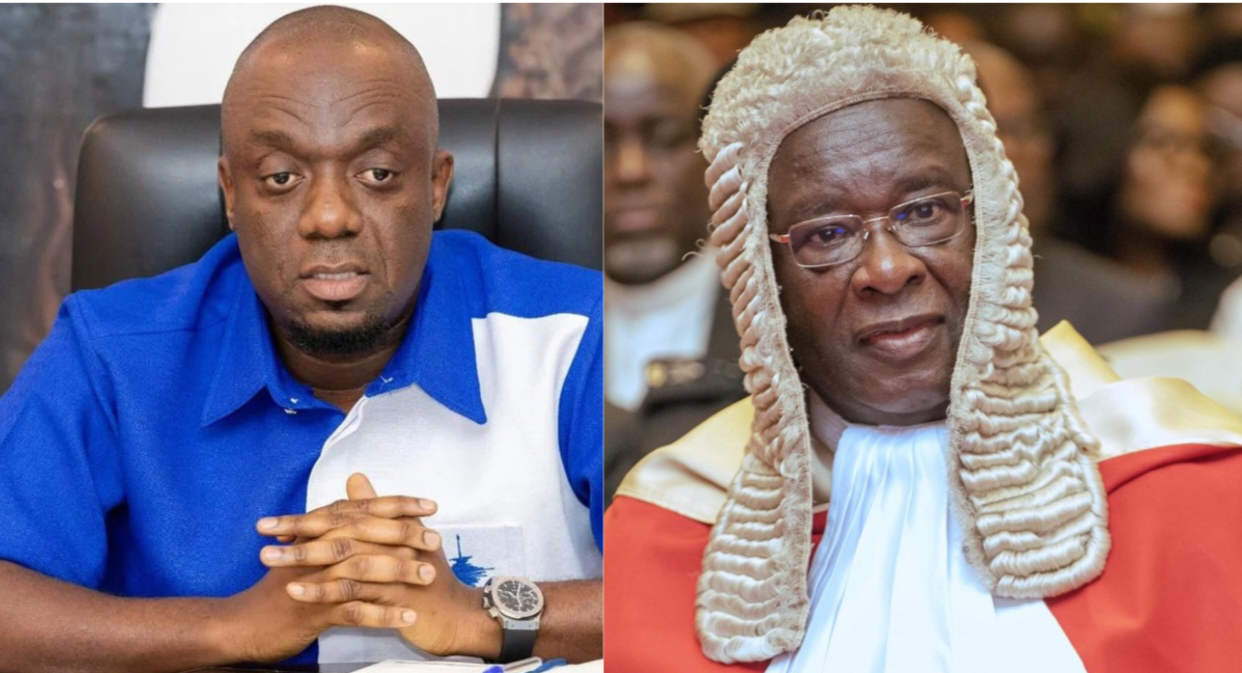
The New Patriotic Party (NPP) has launched one of its strongest attacks yet on Chief Justice Paul Baffoe-Bonnie, accusing him of abandoning judicial neutrality and moving dangerously close to the political agenda of the governing National Democratic Congress (NDC).
The Party is demanding the immediate resignation of Chief Justice Baffoe-Bonnie, following remarks he made during recent visits to public institutions which the party says amount to open political commentary from the head of the Judiciary.
In a strongly worded statement dated September 3, 2026 and signed by NPP General Secretary Justin Kodua Frimpong, the party accused the Chief Justice of descending from what it described as the “sacred heights of the Bench” into partisan politics.
The NPP said it was particularly alarmed by a video circulating publicly in which the Chief Justice appeared to compare the performance of the current NDC government and its appointed chief executives with the record of the previous NPP administration.
According to the opposition party, such commentary is incompatible with the constitutional responsibilities of the Chief Justice and creates the impression that the head of the Judiciary has become politically aligned with the government.
The NPP went as far as demanding that Justice Baffoe-Bonnie either retract his remarks and his reported pledge to help ensure the success of President John Dramani Mahama’s agenda or resign from office and formally join the NDC.
The party said the Chief Justice’s conduct had gone beyond an isolated comment and was part of what it described as a growing pattern of political proximity to the governing administration.
NPP Invokes Constitutional Independence
At the centre of the party’s argument is the constitutional guarantee of judicial independence.
The NPP cited Articles 125 and 127 of the 1992 Constitution, arguing that the Judiciary is established as an independent arm of government and should not be subject to the control or direction of another authority.
The party also invoked the judicial oath, under which judges are required to administer justice without fear or favour, affection or ill will.
Against that background, the NPP argued that the Chief Justice’s public comments about the comparative performance of political administrations risk undermining confidence in the Judiciary.
The party’s position is that the Chief Justice must maintain sufficient distance from the Executive to ensure that citizens appearing before the courts can have confidence that their cases will be determined independently.
The NPP therefore argues that even the appearance of political alignment is damaging because the Judiciary’s authority ultimately depends on public confidence.
“Which Agenda, My Lord?”
The opposition party’s sharpest criticism centres on Justice Baffoe-Bonnie’s comments about ensuring the success of President Mahama’s agenda.
During his visit to MIIF, the Chief Justice told officials that the President’s decision to appoint them demonstrated confidence in their abilities and urged them to do everything possible to make the President’s agenda succeed.
The NPP has seized on that statement and questioned what exactly the Chief Justice meant by the President’s “agenda”.
“Which agenda, My Lord?” the party asked.
The NPP linked the comment to President Mahama’s Operation Recover All Loot (ORAL), a government initiative aimed at recovering allegedly misappropriated state resources and pursuing accountability for persons accused of wrongdoing.
The opposition party argues that because individuals associated with the NPP may appear before courts in cases connected to investigations or prosecutions arising from the government’s accountability agenda, a Chief Justice publicly expressing support for the success of that agenda could create concerns about impartiality.
The party insists that a Chief Justice’s constitutional loyalty should be to the Constitution and the administration of justice—not to the agenda of a President or political party.
According to the NPP, the distinction is fundamental: a government can have a political programme, but the Judiciary cannot become an institutional instrument for achieving that programme.
NPP Links Judicial Speed To Political Cases
The party also raised concerns about what it described as the speed with which certain politically sensitive cases involving opposition figures have moved through the courts.
It specifically referred to what it described as the issuance of vacation warrants in cases involving NPP members and cited the incarceration of Chairman Nontumi as evidence of what it considers unequal treatment within the justice system.
The NPP alleged that the justice system was operating at “two speeds”, with what it described as remarkable haste in cases involving government opponents and greater patience where government supporters were concerned.
These are allegations by the opposition party and have not been established as evidence of political direction of the courts.
Nevertheless, the NPP says the pattern requires public scrutiny.
The party argues that if the Judiciary is perceived to be moving rapidly against political opponents while appearing less aggressive in cases involving individuals connected to the governing party, confidence in the justice system could suffer.
The NPP consequently linked the issue to its broader claim that the Judiciary is being drawn into the political objectives of the Executive.
“Third Chamber Of Jubilee House”
In perhaps its strongest language, the NPP accused the Chief Justice of risking the transformation of the Judiciary into what it called a “third chamber of Jubilee House”.
The party said the Judiciary should neither belong to the President nor to the NDC nor to the Chief Justice personally.
It belongs, the NPP argued, to the people of Ghana.
The party warned that any perception that judicial decisions or administrative priorities are being shaped by political considerations could undermine one of the country’s most important constitutional safeguards.
The opposition party’s argument is based on the principle that the Judiciary must be capable of checking the other arms of government rather than appearing to operate as an extension of the Executive.
The Chief Justice’s Priorities
The party’s statement did not limit its criticism to the Chief Justice’s political comments.
It also questioned his decision to visit state institutions such as MIIF and SSNIT while, according to the NPP, serious problems remain within Ghana’s own court system.
The party pointed to deteriorating court infrastructure, struggling registries and difficult working conditions within parts of the Judiciary.
It argued that the Chief Justice should devote greater attention to courtrooms, registries, judicial infrastructure and the delays faced by litigants.
The NPP described the Chief Justice’s visits to state-owned institutions as an apparent shift away from the problems confronting the Judiciary itself.
In its most sarcastic formulation, the party said the Chief Justice had allegedly become the “monitoring and evaluation officer of the Executive” while his own institutional house remained in difficulty.
The NPP further claimed that Justice Baffoe-Bonnie had yet to demonstrate reforms capable of significantly reducing the delays experienced by litigants.
The party therefore sought to frame the controversy not merely as a dispute over one speech, but as a question about the priorities and legacy of the current Chief Justice.
MIIF Remarks Under Fresh Scrutiny
The NPP’s attack comes against the background of the Chief Justice’s controversial comments about the performance of public institutions.
Justice Baffoe-Bonnie praised MIIF and SSNIT and said information presented to him during his visits had caused him to question how Ghana had been managed during the previous eight years.
The comments have already generated political debate, particularly because the previous eight-year period corresponds largely with the NPP’s tenure in government.
Critics have also questioned whether the Chief Justice’s description of SSNIT’s previous hotel transaction provided the full historical context.
The previous NPP administration’s proposed restructuring of selected SSNIT hotels involved private-sector participation rather than a straightforward transfer of all ownership to a private company.
Under the proposal cited by critics, an investor would acquire a 60 per cent interest for approximately $60 million and inject additional capital, while SSNIT would retain 40 per cent ownership.
The NPP has therefore argued that the transaction should not simply be described as an outright sale of national assets.
The issue is significant because the Chief Justice used the SSNIT transaction as an illustration of what he considered evidence of Ghana’s poor management during the previous administration.
MIIF’s History Also Complicates The Political Narrative
Questions have also been raised about the historical performance of MIIF.
Financial figures cited in the political debate indicate that the institution recorded substantial revenues, surpluses and asset growth before the NDC returned to office.
MIIF reportedly recorded GH¢341.6 million in revenue and GH¢80.09 million in surplus in 2020, with total assets of approximately GH¢1.26 billion.
In 2021, revenue reportedly increased to GH¢615.6 million, surplus to GH¢154.49 million and total assets to approximately GH¢1.73 billion.
The figures cited for 2022 show revenue of GH¢323.22 million, net profit of GH¢212.4 million and total assets of approximately GH¢3.917 billion.
In 2023, revenue was reportedly GH¢296.25 million, net profit GH¢247.41 million and total assets approximately GH¢6.437 billion.
The institution recorded significantly higher reported figures in 2024, including revenue of about GH¢1.964 billion, net surplus of GH¢1.905 billion and total assets of approximately GH¢11.822 billion.
For 2025, figures cited put revenue at approximately GH¢1.658 billion, net surplus at GH¢1.143 billion and total assets at roughly GH¢9.922 billion.
These figures do not establish that MIIF was perfectly managed under the NPP, nor do they disprove improvements under the NDC.
They do, however, demonstrate why the historical performance of the institution requires a more detailed examination than a simple political comparison between two administrations.
MIIF itself was established under legislation during the previous NPP administration, meaning its present performance is part of a longer institutional history involving successive governments.
Torkonoo Controversy Returns To The Centre
The NPP’s latest attack also brings the controversy surrounding former Chief Justice Gertrude Torkonoo back into focus.
Justice Torkonoo was suspended by President Mahama in 2025 after a prima facie case was determined in an Article 146 process concerning her removal.
Justice Baffoe-Bonnie, who was then the most senior Supreme Court Justice, subsequently became Acting Chief Justice.
President Mahama later nominated him as substantive Chief Justice, and Parliament approved his nomination in November 2025 by 163 votes to 69.
The process was controversial, with the NPP Minority raising objections and boycotting the vetting.
The Minority questioned whether the appointment process should proceed while legal challenges connected to Torkonoo’s removal remained pending and raised concerns about Justice Baffoe-Bonnie’s involvement in proceedings related to the matter.
Justice Baffoe-Bonnie rejected suggestions that his elevation was politically motivated and defended his appointment on the basis of his judicial career and experience.
The current dispute therefore has a significant historical dimension.
The NPP argues that Torkonoo was accused of political bias during her tenure even though, in the party’s view, she did not engage in conventional partisan political activity.
It now contends that Justice Baffoe-Bonnie’s visible engagements with government institutions and his remarks about President Mahama’s agenda deserve at least the same level of scrutiny.
The broader argument is that judicial independence cannot be applied differently depending on which political party occupies the presidency.
Council Of State Speculation
The NPP has also called on President Mahama to fill the vacant Council of State position associated with a former Chief Justice and publicly disavow any arrangement concerning Justice Baffoe-Bonnie’s post-retirement future.
The demand appears to be linked to political speculation that the Chief Justice could eventually occupy a Council of State position after retirement.
The party has not provided evidence establishing that such an arrangement exists.
Nevertheless, it wants the President to publicly rule out any understanding concerning the Chief Justice’s future.
The demand reflects the broader concern raised by the opposition party that the Judiciary must not become intertwined with political patronage.
NPP Promises A Fuller Attack
The opposition party says its September 3 statement is not the end of the matter.
According to the statement signed by General Secretary Justin Kodua Frimpong, the NPP intends to organise a major press conference at which it will present what it describes as the “full record” of the Chief Justice’s conduct.
The party says the purpose will be to place before the Ghanaian public what it considers evidence of the erosion of judicial independence.
It also warned that it would use every lawful means available to resist what it described as the conversion of the courts into instruments of political persecution.
The government and the Chief Justice will therefore face increasing pressure to respond to the allegations.