
BY Daniel Bampoe
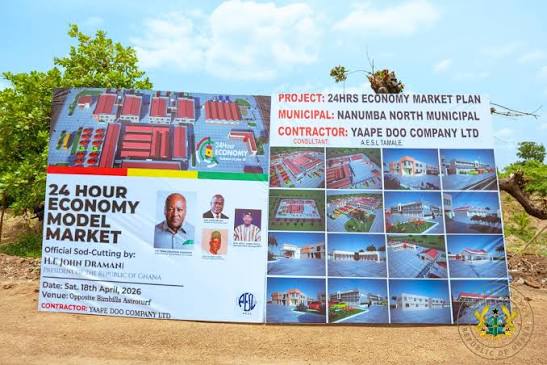
The National Democratic Congress government’s 24-Hour Economy Market Programme has come under intense criticism from the Minority in Parliament, which is demanding an immediate review of the initiative and deeper consultation with affected communities before implementation continues.
The Minority says its concerns are not about modernising the markets or encouraging extended trading hours, but about what it describes as inadequate planning, weak local consultation and the demolition of existing public and community assets to make way for new projects.
The position was contained in a press statement issued on Monday, September 14, 2026, by Francis Asenso-Boakye, Ranking Member of Parliament’s Committee on Local Government and Rural Development, on behalf of the Minority. The statement argues that the programme, as currently being implemented, appears to have been introduced without sufficient consideration of the different development needs, population sizes, economic activities and infrastructure situations of individual districts.
According to the Minority, one of the fundamental problems is that the programme was not presented to Ghanaians in the governing party’s 2024 manifesto as a nationwide market infrastructure programme. It therefore describes the current rollout as appearing to be an “afterthought” and is demanding answers about the needs assessments, feasibility studies and local development plans that are supposedly guiding the construction of 24-hour economy markets across the country.
The Minority argues that the decentralised local governance system gives District Assemblies an important role in determining development priorities within their jurisdictions. It says the needs of districts are not identical: while some communities may genuinely require new markets, others may need existing markets rehabilitated or expanded, while some may have more urgent requirements involving roads, drainage, schools, health facilities or sanitation. The Minority therefore contends that applying essentially the same market-development concept across different districts risks undermining the principle of decentralisation.
The strongest criticism, however, centres on the reported demolition, or proposed demolition, of existing public, commercial, and community infrastructure to make room for the new markets. The Minority cites a number of locations where it says existing facilities have either been destroyed or earmarked for demolition, raising questions about whether public resources are being used efficiently.
In the Upper Manya Krobo enclave, the existing Asesewa Market has reportedly been earmarked for demolition to make way for a 24-hour market. In Kwabre East Municipality, an astroturf that was under construction at Mamponteng has, according to the statement, already been demolished for the programme. The Minority also points to the Nkenkaasu Market in the Offinso North District, which was constructed and commissioned under former President John Agyekum Kufuor in 2007 and had been serving the community, but has reportedly been demolished to make way for a new 24-hour economy market. At Aboabo, a community bank facility has also reportedly been demolished.
Another case highlighted by the Minority is in the Ahafo Ano South West District of the Ashanti Region, where a newly constructed school has reportedly been marked for demolition. The statement says grading has already taken place and foundation works have commenced in the middle of the school premises. The Minority questions why a newly constructed educational facility would be sacrificed for a market project at a time when communities continue to require basic educational infrastructure.
The controversy extends beyond markets and schools. In Nandom in the Upper West Region, the Minority says a Magistrate Court has reportedly been demolished. In the Aowin Constituency of the Western North Region, the newly constructed Enchi Market, which had reportedly not yet been occupied by the community, was pulled down despite resistance from residents. The Minority says the situation raises questions about the rationale for spending public money to construct a facility only for another public programme to demolish it before it is put into use.
In Wa, the statement draws attention to the Tendamba Primary School, described as a 70-year-old institution built in 1956 and carrying decades of community history. The school has reportedly been pulled down, while in Poyentanga, also in the Wa Municipality, several homes and shops have reportedly been demolished to create space for a proposed 24-hour market.
The Minority further lists the Mankrong Market in the Agona East District, together with several other structures, as being demolished for the programme. In Wenchi in the Bono Region, the New Thursday Central Market has reportedly been demolished, while the Abor Market in the Keta Municipality has similarly been demolished to make way for a 24-hour economy market.
At the Kasoa New Market in the Awutu Senya East Municipality, several commercial structures, including corn and cassava milling facilities, have reportedly been demolished. In Elubo in the Jomoro Municipality, the Minority says a newly built storey building being used for commercial purposes has also been demolished, adding to concerns among affected persons.
The rollout has also reportedly triggered resistance from traders in several parts of the country. Traders at the Nungua Market, which has existed for more than 50 years, have opposed plans to demolish the existing market and have instead proposed its rehabilitation. Similar protests have been reported at the Kwabenya Market, while the long-standing Aiyinase Main Market in the Ellembelle District is also expected to be affected. Traders at Ashaiman and Kokomba markets have reportedly demonstrated against the demolition of existing markets.
For the Minority, the various cases point to what it describes as a wider pattern in which existing markets, newly constructed facilities, schools, businesses, homes and other community assets are being displaced or demolished in the name of a programme whose local economic justification, it argues, has not been sufficiently demonstrated. The Minority says the issue becomes even more serious given Ghana’s fiscal constraints, questioning why useful or recently constructed public assets should be destroyed only for scarce public resources to be spent replacing them.
At the heart of the parliamentary opposition’s argument is the question of whether every proposed location can genuinely sustain a 24-hour commercial operation. The Minority stresses that simply designating a facility as a 24-hour economy market does not automatically ma,ke it viable. For such a market to function around the clock, it says there must be adequate commercial activity, traders prepared to operate at night, customers willing to patronise the facility and supporting infrastructure such as security, transportation, electricity, sanitation and water.
The Minority therefore believes the government’s approach should begin with the needs of individual communities rather than with a predetermined decision to build 24-hour markets. It says the central question should be what each community actually requires to strengthen its local economy, rather than simply identifying locations where government can construct a 24-hour market.
Against this background, the Minority is calling for an immediate, comprehensive and non-partisan review of the 24-Hour Economy Market Programme. It wants the programme redesigned to be needs-based and demand-driven, with projects undertaken only after a genuine need has been established.
It is also demanding that District development plans guide the selection of projects. Where existing markets can serve the purpose after rehabilitation or expansion, the Minority says those options should be pursued instead of demolition and reconstruction. It further argues that markets already under construction should be completed rather than abandoned or demolished.
The Minority is equally insisting on greater involvement of local stakeholders. District Assemblies, traders, traditional authorities, residents and other affected groups, it says, must have a meaningful say in decisions concerning the location, design and operation of the proposed markets.
Despite its criticism, the Minority maintains that it supports investment in modern markets and the strengthening of local economies. Its objection, it says, is to development that is undertaken without sufficient evidence of need, proper planning, consultation and value for money. It argues that government cannot simultaneously champion decentralisation while imposing development priorities from the centre, nor should useful public and community assets be destroyed simply to replace them under a new political programme.
The Minority’s final appeal is for government to pause the implementation of controversial aspects of the programme, listen to affected communities and review its approach. Its proposed principles are to build where there is a genuine need, upgrade where that makes greater economic sense, consult project-affected people, respect local development plans, protect existing public assets and safeguard the public purse.


