BY Daniel Bampoe
Former National Signals Bureau (NSB) Director-General Kwabena Adu-Boahene has secured an important but limited victory in his GH¢49.1 million cyber-defence trial, after the Accra High Court acquitted and discharged him on two charges while ordering him and his wife to open their defence on nine others.
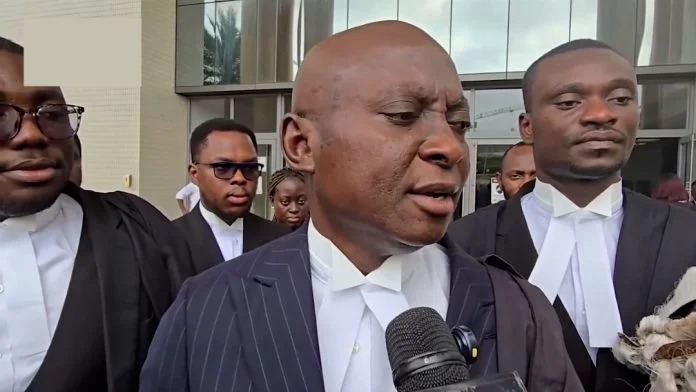
But the partial acquittal has not ended the legal battle. Lead defence counsel Samuel Atta Akyea has described the ruling as unfortunate, accused the court of failing to address what he considers fundamental gaps in the prosecution’s evidence and announced plans to challenge the decision on appeal.
The ruling was delivered on Thursday, November 12, 2026, by Justice Francis Apangabuno Achibonga at Specialised Court 1 of the Accra High Court, following months of proceedings and extensive arguments over whether the prosecution had established sufficient evidence to require the accused persons to defend themselves.
The court acquitted and discharged Adu-Boahene on the charges of defrauding by false pretences and obtaining public funds by false statements.
However, it rejected the no-case submissions in respect of the remaining charges, directing the accused persons to open their defence.
The decision means that Adu-Boahene has escaped prosecution on two specific counts but must still answer allegations including stealing, wilfully causing financial loss to the State, using public office for profit and money laundering.
His wife, Angela Adjei-Boateng, has also been directed to open her defence on the charges against her, while Advantage Solutions Limited remains part of the proceedings.
Atta Akyea: ‘It’s very unfortunate’
Speaking to journalists after the ruling, Atta Akyea expressed disappointment with the court’s decision, insisting that the judge had failed to adequately address what the defence considers the most important evidential issues raised in its 142-page submission of no case to answer.
Asked for his reaction after Adu-Boahene was acquitted on only two counts but ordered to defend the others, the lawyer described the outcome as “very unfortunate”.
He argued that the judge’s observations about the case were largely conjectural and did not sufficiently engage with the evidence presented by the prosecution’s own witnesses.
“If you heard the judge, the judge said there are trouble issues. The judge said, ‘it seems to me’. So it was just his conjectures. It didn’t deal with the evidence,” Atta Akyea said.
The lawyer maintained that the defence had drawn the court’s attention to testimony which, in its view, raised serious questions about the prosecution’s allegation that the GH¢49.1 million was diverted and used for the personal benefit of the accused persons.
He specifically referred to evidence from the third prosecution witness concerning the handling and possible reconciliation of the funds.
According to Atta Akyea, the witness had made reference to the need for a bullion van to collect money, an issue he believes should have received greater attention in the court’s assessment of the prosecution’s case.
“Look at PW3 saying that you need to bring a bullion van so we collect our money back. The strong issue of reconciliation of accounts, he didn’t talk about it,” he argued.
He also relied on the evidence of the fourth prosecution witness, EOCO investigator Frank Marshall Cromwell, whom the defence had questioned extensively during cross-examination.
Atta Akyea said the investigator had acknowledged that the investigation did not establish that any portion of the GH¢49.1 million was used to purchase even one property.
“Evidence from PW4, we said that, look, when we were doing the investigation, we never saw that any of the 49.1 million Ghana cedis were used to purchase even one property,” he told journalists.
The lawyer argued that this was significant because the prosecution had sought to connect the disputed funds to properties and other assets allegedly acquired for private benefit.
Lawyer raises concern over judge’s reference to tribal issues
One of the strongest criticisms from Atta Akyea concerned what he described as the judge’s reference to tribal issues during the delivery of the ruling.
The lawyer said he was troubled that tribal considerations had featured in a criminal proceeding which, in his view, should have been determined strictly on the sufficiency of the evidence and the applicable legal principles.
“My sad moment is when, in a criminal trial, the judge is talking about tribal issues. That is to say, they will not look at the sufficiency of the evidence and come to the conclusion that prima facie there is nothing for them to come and open their defence,” he said.
His comments formed part of a broader criticism of the court’s approach to the no-case submission, with the defence arguing that the accused persons should not be required to provide explanations to fill gaps in the prosecution’s case.
Atta Akyea maintained that where the prosecution had failed to establish essential elements of the offences, those deficiencies should operate in favour of the accused persons rather than become matters they must explain during their defence.
He described the ruling as one that had given his legal team “a lot of raw material for an appeal”.
“We’ll have the whole of the weekend to look at it clinically and lodge a proper appeal to overturn what I see as an unfortunate situation,” he said.
The lawyer further argued that the court’s decision had effectively placed a burden on the accused persons to explain matters which, according to the defence, the prosecution had not adequately established.
He said the defence would examine the full ruling before deciding on the precise grounds and arguments to advance in challenging the decision. Why the court rejected the no-case submission on the remaining charges
In explaining its decision, Justice Achibonga stated that at the stage of a submission of no case to answer, the prosecution was not required to prove the guilt of an accused person beyond reasonable doubt.
The court explained that such an application could succeed where the prosecution had failed to lead sufficient evidence to establish an essential element of an offence, or where the evidence presented had been so discredited that no reasonable jury could return a guilty verdict.
On the three stealing counts, the prosecution’s case is that Adu-Boahene, while serving as Director of the Bureau of National Communications, caused GH¢49.1 million to be transferred in three separate tranches of GH¢27.1 million, GH¢1 million and GH¢21 million.
The money was allegedly transferred from the bureau’s account at Fidelity Bank into an account at UMB described as B.N.C. Communications Bureau, which the prosecution claims was connected to Adu-Boahene.
The judge identified the essential elements of stealing as the appropriation of property belonging to another person dishonestly.The court found that the prosecution had presented sufficient evidence at this stage to establish that the money involved belonged to the State and that the alleged dishonest appropriation had been carried out through the transfers.
However, on the charges of defrauding by false pretences and obtaining public funds by false statements, the judge held that the prosecution witnesses had not referred to any false representations. Adu-Boahene was consequently acquitted and discharged on those two counts.
The court’s decision was therefore a mixed outcome: the prosecution failed to establish a case requiring an answer on two charges, but the judge found sufficient evidence to require the accused persons to defend themselves on the remaining counts.
The GH¢49.1 million cyber-defence procurement controversy
The case dates back to allegations that GH¢49.1 million, intended for the procurement of a US$7 million cyber-defence system for a state security institution, was diverted through financial transactions involving private entities.
The prosecution alleges that Adu-Boahene used his position as head of the National Signals Bureau, with the assistance of his wife and their company, Advantage Solutions Limited, to move and spend the funds for purposes unrelated to the intended procurement.
The defence has consistently rejected that account, maintaining that the transactions were connected to the acquisition of a cyber-defence system for the State.
A major part of the defence’s challenge has concerned the identity and purpose of the accounts through which the funds moved, the authority behind the transactions, the role of the National Security Coordinator and whether the prosecution had established a direct connection between the GH¢49.1 million and the properties it claims were acquired for private benefit.
After the prosecution called four witnesses and closed its case in September 2026, Atta Akyea filed a 142-page submission of no case to answer, asking the court to discharge the accused persons.
The defence questioned the prosecution’s evidence on the source and destination of the funds, the alleged unauthorised transfers, the procurement arrangements and the financial trail said to link the accused persons to the money.
It also questioned the prosecution’s failure to call certain material witnesses, including the late National Security Coordinator, Joshua Kyeremeh, whose role in signing the disputed cheques featured prominently in the defence’s arguments.
The prosecution, represented by Deputy Attorney-General Dr Justice Srem-Sai, opposed the application and maintained that the documentary evidence and witness testimony established a sufficient basis for the accused persons to answer the charges.
Dispute over alleged misrepresentation of evidence
The no-case ruling also followed a separate legal confrontation in October, when the defence sought to strike out portions of the prosecution’s written response, accusing the State of attributing statements to witnesses that they had allegedly never made.
Atta Akyea argued that the prosecution’s submissions contained manufactured facts and misrepresented testimony, particularly in relation to the disputed invoices, the cyber-defence procurement and the alleged use of the funds to acquire properties.
The court dismissed the application on October 29. However, the dispute brought further attention to the defence’s position that the prosecution’s arguments should be confined to evidence properly presented and admitted during the trial.
The defence subsequently continued to insist that the prosecution had not answered several evidential questions raised in its no-case submission.
Defence given three weeks to prepare
Following Thursday’s ruling, the court gave the accused persons three weeks to file witness statements if they intended to call witnesses in their defence.
The statements are expected to be filed on or before December 4, 2026. The case has been adjourned to December 10, 2026, at 9:30 a.m., when the defence stage is expected to continue.
The accused persons have the option of entering the witness box and giving evidence on oath, making an unsworn statement from the dock or exercising their right to remain silent. The choice of whether to testify remains theirs.