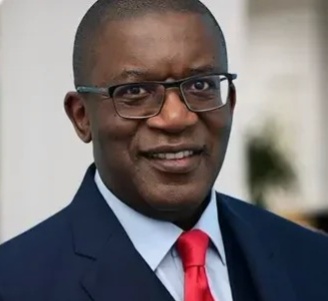
By Daniel Bampoe
The Supreme Court is set to determine whether former Ghana Infrastructure Investment Fund (GIIF) Chief Executive Officer Solomon Asamoah can be compelled to open his defence before calling witnesses he has subpoenaed in the ongoing US$2 million Sky Train trial.
A five-member panel of the apex court, presided over by Justice Amadu Tanko, has scheduled Wednesday, November 25, 2026, to deliver its ruling on Asamoah’s application seeking to quash an order by the High Court directing him to testify before presenting his other defence witnesses.
The application has brought into focus a significant legal dispute over the order in which an accused person may present evidence in a criminal trial, as well as the constitutional right to a fair hearing and the right to remain silent.
Asamoah is standing trial alongside former GIIF Board Chairman, Professor Christopher Ameyaw-Akumfi, over an alleged US$2 million financial loss to the state arising from the proposed Accra SkyTrain project. The two have pleaded not guilty to six charges, including conspiracy to willfully cause financial loss to the Republic, conspiracy to intentionally dissipate public funds and intentional dissipation of public funds.
The prosecution alleges that the two former officials facilitated the payment of US$2 million to Africa Investor Holdings Limited in February 2019 without the requisite approval of the GIIF Board.
Following the close of the prosecution’s case, the High Court directed the accused persons to open their defence. However, Asamoah wants witnesses he has subpoenaed to appear before the court for cross-examination before he decides whether to mount the witness box himself.
The trial court declined to adopt that approach, prompting Asamoah to invoke the supervisory jurisdiction of the Supreme Court.
Moving the application, his lawyer, Victoria Barth, argued that the High Court’s directive was made in excess of jurisdiction and constituted an error apparent on the face of the record.
Relying on Article 132 of the 1992 Constitution, she asked the Supreme Court to issue an order of certiorari to quash the disputed direction. She maintained that the trial judge had no legal authority to insist that her client testify before calling his other witnesses.
Ms Barth further argued that the order violated Asamoah’s constitutional right to a fair hearing and his right to remain silent until he decides whether to testify, as provided under Article 19(2)(g) of the Constitution.
“The court exercised a power that does not exist,” she argued.
To support her position, counsel cited the Nigerian case of Otunba Justice v Federal Republic of Nigeria, contending that the principle established in the authority supported her argument that the trial court’s directive lacked statutory foundation and infringed the accused person’s fair-trial rights.
She also relied on processes filed in support of the application and a subsequent reply filed on November 24, 2026.
The prosecution, however, strongly opposed the application, arguing that the High Court acted within its jurisdiction and that disagreement with the trial judge’s approach did not provide sufficient grounds for the Supreme Court to invoke its supervisory powers.
Chief State Attorney Sefakor Batse told the panel that the prosecution was relying on its statement of case and affidavit in opposition filed on November 19, 2026.
She argued that, apart from the Nigerian authority cited by the applicant, the 1992 Constitution does not prescribe the specific sequence in which an accused person must call witnesses during a criminal trial.
“This is a matter in which the court has jurisdiction. The judge had authority to take that decision and she took it,” Ms Batse submitted.
She further maintained that the fact that Asamoah disagreed with the manner in which the trial judge had directed him to present his defence did not automatically amount to an error of law or establish that the court had acted without jurisdiction.
According to the prosecution, the appropriate legal remedy available to the accused was to pursue an appeal rather than seek certiorari from the Supreme Court.
“The way out is to proceed on appeal and not come to this court seeking certiorari,” the Chief State Attorney argued.
Ms Batse also insisted that the applicant had failed to demonstrate any jurisdictional error warranting the intervention of the apex court, stressing that the trial judge had the authority to make the disputed order.
After hearing arguments from both parties, the five-member panel adjourned the application to Wednesday, November 25, 2026, for its ruling. The panel comprises Justices Samuel Asiedu, Janapare Adzua Bartels-Kodwo, Edward Amoako Asante and Anthony Forson Jnr., in addition to the presiding judge, Justice Amadu Tanko.
The Supreme Court also adjourned a separate application seeking to restrain the trial judge from taking Asamoah’s evidence.