By Issah Olegor
Ghana’s presidential aircraft, the Dassault Falcon 900EX EASy, remains grounded in France amid ongoing and costly repairs, following what Defence Minister Dr. Edward Omane Boamah described as “heavy corrosion” in its critical systems.
The revelation has intensified a growing national conversation about the future of presidential air travel, the cost of maintenance, and whether Ghana should finally invest in a new executive aircraft.
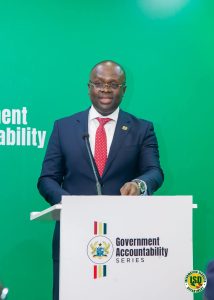
Addressing the media during the Government Accountability Series at the Jubilee House on Monday, July 21, 2025, Dr. Omane Boamah provided a stark update on the condition of the presidential jet—bearing registration number 9G-EXE—noting that the aircraft has been out of service since March 11, 2025.
A Sick Jet and a Stretched Timeline
“It is sad to note that for some time now, whenever the president’s jet goes for either maintenance or overhaul, the date that is scheduled for it to return to Ghana keeps changing,” the Minister said.
He revealed that although technicians had previously promised the aircraft’s return within two months, the repair timeline had been extended multiple times due to worsening findings.
Currently, he explained, another return date has been proposed, but he declined to make it public given the number of previously missed deadlines.
“The aircraft is still not in. We are hoping that the date that has been given will see the Falcon in Ghana,” he added.
The extent of the corrosion—particularly in the fuel tanks and engine compartments—has raised serious questions about the long-term viability and safety of the Falcon 900EX, which was acquired in 2010 under President John Evans Atta Mills’ administration.
Now over 15 years old, the jet has served four successive presidents but has struggled with frequent technical faults in recent years.
Mounting Pressure for a Replacement
The Falcon’s prolonged grounding has reignited a debate among stakeholders and citizens about whether Ghana should procure a more modern and efficient presidential aircraft.
Critics argue that the country’s dependence on the aging jet compromises the president’s mobility and exposes the country to unnecessary risks.
In the absence of the Falcon, the presidency has had to rely on costly leased aircraft—sometimes luxury-class—which has drawn backlash from segments of the public and opposition political figures who see the rentals as extravagant, especially in times of economic hardship.
Dr. Omane Boamah, while acknowledging the jet’s deteriorated condition, made it clear that the situation does not justify the “persistent hiring” of luxurious aircraft for presidential travel.
“The truth is that the presidential jet is heavily corroded… However, that does not in any way justify hiring or renting luxurious aircraft persistently for presidential use,” he said firmly.
Financial and Strategic Implications
Aviation and defense analysts suggest that continuing to invest in major repairs for the Falcon may no longer be cost-effective. With frequent servicing required and parts becoming harder to source due to the aircraft’s age, maintenance costs are ballooning.
There is also the question of national prestige and operational readiness. For many developed and even some developing nations, a reliable executive aircraft is considered a strategic asset—used not only for presidential travel, but also for diplomatic missions, emergency evacuations, and special assignments.
Background and Previous Controversy
This is not the first time Ghana’s presidential jet has stirred controversy. In 2021 and 2022, then-President Nana Akufo-Addo faced sharp criticism from civil society and opposition MPs for opting to lease luxurious jets for official foreign trips instead of using the Falcon.
At the time, government officials defended the decision by citing the jet’s limited range and technical challenges.
Calls for the procurement of a new jet were made as early as 2021, but faced pushback from the public due to economic constraints and competing national priorities.