BY Daniel Bampoe
The devastating floods that swept through Accra and parts of the Greater Accra Region have once again exposed the capital’s long-standing vulnerability to perennial flooding, reigniting questions over whether successive governments have moved beyond political rhetoric to implement lasting engineering solutions capable of protecting lives and property.
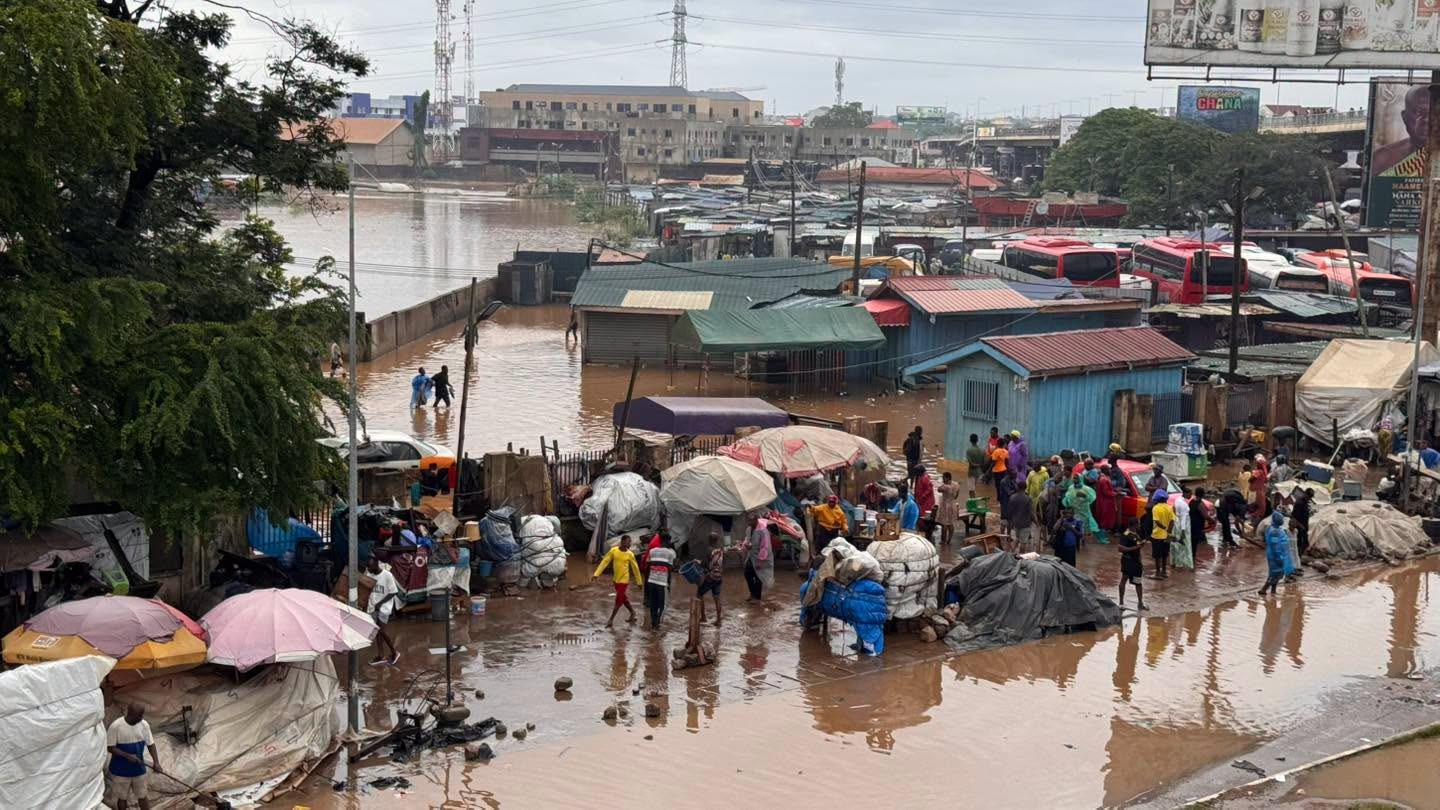
Monday’s torrential rains submerged major roads, homes, markets, schools and businesses across the capital, leaving at least nine people dead, hundreds displaced and causing millions of cedis in property losses.
The disaster also brought economic activity to a near standstill as traders, transporters and commuters struggled to navigate flooded communities and impassable roads.
Communities including Alajo, Circle, Adabraka, Kaneshie, Odawna, Weija, Madina, Adenta, Lapaz, Achimota, Spintex Road, East Legon and parts of Tema were among the worst affected as hours of relentless rainfall overwhelmed drains and submerged entire neighbourhoods.
Commercial transport services were disrupted across the city, with motorists abandoning vehicles trapped in floodwaters while thousands of commuters remained stranded for several hours.
The flooding also paralysed economic activities as trucks transporting tomatoes and other food commodities from farming communities into Accra were forced to park along major highways after floodwaters blocked access to the city’s markets.
The President of the Tomato Transporters Association of Ghana, Eric Tuffour, disclosed that several tomato trucks became stranded around Nsawam after the Pokuase road became flooded, preventing access to Accra’s central markets.
According to him, the delays threatened substantial financial losses because tomatoes and other vegetables are highly perishable and require early morning distribution.
The disaster equally disrupted public institutions.
The University of Ghana suspended lectures and advised students to remain indoors, while the Ghana School of Law postponed scheduled examinations due to dangerous travel conditions created by the flooding.
As the humanitarian situation worsened, emergency response agencies mounted one of the largest coordinated rescue operations witnessed in recent years.
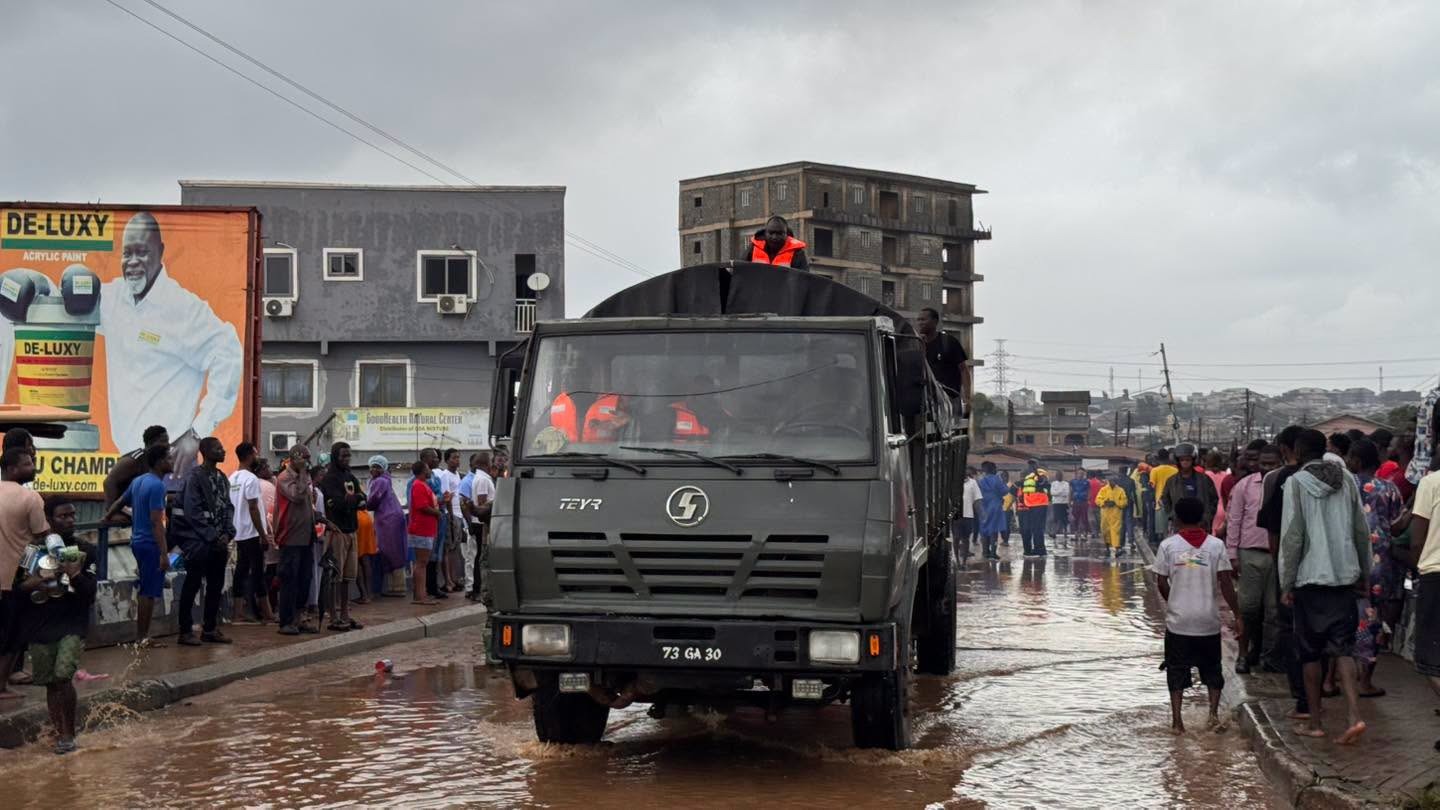
The Ghana National Fire Service (GNFS), working together with the Ghana Police Service, the National Disaster Management Organisation (NADMO), the Ghana Armed Forces and other emergency responders, rescued or safely evacuated 479 people between June 28 and June 30.
Among the largest rescue operations was the evacuation of 105 people trapped by floodwaters at Tse-Ado Last Stop, including women, men and children.
More than 300 additional residents were rescued from floodwaters within the Adabraka-Odawna corridor, while firefighters also responded to dozens of flood emergencies, fires, fallen trees and a collapsed four-storey building whose occupants escaped before the structure gave way.
Despite those rescue efforts, the Ghana National Fire Service confirmed that the flood-related death toll had risen to nine, while one trader remains missing after being swept away by floodwaters near Tema Community One Market.
Following an aerial inspection of the devastated communities, President John Dramani Mahama expressed sympathy to families who had lost relatives and property.
Describing the destruction as extensive, the President announced immediate government intervention by directing the Minister for Finance to release money from the Contingency Fund to support victims through NADMO.
The emergency package is expected to provide temporary shelter, food, household supplies and other humanitarian assistance while detailed damage assessments continue.
The President also commended the military, police, firefighters, NADMO and the 48 Engineers Regiment for their rescue operations, noting that their swift response had saved many lives.
Beyond the emergency response, President Mahama acknowledged that Ghana must move beyond temporary relief measures if the country is to permanently resolve Accra’s flooding crisis.
He disclosed that approximately 140 millimetres of rainfall fell during the latest storm—far exceeding the highest daily rainfall recorded in the previous year—and argued that changing climatic conditions have increased the intensity of extreme weather events.
At the same time, the President blamed indiscriminate dumping of refuse, encroachment on waterways, illegal construction on wetlands and poor public attitudes as major contributors to the recurring disaster.
According to him, aerial surveys revealed extensive illegal developments and refuse dumping on wetlands that previously served as natural flood retention areas.
To address the problem, government announced plans for a nationwide exercise to identify and demolish buildings obstructing waterways and drainage channels.
President Mahama disclosed that the issue would be tabled before the National Security Council before Metropolitan, Municipal and District Assemblies begin identifying structures earmarked for removal.
Government also announced a longer-term strategy to decongest Accra by developing an entirely new city outside the capital over the next two decades.
The proposed development would involve relocating major government institutions while creating a new economic growth centre with roads, electricity, water supply and other infrastructure intended to ease population pressure on Accra.
While government insists these measures represent a comprehensive long-term strategy, the latest floods have also revived political debate over accountability.
Critics have contrasted President Mahama’s current position with statements he made while serving as Leader of the Opposition following major floods in May 2024.
At the time, Mr. Mahama accused the then Akufo-Addo administration of failing to effectively prevent flooding despite substantial investments under the Greater Accra Resilient and Integrated Development (GARID) Project.
He questioned the impact of hundreds of millions of dollars reportedly invested in flood mitigation and promised that an NDC government “would not rest until we find an engineering solution to the persistent flooding and implement an effective prevention and management plan.”
Following this week’s disaster, some political opponents argue that government has yet to deliver the comprehensive engineering solution previously promised and accuse the administration of placing greater emphasis on climate change and human behaviour than on infrastructure delivery.
They also point to the establishment of a flood intervention committee after the current administration assumed office, arguing that tangible results have yet to be seen.
Government, however, rejects suggestions that it has abandoned its earlier commitments.
Officials maintain that emergency relief, improved drainage infrastructure, restoration of waterways, enforcement against illegal developments and the proposed development of a new administrative city together form part of a broader strategy to permanently reduce Accra’s flood risk.
Urban planners have long identified poor drainage systems, rapid urbanisation, uncontrolled development, encroachment on waterways and indiscriminate waste disposal as the principal causes of Accra’s perennial flooding.
For many residents, however, the recurring disasters have moved beyond political debate.
Each rainy season brings renewed loss of lives, destruction of homes, disruption to businesses and growing economic hardship, reinforcing calls for successive governments to prioritise implementation over promises.
However, as rescue teams conclude recovery operations and affected families begin rebuilding their lives, many Ghanaians believe the central question is no longer which political party bears responsibility for the crisis, but whether the country can finally deliver the permanent engineering and planning solutions needed to prevent Accra from once again coming under flood siege.