By Grace Zigah
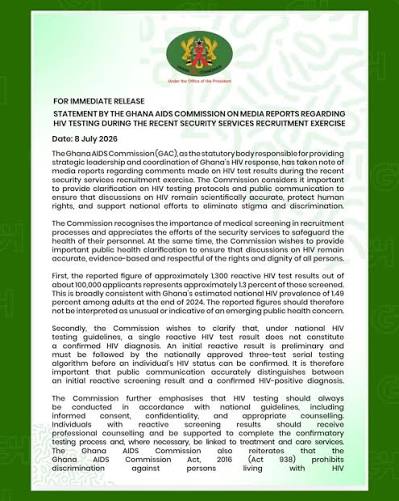
The Ghana AIDS Commission has moved to calm public anxiety following widespread reports that approximately 1,300 applicants in the ongoing security services recruitment exercise had tested positive for HIV, stressing that the reported figures refer only to preliminary reactive screening results and not confirmed HIV diagnoses.
The clarification comes after comments made by the Minister for the Interior indicated that about 1,300 applicants who participated in the recruitment exercise had recorded reactive HIV test results.
The disclosure generated widespread public discussion and concerns about the health status of applicants seeking employment in the security services.
In a statement the Ghana AIDS Commission explained that it was necessary to provide scientific clarification on the country’s HIV testing procedures while protecting the rights, dignity and privacy of all applicants involved in the recruitment exercise.
According to the Commission, the reported figure of approximately 1,300 reactive HIV tests out of about 100,000 applicants screened represents roughly 1.3 percent of those tested. It noted that this percentage closely aligns with Ghana’s estimated national HIV prevalence rate of 1.49 percent among adults as of the end of 2024.
The Commission therefore stressed that the figures should not be interpreted as unusual or viewed as evidence of a worsening HIV situation in the country.More importantly, the Commission explained that under Ghana’s national HIV testing guidelines, a single reactive HIV screening result does not amount to a confirmed HIV-positive diagnosis.
It stated that every initial reactive result must undergo the country’s approved three-test serial testing algorithm before an individual’s HIV status can be medically confirmed.
“An initial reactive result is preliminary and must be followed by the nationally approved three-test serial testing algorithm before an individual’s HIV status can be confirmed,” the Commission stated.
The Commission further appealed to public officials, media organisations and the general public to clearly distinguish between an initial reactive screening result and a confirmed HIV diagnosis in order to prevent misinformation and unnecessary public panic.
It warned that inaccurate public communication regarding HIV has the potential to reinforce stigma and discrimination against affected individuals, discouraging many people from voluntarily seeking HIV testing, counselling and treatment services.
According to the Commission, Ghana has made significant progress over the years in expanding access to HIV prevention programmes, treatment and care services, and maintaining those gains requires creating an environment where individuals can confidently know their HIV status without fear of prejudice or discrimination.
The Commission also reiterated the importance of protecting the confidentiality of persons undergoing HIV testing, particularly during recruitment exercises, and encouraged all stakeholders to communicate responsibly on public health issues.