

By Daniel Bampoe
Governor Dr. Johnson Pandit Asiama, of the Bank of Ghana, has signalled a delicate balancing act for monetary policy as Ghana enters a new phase of economic recovery, warning that strong domestic gains are now colliding with rising global uncertainty.
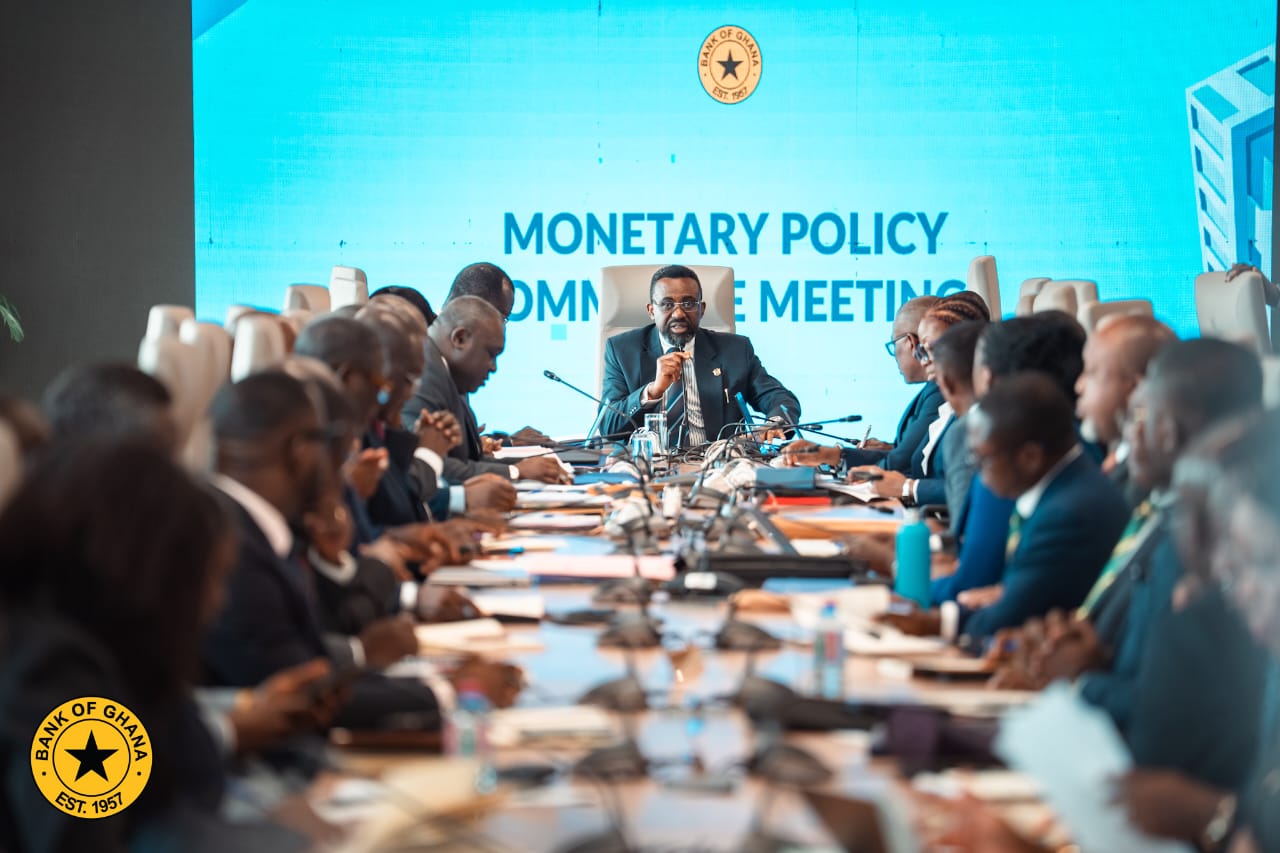
Speaking at the 129th Monetary Policy Committee (MPC) meeting, the Governor said the central bank is no longer focused on restoring stability, but on sustaining it under increasingly complex conditions.
“This is not a meeting to ratify good news,” Dr. Asiama stated. “It is a meeting to make a judgment on conditions that have become simultaneously more encouraging and more uncertain.”
Inflation Drops To Historic Lows
The Governor revealed that the disinflation trend has continued strongly, with headline inflation falling to 3.3 percent in February 2026, marking the fourteenth consecutive monthly decline.
This places inflation below the Bank’s medium-term target band of 8 ± 2 percent, a milestone that, according to the Governor, would have been considered unrealistic just months ago.
The improvement reflects tight monetary policy, exchange rate stability, and anchored inflation expectations across households, businesses, and financial markets.
Stronger Reserves And Economic Momentum
Dr. Asiama also pointed to significant improvements in the external position. Gross international reserves have increased to approximately $14.5 billion, equivalent to 5.8 months of import cover, up from $13.8 billion at the previous MPC meeting in January.
On the real sector side, economic activity is gaining momentum. The Composite Index of Economic Activity (CIEA) recorded 8.4 percent year-on-year growth at the start of 2026, supported by increased bank credit, stronger industrial output, rising trade activity, and improved household consumption.
Business and consumer confidence have also strengthened, driven largely by easing inflation and improving macroeconomic stability.

Taken together, these indicators suggest that Ghana’s economy is stabilising faster than initially expected.
Global Shocks Threaten Progress
Despite these gains, the Governor warned that the external environment has become more volatile since the last MPC meeting.
He cited escalating tensions in the Middle East, which have disrupted energy and shipping routes and increased volatility in global oil markets. These developments, he noted, pose a direct risk to Ghana through imported inflation, particularly if oil prices remain elevated.
“Sustained oil price increases raise the risk of imported inflation, which could necessitate policy tightening,” he cautioned.
While higher global gold prices may provide some support to Ghana’s trade balance, the Governor stressed that the overall balance of risks remains inflationary.
Key Policy Issues Before The Committee
Dr. Asiama outlined three critical issues that will shape the MPC’s decision-making at this meeting.
The first is the geopolitical risk channel, which introduces a new external threat to Ghana’s disinflation gains. Unlike earlier in the year, when the main concern was complacency, the current challenge is managing external shocks that could reverse progress.
The second is the newly announced Ghana Accelerated National Reserve Accumulation Programme (GANRAP), which aims to increase reserves to 15 months of import cover by 2028, from the current level of about 5.8 months.
While the programme is expected to strengthen macroeconomic resilience, the Governor noted that it also raises questions about liquidity conditions, the central bank’s balance sheet, and how reserve accumulation interacts with monetary policy operations.
The third issue is the effectiveness of monetary policy transmission. Although the banking sector remains well-capitalised, profitable, and stable, the central bank is closely examining whether policy rate changes are fully translating into lower borrowing costs and increased credit to the private sector.
A More Complex Policy Decision
Dr. Asiama emphasised that the nature of the MPC’s decision has evolved. While the January meeting focused on maintaining restraint, the current meeting requires a more nuanced judgment.
“The question before this Committee is not whether conditions have improved—they have,” he said. “The question is how we respond to that improvement when the conditions that enabled it are under pressure.”
He added that central banking is not only about managing crises, but also about managing success, ensuring that gains achieved through disciplined policy are not undermined by emerging risks.
Outlook: Stability Under Test
With inflation at historic lows, reserves strengthening, and growth recovering, Ghana’s economy appears to be on a firmer footing. However, rising global uncertainties—particularly from energy markets and geopolitical tensions—are expected to test the durability of these gains.
The outcome of the 129th MPC meeting is therefore expected to signal how the Bank of Ghana intends to navigate this delicate phase—balancing support for growth with vigilance against renewed inflationary pressures.


