BY ISSAH OLEGOR
Chief of Staff Dr Julius Debrah has called for deeper Ghana-Japan collaboration in cocoa processing, technology transfer and innovation, arguing that Ghana must move beyond exporting cocoa beans and unlock new economic opportunities from the entire cocoa value chain.
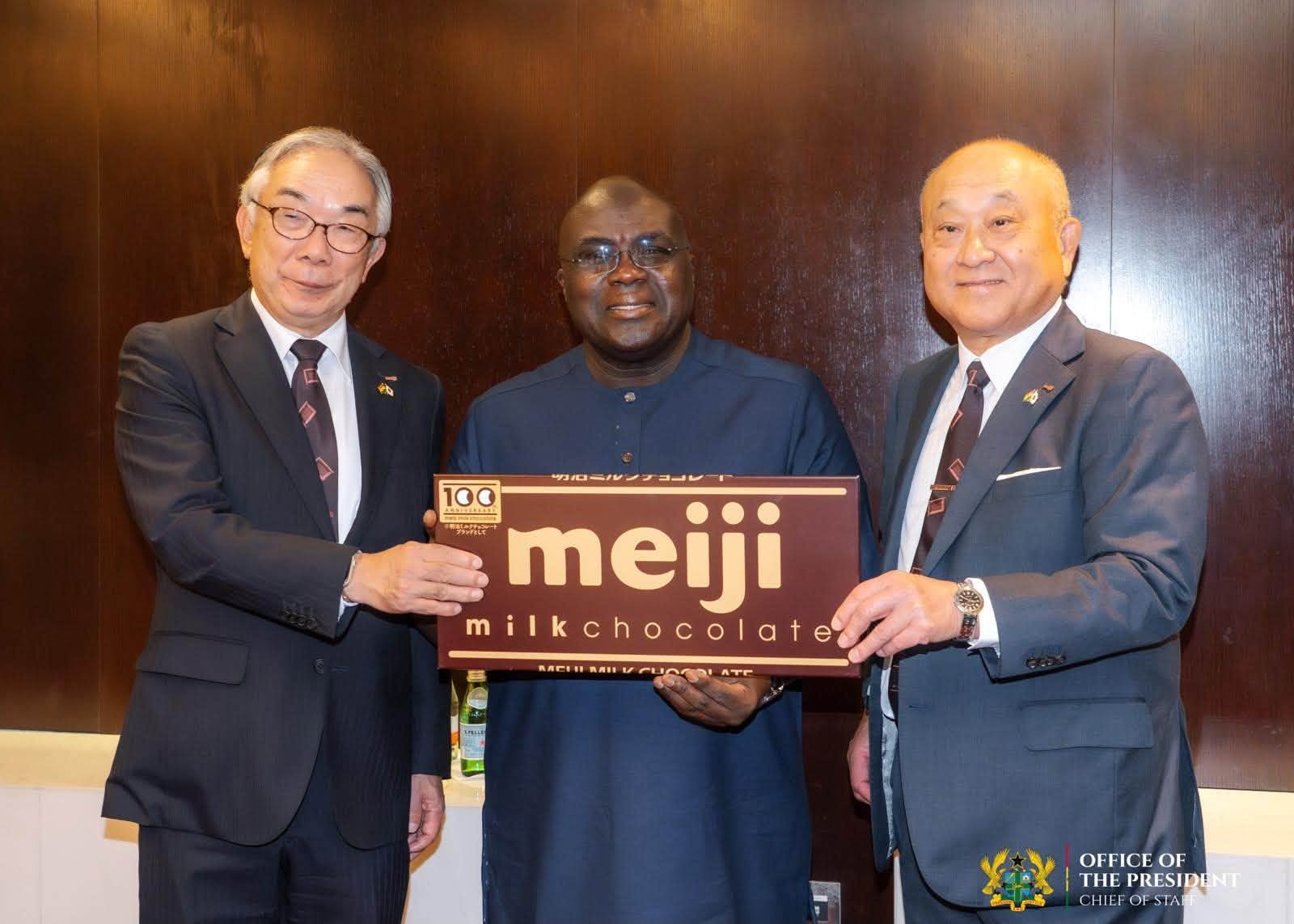
Dr Debrah made the call after joining Japan’s Ambassador to Ghana, Hiroshi Yoshimoto, representatives of Meiji, officials from the Japan International Cooperation Agency (JICA) and the Japan External Trade Organisation (JETRO), COCOBOD, cocoa farmers and other stakeholders to commemorate the 100th anniversary of Meiji Milk Chocolate.
Representing President John Dramani Mahama and the Government of Ghana, the Chief of Staff congratulated Meiji on a century of what he described as quality, innovation and global success, while using the occasion to highlight the importance of the longstanding relationship between Ghana’s cocoa sector and Japanese industry.
He noted that since 2006, Meiji Cocoa Support has contributed to initiatives in Ghana’s cocoa-growing communities, including improved farming practices, agroforestry, education, traceability and efforts to address child labour and deforestation.
He said such interventions demonstrate how international partnerships can contribute to strengthening the sustainability of Ghana’s cocoa industry while improving conditions in farming communities.
Debrah linked the partnership to President Mahama’s broader reforms in the cocoa sector, saying the government’s agenda is focused on protecting farmer incomes, improving productivity and significantly expanding domestic processing.
According to him, the government’s ambition is to process at least half of Ghana’s cocoa locally, a target that could create additional employment opportunities and enable the country to retain a greater share of the value generated from its cocoa production.
The push for increased local processing reflects a broader objective of moving Ghana further up the cocoa value chain instead of relying predominantly on the export of raw or semi-processed cocoa.
Dr Debrah argued that greater domestic value addition could create opportunities not only for large processors but also for businesses, researchers, technology companies and entrepreneurs operating around the cocoa industry.
He said the company’s work on cocoa-derived bioplastics demonstrated the possibility of transforming what is traditionally regarded as agricultural waste into commercially valuable products.
He noted that cocoa pod waste could potentially be converted into biochar, fibre and bio-based or biodegradable plastics, creating new economic opportunities while contributing to a cleaner and more circular economy.
The development, he suggested, offers Ghana an opportunity to rethink the cocoa pod itself—not simply as waste left behind after harvesting, but as a potential source of additional industrial value.
“The cocoa pod has already given the world chocolate. With partnership, innovation and disciplined execution, it can give our people much more,” Dr Debrah said.
Ghana-Japan partnership
Debrah also used the occasion to highlight the importance of Ghana’s relationship with Japan, particularly in areas where technology, investment and agricultural expertise can support Ghana’s development objectives.
The participation of the Japanese Ambassador, Meiji, JICA and JETRO, together with COCOBOD, cocoa farmers and other stakeholders, provided a platform for discussions around the future of Ghana’s cocoa industry and opportunities for deeper collaboration.
He expressed the hope that the longstanding friendship between Ghana and Japan would continue to grow and produce practical benefits for both countries.