BY DANIEL BAMPOE
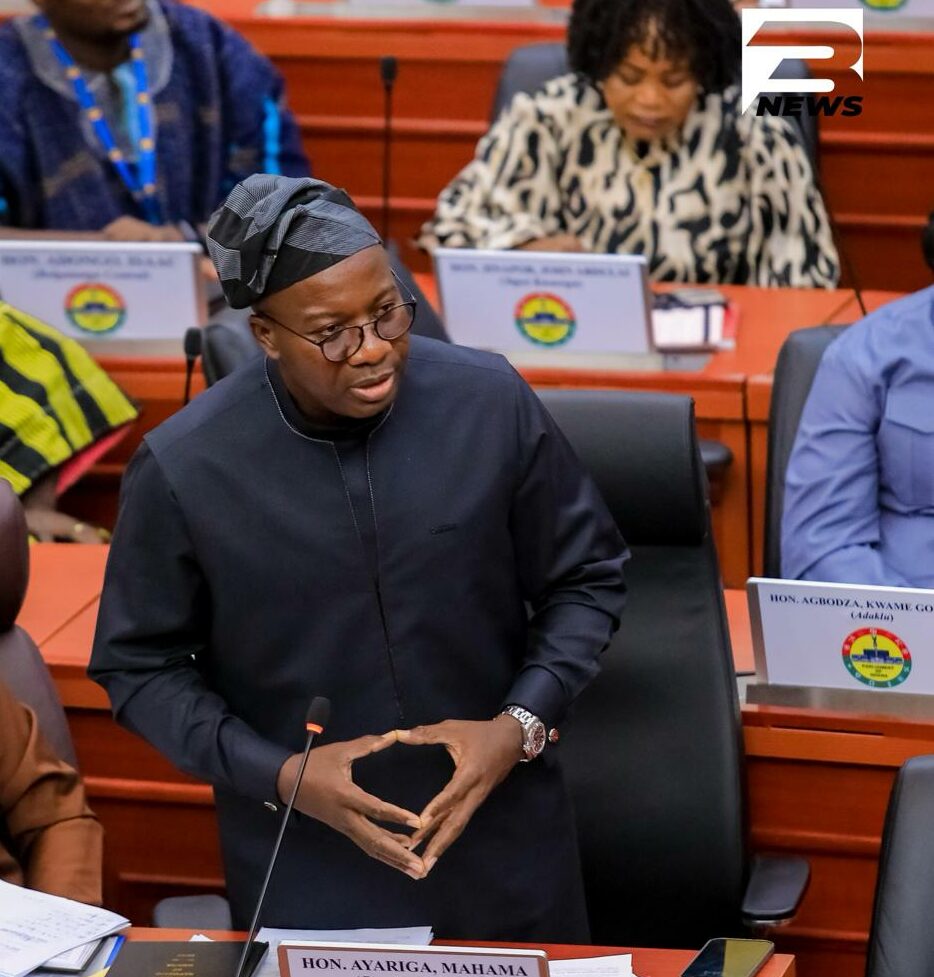
The Majority Leader in Parliament, Mahama Ayariga, is facing renewed scrutiny over what critics describe as a dramatic shift in his position on transparency and accountability at the Bank of Ghana (BoG), after leading the Majority’s support for a closed-door parliamentary engagement with the Central Bank Governor just three years after demanding public accountability from the previous BoG leadership.
The debate follows Parliament’s decision on Wednesday to hold the Bank of Ghana Governor’s appearance before a Committee of the Whole behind closed doors, resulting in the exclusion of journalists from proceedings.
The decision, supported by the Majority, triggered a walkout by the Minority Caucus, which argued that Ghanaians deserved to hear the Governor’s responses on critical issues including the source of foreign exchange interventions, the Domestic Gold Purchase Programme and the Bank’s financial position.
The controversy has revived attention to a strongly-worded letter authored by Mahama Ayariga on October 2, 2023, when he was in opposition.
In that letter, addressed to the then Governor of the Bank of Ghana, Dr. Ernest Addison, Mahama Ayariga accused the Central Bank leadership of withholding information regarding the construction of the new BoG headquarters and announced plans to report the Governor, his deputies, Board members and contractors to the Office of the Special Prosecutor (OSP) for investigations into suspected corruption and procurement irregularities.
At the time, Mahama Ayariga argued that the Bank’s refusal to disclose details of the project’s scope of works under the justification of “national security considerations” was unacceptable.
He insisted that transparency could not be sacrificed under the guise of national security and described the Bank’s response to his Right to Information request as “brief and inadequate.”
His letter questioned the escalation of the headquarters project cost from an initial estimate of US$100.86 million to US$121.08 million, before eventually rising to US$222.8 million after revisions to the project.
According to Mahama Ayariga, while the project’s gross floor area increased from approximately 73,000 square metres to just over 107,700 square metres—representing roughly a 36.9 percent increase—the contract value rose by about 84 percent, a disparity he described as unreasonable.
He argued that the variation in cost could only reasonably suggest possible project cost padding and suspected corruption.
The then opposition MP maintained that the Bank’s refusal to release detailed bills of quantities, pricing breakdowns and scope of works only reinforced suspicions surrounding the project.
In one of the strongest anti-corruption positions taken by an opposition lawmaker at the time, Mahama Ayariga formally announced that he would petition the Office of the Special Prosecutor to investigate the Governor, Deputy Governors, members of the Bank’s Board and the project’s contractor, Goldkey Properties Limited, for alleged corruption and corruption-related offences under the Office of the Special Prosecutor Act, 2017 (Act 959).
He further rejected what he described as the Bank’s attempt to hide behind “national security considerations,” insisting that public officials entrusted with taxpayers’ money must be prepared to account fully for their decisions.
Fast forward to 2026, however, the Majority Leader now finds himself defending a parliamentary process that prevented journalists from covering the Bank of Ghana Governor’s appearance before Parliament.
The Majority argued that proceedings of the Committee of the Whole could legitimately be held in camera under Parliament’s Standing Orders and maintained that the decision was procedural rather than an attempt to shield the Governor.
The Minority disagreed sharply, insisting that the Governor’s written responses had already been published on Parliament’s Order Paper and therefore contained no classified information warranting secrecy.
The opposition argued that excluding the media denied Ghanaians the opportunity to hear explanations on issues affecting the economy and weakened Parliament’s oversight role.