BY Daniel Bampoe
Ghana is accelerating efforts to build a locally driven and self-sustaining HIV/AIDS response as the country confronts shrinking international support and persistent infection rates among young people.
This renewed national direction was outlined by Vice President Professor Naana Jane Opoku-Agyemang during the opening of the 23rd International Conference on AIDS and STIs in Africa (ICASA 2025), held in Accra.

Her remarks come at a critical phase in Ghana’s decades-long battle against HIV/AIDS—a fight historically dependent on international partners for funding, commodities, and vaccines.
Since the early 2000s, global initiatives such as PEPFAR and the Global Fund have supplied a major share of the antiretroviral drugs, testing kits, and prevention tools.
But in recent years, these donor instruments have steadily reduced allocations as nations move toward “country ownership” of public health programmes.
Addressing delegates, Prof. Opoku-Agyemang acknowledged that although 65 percent of Ghanaians living with HIV are on treatment, the country’s heavy reliance on imported medicines and foreign financing remains a major vulnerability.
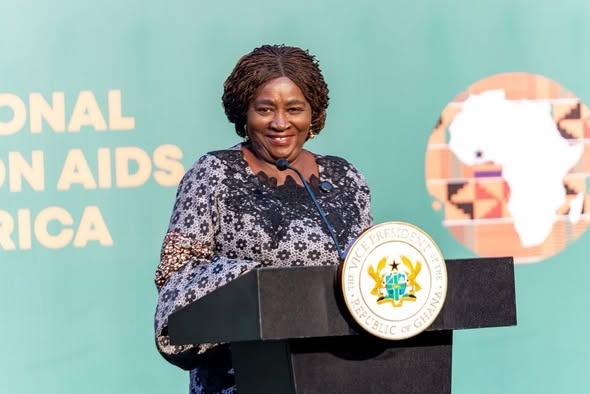
She revealed that government is developing a National HIV Response Sustainability Roadmap, a comprehensive plan aimed at weaning Ghana off aid dependence.
A key pillar of the roadmap is the establishment of local pharmaceutical capacity. A feasibility study, according to the Vice President, is already underway to explore domestic manufacturing of HIV vaccines, treatment medicines, and other essential commodities. If implemented, this would mark a historic shift in Ghana’s health sector, which has for decades imported nearly all high-level medical supplies.
“Our national approach is anchored on sustainable financing, strong accountability mechanisms, and local production of critical health commodities,” she said. “Ghana must no longer depend on unpredictable external sources.”
Adolescent Girls
While progress has been made in treatment coverage, the Vice President highlighted a troubling pattern: adolescent girls and young women continue to account for a significant share of new HIV infections.
Health experts attribute this to socio-economic vulnerabilities, transactional relationships, limited access to sexual reproductive health education, and stigma associated with testing.
This demographic challenge has long concerned policymakers. Over the last decade, government launched several youth-focused prevention campaigns, yet infection rates among girls aged 15 to 24 remain disproportionately high.
Prof. Opoku-Agyemang called for a renewed focus on prevention, urging African governments to invest in self-testing, community education, and youth-friendly health services.
Africa Urged To Build Resilient, Home-Grown Health Systems
Turning to the continental landscape, the Vice President warned that the decline in global HIV financing threatens years of progress. She urged African nations to “refuse to let hard-won gains unravel” by redesigning sustainable health financing systems that do not depend on donor generosity.