BY DANIEL BAMPOE
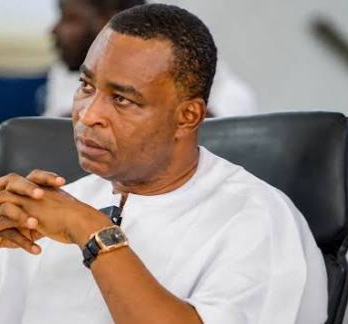
The New Patriotic Party (NPP) Ashanti Regional Chairman Bernard Antwi-Boasiako, popularly known as Chairman Wontumi, has reportedly begun serving his 20-year prison sentence at the Nsawam Medium Security Prison following his conviction by the Accra High Court in the high-profile Samreboi mining concession case, a development that has intensified political tensions and renewed debate over the legal basis of his conviction.
Confirmation of Chairman Wontumi’s incarceration came from his Campaign Manager, former Deputy Minister and former Member of Parliament for New Edubiase, George Oduro, who disclosed on Asempa FM that he had personally visited the incarcerated NPP stalwart at the Nsawam prison.
“I can confirm that Chairman Wontumi has begun his prison term at Nsawam. I saw him in high spirit there today. He can be released from prison at any time, so I urge all his supporters to continue to have faith in him as he pursues the National Chairmanship bid,” George Oduro stated.
His comments came hours after the Criminal Division of the Accra High Court, presided over by Justice Audrey Kocuvie-Tay, convicted Chairman Wontumi and his company, Akonta Mining Limited, on six counts relating to the unlawful assignment of mineral rights without ministerial approval and facilitating an unlicensed mining operation on the company’s concession at Samreboi in the Western North Region.
The court subsequently sentenced Chairman Wontumi to 20 years’ imprisonment and imposed a fine of 10,000 penalty units, equivalent to GH¢120,000, with an additional custodial sentence in default of payment. Akonta Mining Limited was also fined on separate counts.
Court says conviction was over unauthorized assignment of mineral rights
Throughout the proceedings, the prosecution argued that Chairman Wontumi unlawfully permitted Henry Okum and Michael Gyedu Ayisi to undertake mining activities on Akonta Mining’s concession without first obtaining the approval of the Minister responsible for Lands and Natural Resources, contrary to Ghana’s mining laws.
In its judgment, the court held that Chairman Wontumi had facilitated illegal mining by allowing others to operate on his concession without the legally required ministerial authorization.
The prosecution maintained that the offences centred on the unlawful assignment or transfer of mineral rights and the facilitation of unlicensed mining activities.
During the trial, Chairman Wontumi denied authorising illegal mining. He testified that Henry Okoom had been engaged solely to reclaim degraded portions of the concession through the planting of coconut trees and not to mine gold. He further stated that Okum had introduced himself as a mine support services provider rather than a small-scale miner.
Justice Kocuvie-Tay, however, rejected that explanation after finding that the defence failed to provide evidence supporting the reclamation arrangement.
The court accepted evidence that Okum undertook mining activities on the concession and concluded that Chairman Wontumi knowingly permitted those activities.
The judge relied substantially on circumstantial evidence and held that there was no evidence showing Akonta Mining had sought or obtained ministerial approval before allowing third parties to operate on the concession.
Applying the principles established in Duah v Republic, the court concluded that the only reasonable inference from the evidence was that Chairman Wontumi had knowingly facilitated the mining operations.
The court also lifted the corporate veil of Akonta Mining Limited, holding that there was effectively no distinction between the company and Chairman Wontumi because he exercised complete control over its affairs during the period the offences were committed.
Defence insists convict was not for personally engaging in illegal mining
The judgment has generated significant legal and political debate, with Chairman Wontumi’s legal team and the New Patriotic Party insisting that the conviction was not based on allegations that he personally engaged in illegal mining, but rather on findings that he unlawfully permitted other individuals to operate on his concession without obtaining ministerial approval.
The NPP has argued that Chairman Wontumi lawfully acquired the concession and maintains that there was no evidence that he assigned or transferred his mineral rights in breach of the law. According to the party, the conviction rests on inferences drawn from the leasing or permitting of activities on the concession rather than proof that he personally carried out illegal mining.
The party has therefore described the judgment as a miscarriage of justice and announced that it will challenge both the conviction and sentence at the Court of Appeal.
NPP declares Wontumi a political prisoner
Addressing a press conference shortly after the judgment, NPP General Secretary Justin Kodua Frimpong rejected the High Court’s decision, describing it as a “travesty of justice.”
“We address you today with profound disappointment but also with an unwavering commitment to the rule of law. While we respect the authority of our courts, respect for the judiciary does not require silence in the face of a judgment that is fundamentally flawed,” he stated.
The NPP insisted that the prosecution failed to produce evidence showing that Chairman Wontumi assigned or transferred his mineral rights and argued that the conviction was based on assumptions rather than proof beyond reasonable doubt.
“It is our considered view that Chairman Wontumi has been convicted in circumstances where there was no evidence at all to support a conviction,” Kodua Frimpong said.
The party subsequently declared Chairman Wontumi a “political prisoner” and confirmed that its legal team had commenced the appellate process.
Emergency meeting after judgment
Following the conviction, the NPP leadership, together with the party’s flagbearer and legal team, held an emergency meeting to assess the judgment and determine the party’s next course of action.
The party appealed to supporters nationwide to remain calm, united and disciplined while awaiting the outcome of the appeal process.
Ashigbey wanted a harsher punishment
Meanwhile, Convener of the Media Coalition Against Illegal Mining, Kenneth Ashigbey, welcomed the judgment, describing it as a landmark victory in Ghana’s fight against illegal mining.
Speaking on JoyNews after the judgment, he argued that Chairman Wontumi should have received the maximum 25-year sentence permitted under the law.
“I would have wished that the judge would have given the maximum sentence of 25 years and also added the maximum fine,” Ashigbey said.
He praised the Attorney-General for pursuing the prosecution to its conclusion and commended Justice Audrey Kocuvie-Tay for what he described as courage in delivering judgment in one of Ghana’s most significant illegal mining prosecutions.
Ashigbey also disclosed that the case originated from a petition submitted by the Media Coalition Against Illegal Mining, together with lawyer Martin Kpebu and other campaigners, to the Attorney-General and the then Inspector-General of Police.
Supporters remain hopeful
Despite the conviction, George Boahen Oduro urged NPP supporters not to lose hope, insisting that Chairman Wontumi remained optimistic and determined despite beginning his prison sentence.
According to him, the legal process is far from over, expressing confidence that developments in the appellate courts could alter the outcome.