

News Desk
In a strategic push to accelerate Ghana’s industrialisation and job creation agenda, the Chinese Embassy in Ghana, in collaboration with the 24-Hour Economy and Accelerated Export Development Secretariat, held a high-level business engagement session in Accra to deepen bilateral investment ties.
The meeting, which drew participation from key Ghanaian state institutions and more than 50 top Chinese private sector executives, focused on identifying practical pathways for collaboration under the government’s flagship 24-Hour Economy Programme—a bold initiative aimed at transforming Ghana into a round-the-clock productive and export-oriented economy.
Chinese Investment Drive
At the heart of the engagement was a shared interest: how Chinese capital and expertise can be aligned with Ghana’s priority development projects across sectors such as agriculture, logistics, health, manufacturing, energy, and the creative economy.
Delivering the keynote address, Goosie Tanoh, Presidential Adviser and lead architect of the 24-Hour Economy, made clear that the era of mere policy talk was over.
“We are building a portfolio of coordinated projects that will bring the Programme to life and deliver real value for Ghana,” he stated.
“We have completed concept notes for our first 20 priority projects and are now commencing feasibility studies to make them bankable and investment-ready.”
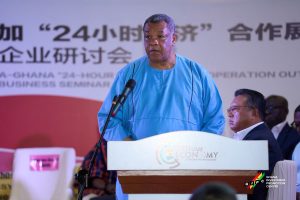
He added that while bureaucratic hurdles remain a reality, the government is finalising a simplified and transparent incentive regime to ease the entry and operations of foreign investors—particularly those aligned with Ghana’s long-term development vision.
Longstanding Ties Reinforced
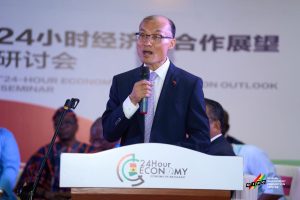
Chinese Ambassador Tong Defa echoed these sentiments, highlighting how the 24-Hour Economy complements China’s development cooperation goals in Africa.
“China remains Ghana’s largest trading partner and a major source of foreign investment,” he noted.
In 2024 alone, bilateral trade hit a record $11.8 billion, with Chinese direct investments reaching $62.15 million—supporting job creation and critical infrastructure development across Ghana.
Ambassador Tong reaffirmed China’s readiness to support priority sectors under the 24H+ umbrella, including agro-processing, logistics, and energy infrastructure.
“The Programme aligns perfectly with our Belt and Road Initiative and China’s industrial partnership goals for Africa,” he said.
Institutional Readiness and Project Pipeline
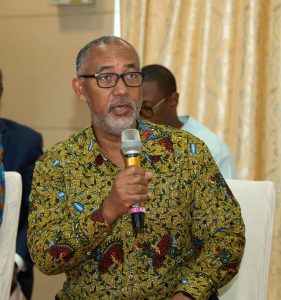
Alexander Kofi-Mensah Mould, CEO of the Millennium Development Authority (MiDA), assured Chinese investors that MiDA will serve as a credible and efficient project execution partner.
“We will ensure end-to-end procurement and partner with the right service providers to deliver projects on time and within budget,” he said.
He specifically pointed to near-ready opportunities in agro-ecological industrial parks, feeder roads, and inland water transport systems on the Volta Lake as key areas with strong commercial viability.
Government, he added, is prepared to bridge financing gaps to ensure these projects are bankable and attractive to private partners.
A Whole-of-Government Approach
The event saw strong representation from Ghana’s financial and investment institutions, including:
Ghana Investment Promotion Centre (GIPC), represented by CEO, Simon Madjie
Ghana Infrastructure Investment Fund (GIIF), represented by Deputy CEO Bennett Akantoa
Ghana EXIM Bank, led by Sylvester Mensah
Development Bank Ghana (DBG), led by Dr. Randolph Nsor-Ambala
Legal insights were provided by David Addo-Ashong, Senior Partner at Ashong Benjamin & Associates
Together, these institutions laid out Ghana’s integrated investment roadmap and financing architecture, designed to support private sector-led growth under the 24H+ vision.
Investor Confidence Strengthened
The structured, data-driven nature of the Programme impressed many Chinese attendees, who praised Ghana’s clarity in presenting investment pipelines and regulatory support mechanisms.


