BY DANIEL BAMPOE
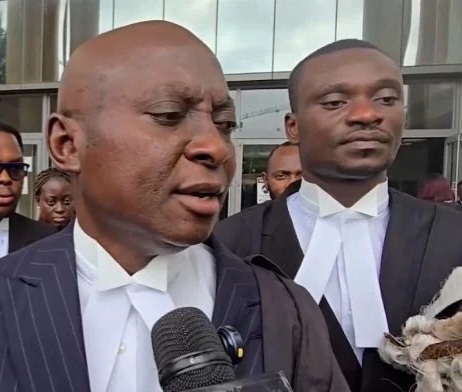
Lead counsel for former National Signals Bureau Director-General Kwabena Adu-Boahene, Samuel Atta Akyea, has rejected a directive requiring him to return to court during the legal vacation, declaring emphatically that he will not appear in court merely because the trial has been designated to continue during the recess.
Atta Akyea’s position comes amid a growing legal controversy over the decision by the Chief Justice to authorise selected High Court judges to sit during the legal vacation to hear certain criminal cases.
Defence lawyers in several politically sensitive cases have challenged the arrangement, arguing that it interferes with lawyers’ professional commitments and raises questions about equal treatment of accused persons.
In a strongly worded response, Atta Akyea questioned the very purpose of the legal vacation, arguing that lawyers who have worked throughout the legal year should be entitled to the recess just as judges and other judicial officers are.
“I am not going to court at all,” Atta Akyea declared when asked whether he would comply with the directive requiring him to appear in court on August 17.
He questioned why a lawyer who has worked throughout the year should suddenly be compelled to abandon his vacation because a particular case has been classified for hearing during the recess.
“I have been working. The whole year, when was the time that I said I won’t come to court?” he asked, challenging the basis for treating selected cases differently from other matters pending before the courts.
The former Abuakwa South Member of Parliament also invoked the legal framework governing the judiciary’s vacation period, urging critics and authorities alike to examine the relevant provisions, particularly Order 79, which he said gives meaning to the concept of legal vacation.
“What is the meaning of legal vacation?” he asked. “When a court is on vacation, and you say that there are some special cases that you should come in here, you should justify what is special.”
For Atta Akyea, the central question is not whether the judiciary possesses administrative powers to determine which cases should be heard, but whether those powers are being exercised in a manner consistent with constitutional principles and fairness.
He questioned why certain criminal matters should receive priority during the vacation while other cases, including serious criminal trials, are adjourned until the new legal year.
“What is special between a murder case and a case like this? Why is the murder case not being heard?” he asked.
The controversy intensified after the court reportedly gave the defence six days to make arrangements for the continuation of the Adu-Boahene trial.
The directive reportedly raised the possibility that Kwabena Adu-Boahene could be required to participate in proceedings without his chosen lawyer if Atta Akyea failed to appear.
Atta Akyea strongly rejected that proposition, arguing that a technically complex criminal trial cannot reasonably expect an accused person without legal training to conduct his own cross-examination or defend himself effectively.
He compared such an arrangement to asking a professional outside the legal field to perform a task requiring specialised expertise.
“How can a lay person cross-examine in such a matter?” he asked. “You are asking a carpenter to go and do surgery.”
The lawyer maintained that the right to legal representation is particularly important in complex criminal proceedings, where the accused may be required to challenge witnesses, examine evidence and respond to intricate questions of law and procedure.
He therefore questioned the rationale behind insisting that proceedings continue during the vacation when the principal defence lawyer has indicated that he is unavailable.
“Then what? Go to court for what?” he asked repeatedly.
Atta Akyea also challenged the urgency behind the decision to continue the selected trials during the vacation, asking whether there was any identifiable national emergency requiring those particular cases to be heard immediately.
“When we try these cases in the vacation, will the inflation of Ghana go down?” he asked rhetorically.
“What is the emergency about these cases? They can’t answer.”
His comments come against the backdrop of petitions by defence lawyers challenging the Chief Justice’s decision to authorise selected judges to sit during the legal vacation.
Lawyers representing accused persons in cases including Republic v Adu-Boahene, Republic v Hanan Abdul Wahab and Republic v Mustapha Hamid & Others have raised concerns about what they describe as selective treatment and interference with lawyers’ professional and personal commitments during the recess.
The lawyers have argued that numerous criminal and civil cases have been adjourned until the next legal year, making the selection of particular cases for vacation hearings difficult to justify.