By Issah Olegor
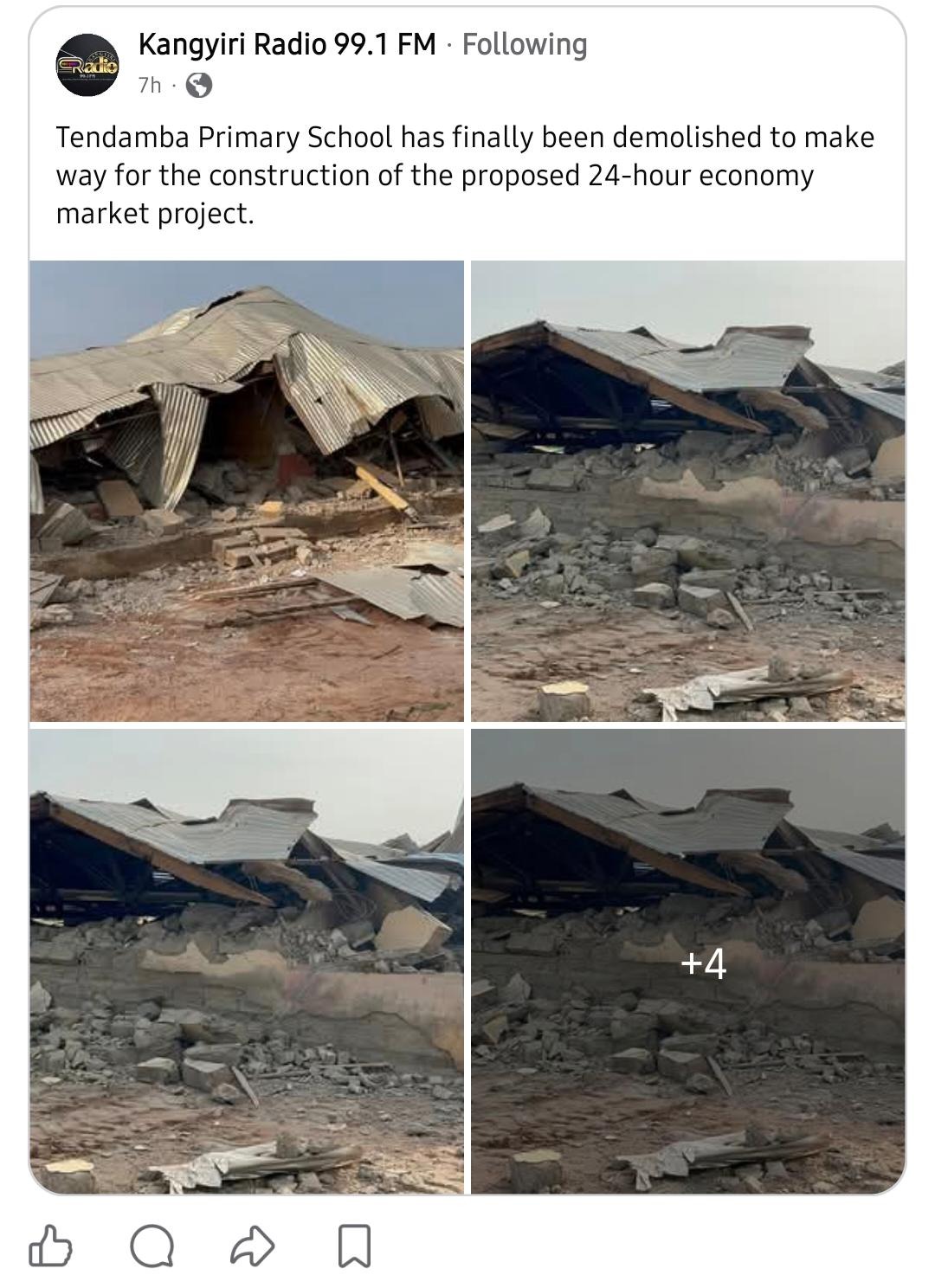
A major chapter in the educational history of the Upper West Region has come to an end following the demolition of the historic Tendamba Primary School in Wa to pave the way for the government’s flagship 24-hour economy market project. This development has reignited controversy months after fierce opposition from alumni, traditional leaders, parents, and community stakeholders.
The demolition of the school, one of the oldest educational institutions in the region, marks the culmination of a protracted dispute pitting advocates of educational heritage preservation against proponents of the government’s ambitious market-infrastructure agenda.
For many residents of Wa, the demolition represents more than the loss of a school building. It symbolizes the disappearance of a landmark institution that has served generations of families and produced some of the country’s most accomplished professionals, including Supreme Court Justice Yonny Kulendi.
Established in 1956, before Ghana attained independence, Tendamba Primary School occupied a unique place in the educational development of the Upper West Region. Located within the Sapuayiri-Zongo enclave of Wa, the school was among the pioneering institutions established to expand access to formal education in northern Ghana during the colonial era.
Over the past seven decades, the school became a symbol of academic excellence and social mobility, producing lawyers, judges, teachers, public servants, traditional leaders, academics and business professionals who have contributed significantly to national development.
Among its distinguished alumni are Justice Yonny Kulendi, retired academics, senior public servants, legal practitioners and former Ghana Football Association President Kwesi Nyantakyi.
The institution also counts the Paramount Chief of the Waala Traditional Area among its former students.
Before its demolition, the school had an enrolment of approximately 370 pupils and was preparing to celebrate its 70th anniversary, a milestone many stakeholders had hoped would be marked with major educational investments rather than the destruction of its historic structures.
The controversy surrounding the school’s fate began earlier this year when reports emerged that the Wa Municipal Assembly intended to utilize the school’s land for the construction of a 24-hour economy market, one of the key initiatives linked to the government’s economic transformation agenda.
The proposal immediately generated public backlash.
Parents, landlords, traditional leaders, members of the School Management Committee, the Parent-Teacher Association and the school’s Old Students Association questioned the rationale behind demolishing a functioning educational institution to create space for commercial activities.
Critics argued that while market infrastructure was important, education should not be sacrificed in pursuit of economic development.
Leading the opposition was Justice Yonny Kulendi, who publicly challenged the proposal and vowed to resist any attempt to replace the school with a market.
The Supreme Court judge joined fellow alumni and community leaders in engaging educational authorities, traditional rulers and local government officials in an effort to halt the project.
At the height of the controversy, Justice Kulendi passionately defended the school’s historical significance, insisting that education should never be subordinated to commerce.
He warned that all lawful means would be employed to resist any effort to turn the institution into a marketplace.
The opposition was further strengthened by community leaders who argued that stakeholders had not been adequately consulted before the decision was taken.
Many residents questioned why authorities would choose a school with such historical importance when alternative lands could potentially be identified for the market project.
Concerns were also raised about the identity of the school and the future of its pupils if they were dispersed among other institutions.
Parents feared that the relocation would disrupt learning and erase a legacy that had been carefully built over seven decades.
The debate attracted national attention after the Minister for Local Government, Chieftaincy and Religious Affairs, Ahmed Ibrahim, publicly distanced himself and the government from reports that a school would be demolished for a market.
Speaking at the time, the minister stated that neither the Presidency nor his ministry had approved the destruction of a historic school for the 24-hour market programme.
He emphasized that Metropolitan, Municipal and District Chief Executives had been directed to work with traditional authorities to identify suitable and strategic lands for market construction.
According to him, government policy required consultation and consensus-building before project sites were selected.
The minister questioned why a 70-year-old school that had produced numerous professionals would be targeted for demolition when alternative locations could be found.
His remarks were interpreted by many as a sign that the school would ultimately be spared.
However, developments on the ground later took a different turn.
Despite the assurances and public opposition, authorities proceeded with plans to relocate the pupils and clear the site for the proposed market development.
The relocation process involved transferring pupils to Tendamba Junior High School as well as the Nuria and Huria Islamic Schools to ensure teaching and learning continued while preparations for the market project advanced.
Officials maintained that the relocation was necessary to facilitate the implementation of the 24-hour economy market project while minimizing disruption to academic activities.
The demolition has now transformed what was once a thriving educational institution into a construction site for one of the government’s flagship economic initiatives.
The decision continues to divide public opinion.
Supporters of the project argue that the market will stimulate economic activity, create jobs and support the broader objectives of the government’s 24-hour economy policy.
Critics, however, maintain that the loss of a historic educational institution represents too high a price to pay and raises questions about planning, stakeholder consultation and the preservation of the educational heritage.
The controversy also highlights the ongoing tension between infrastructure development and the protection of historical institutions, particularly in communities where schools serve not only as centres of learning but also as symbols of collective identity and social progress.