
By Issah Olegor
Former Finance Minister Ken Ofori-Atta has been thrust into the centre of a major corruption storm following damning revelations by the Office of the Special Prosecutor (OSP) and subsequent termination of the controversial Strategic Mobilisation Ghana Limited (SML) contracts by President John Dramani Mahama.
The scandal, which has been described as one of Ghana’s biggest procurement and conflict-of-interest breaches in recent years, exposes how politically connected officials allegedly used state institutions to facilitate questionable deals worth over $500 million.
The Background of the Deal
The SML saga began in 2019, when the Ghana Revenue Authority (GRA) signed an agreement with SML to provide revenue assurance services in the downstream petroleum sector.
The company’s mandate was to audit transactions, verify prices, and measure petroleum volumes to prevent revenue leakages.
However, controversy soon followed as SML’s role appeared to duplicate functions already being performed by the Customs Technical Services Bureau (CTSB) and other state agencies. Despite these concerns, the contract was repeatedly expanded — with the most contentious move coming in June 2023, when then-Finance Minister Ken Ofori-Atta authorized an expansion of SML’s scope to cover upstream oil drilling and gold mining.
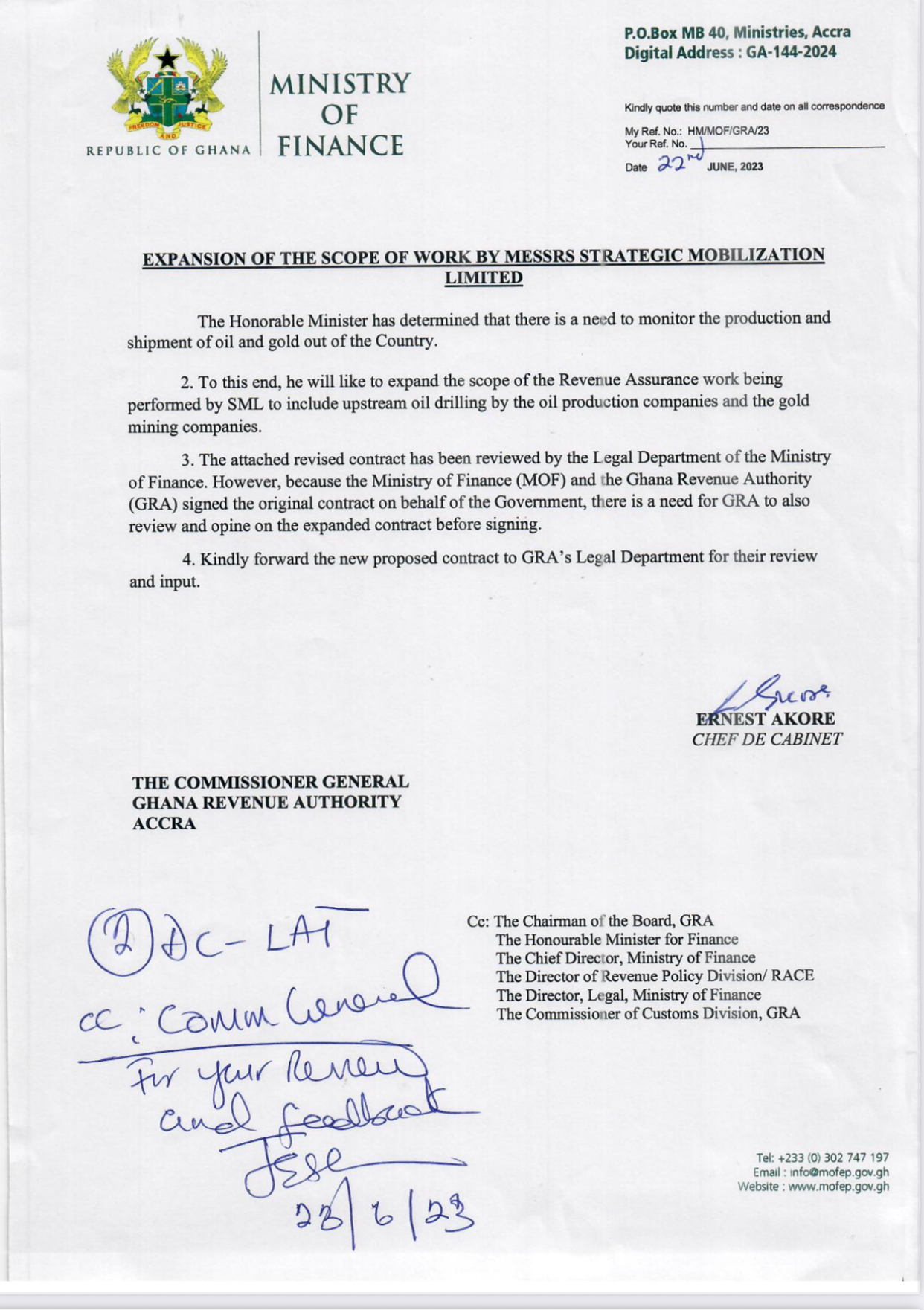
A confidential letter dated June 22, 2023, written from the Ministry of Finance to the Ghana Revenue Authority, and signed by Ernest Akore, Chief of Staff to the Minister, instructed the GRA to review and approve the expanded contract.
The letter stated that “the Honourable Minister has determined that there is a need to monitor the production and shipment of oil and gold out of the country,” effectively sidelining regulatory bodies such as the Minerals Commission and Petroleum Commission.
According to internal ministry documents, this unilateral decision would have earned SML over $90 million annually from the two new sectors alone. When combined with its existing contracts at the ports and in the downstream petroleum market, the consolidated deal — signed in October 2023 — was valued at over $500 million for an initial five-year term, renewable for another five.
Ofori-Atta’s Role and the Alleged Abuse of Office
Investigations by the OSP have since revealed that Ofori-Atta’s decision to expand SML’s services was not backed by any needs assessment or technical justification.
The OSP described the move as an act of “official patronage and self-serving sponsorship,” driven by false claims of revenue leakages that were never verified.
Evidence presented by the OSP indicated that Ofori-Atta personally supervised communications, payments, and contract approvals related to SML — despite being aware that the company lacked the technological and operational capacity for the expanded work. Payments were reportedly made from three key state accounts: the Consolidated Fund, the Petroleum Revenue Account, and the Tax Refund Account.
The Special Prosecutor, Kissi Agyebeng, stated that these payments were made on an “automatic mode,” meaning SML received money regardless of whether it performed the services. “There was no established system to confirm that the Republic was obtaining value for money,” he said, describing the arrangement as a classic case of financial loss to the state.
Conflict of Interest and the Revolving Door Culture
The OSP’s report also exposed a conflict of interest involving senior GRA officials. Former Customs Commissioner Isaac Crentsil, who promoted the SML deal while in office, later joined the company as its General Manager upon retirement. This move, according to Agyebeng, demonstrated “a revolving-door culture” where public officers allegedly used their positions to secure future private gains.
“Mr. Crentsil’s actions while in office were clearly induced by the promise of post-retirement rewards,” the report concluded.
Following months of public outrage and civil society pressure, President John Mahama on October 31, 2025, ordered the immediate termination of all SML-related contracts. In a directive signed by Dr. Callistus Mahama, Secretary to the President, the Finance Minister, Dr. Cassiel Ato Forson, was instructed to end every agreement between the government and SML.
The decision followed the OSP’s final report, which confirmed that the SML contracts lacked justification, violated procurement laws, and were executed without mandatory prior approvals.


