By Daniel Bampoe
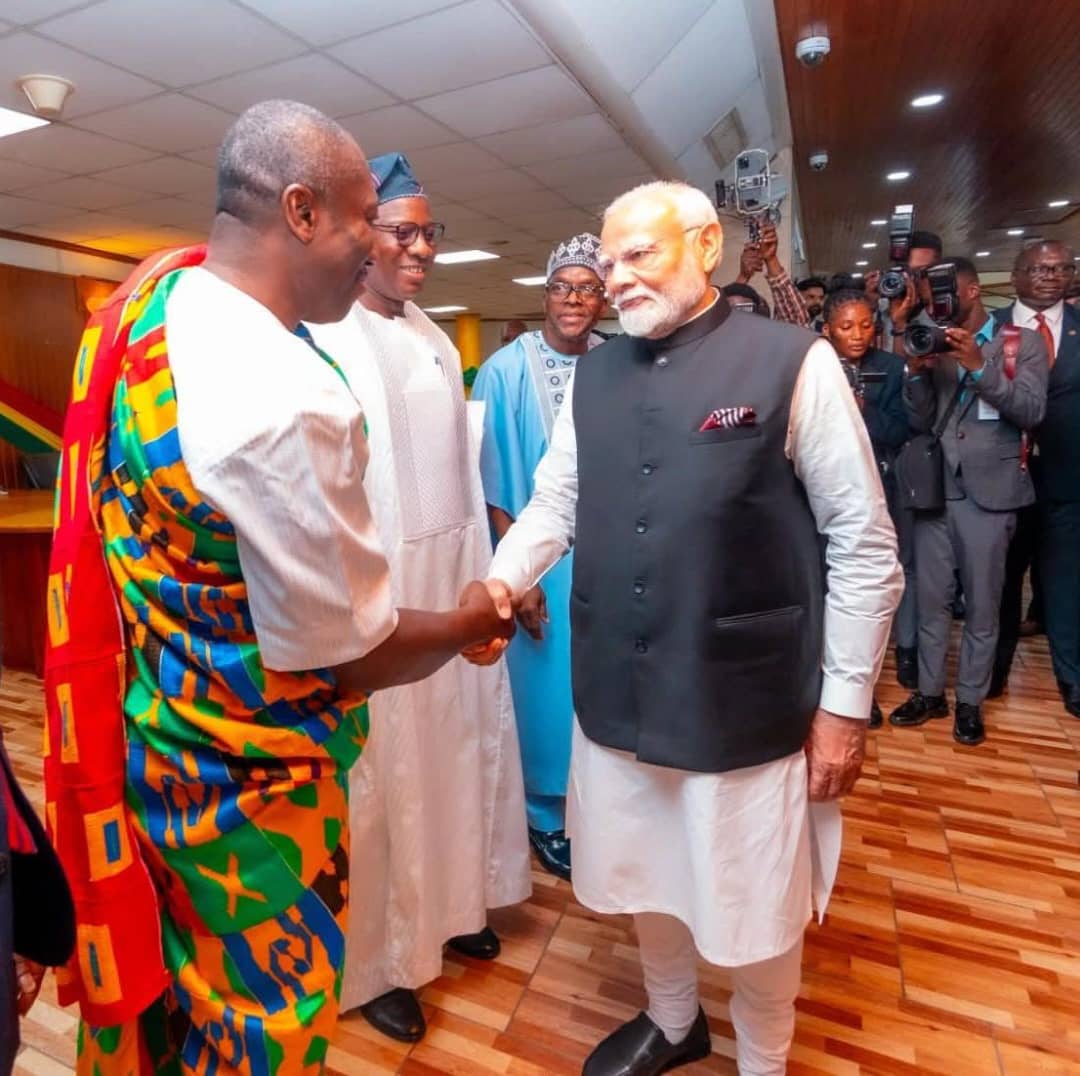
The Minority Caucus in Ghana’s Parliament has described the historic visit of Indian Prime Minister Shri Narendra Modi as a defining moment in Ghana’s international relations and a symbol of hope for visionary, transformational leadership across the developing world.
In a strongly worded statement issued on Wednesday, July 3, the Caucus not only welcomed Prime Minister Modi to Ghana but also used the opportunity to draw attention to the deeper lessons his leadership offers—particularly for African democracies like Ghana that are grappling with economic recovery, political polarisation, and the search for sustainable development models.
This is the first time in more than 30 years that a sitting Indian Prime Minister has visited Ghana, and the first ever to address the Ghanaian Parliament.
For the Minority Caucus, this is not merely a ceremonial occasion but a powerful diplomatic signal—one that underlines the strategic importance of Ghana-India relations in the 21st century.
A Friendship Rooted in History
According to the Minority, the Ghana-India bond predates independence, going back to the days when Ghana’s first President, Dr. Kwame Nkrumah, and India’s Jawaharlal Nehru were united in the struggle against colonial domination and in the fight for a more equitable world order.
That historical partnership, the statement noted, has evolved into a multifaceted development cooperation spanning sectors such as education, healthcare, trade, technology, and governance.
India, the statement observed, has made significant contributions to Ghana’s development through capacity building and knowledge sharing, and Prime Minister Modi’s visit reaffirms India’s commitment to supporting Ghana’s long-term growth.
Lessons from Modi’s Political Journey
Rather than limiting the focus to diplomatic pleasantries, the Minority Caucus highlighted Narendra Modi’s political life as a case study in strategic leadership, resilience, and institutional transformation.
From being denied a U.S. visa in 2005 amid international criticism over the Gujarat riots to becoming one of the world’s most influential leaders, Prime Minister Modi’s career, the Caucus said, is “a study in how adversity can be turned into strength.”
Modi’s transformation of the Bharatiya Janata Party (BJP)—once dismissed as a fringe political movement—into India’s dominant political force was particularly praised.
The statement emphasized that his success was rooted in grassroots mobilisation, ideological clarity, and disciplined governance.
“In Ghana, we must learn to reconnect with ordinary people. Leadership must move beyond bureaucracy and elite circles. We must engage farmers, traders, artisans, and students directly,” the statement said, making a subtle critique of Ghana’s current political culture.
Economic Vision for Ghana’s Future
Prime Minister Modi’s economic reforms, particularly in taxation, manufacturing, and digital infrastructure, were also cited as examples Ghana could draw from.
His introduction of the Goods and Services Tax (GST), digital financial platforms, and rural-based industrial initiatives were described as policies that have helped transform India’s economy.
Ghana, the Caucus suggested, must rethink its own development model by investing in industrialisation, streamlining its tax systems, and creating space for private sector-led growth.
A key example of Indo-Ghanaian collaboration was highlighted in the statement: a $31 million tissue production factory being built in the Effutu constituency.
The factory, a joint private sector venture, will be the first in Sub-Saharan Africa to use wood pulp as raw material and is expected to create more than 200 jobs when it begins operations in late 2025.
“This is not just about infrastructure. It’s about dignity, jobs, and economic independence. That is the kind of cooperation we must scale up,” the Caucus asserted.
From Aid to Partnership
In a subtle shift in tone, the statement urged both the Government of Ghana and India to move away from traditional donor-recipient frameworks and instead institutionalise their relationship through long-term parliamentary diplomacy, technical exchanges, and joint innovation hubs.
To that end, the Minority Caucus proposed the creation of a Ghana-India Parliamentary Friendship Association to anchor cooperation between lawmakers from both countries.
It also welcomed India’s pledge to support Ghana’s bid to become an African vaccine production hub, as well as the recent signing of several Memoranda of Understanding (MoUs) in agriculture, digital services, defence, and healthcare.
Beyond Symbolism: A Call for Action
As Prime Minister Modi continues his historic visit, the Minority cautioned against reducing such milestones to ceremonial headlines.
The real value, they said, lies in translating diplomacy into results for ordinary Ghanaians—through job creation, industrial transformation, knowledge transfer, and improved service delivery.
“Ghana is not just seeking investors; we are seeking partners in progress,” the statement concluded. “The future of our people depends on bold, strategic, and people-centred leadership. Prime Minister Modi has shown that it is possible—and we must take that lesson seriously.”