
By Issah Olegor
In a stunning political upset, the National Democratic Congress (NDC) has clinched victory in the historically New Patriotic Party (NPP) stronghold of Ablekuma North, following a contentious parliamentary rerun held on Friday, July 11.
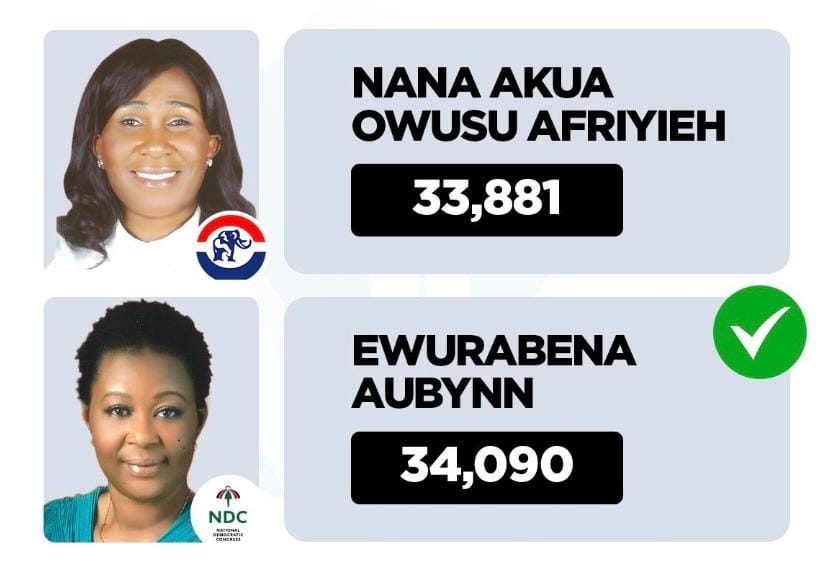
The NDC’s Ewurabena Aubynn emerged victorious with 34,090 votes, narrowly defeating NPP’s Nana Akua Owusu Afriyieh, who garnered 33,881 votes.
The result marks a major political shift in the constituency and delivers a symbolic blow to the NPP, which has controlled the seat since 1996.
This is only the second time the NDC has won the seat, and it arrives amidst internal disunity within the NPP and months of electoral and legal drama.
Background: Disputed Results and a Court-Ordered Rerun
The road to Friday’s rerun was paved with controversy.
The December 7, 2024, general election in Ablekuma North ended in a disputed outcome.
While the NPP claimed victory with an alleged margin of 414 votes, the credibility of the result was called into question after pink sheets from 19 polling stations were discovered to be either unsigned or missing crucial endorsements.
The Electoral Commission (EC) subsequently withheld its official declaration for the parliamentary seat, sparking weeks of political tension. A legal challenge led to a High Court ruling in January 2025, directing the EC to complete the collation.
However, further irregularities—including the discovery of unauthenticated pink sheets—compelled the EC to call for a rerun in the affected 19 polling stations.
NPP’s U-turn and Campaign Turmoil
Initially, the NPP’s leadership rejected the EC’s directive, describing the decision as a miscarriage of justice.
They threatened a boycott of the rerun and accused the EC of capitulating to NDC pressure.
But in a surprising turn of events, Nana Akua Owusu Afriyieh defied her party’s stance and filed her nomination to contest.
Her quiet return was eventually met with backing from the party’s grassroots and influential figures who feared the consequences of conceding the seat without a fight.
Meanwhile, the NDC capitalized on the NPP’s internal confusion.
Led by a vigorous regional and national campaign machinery, Ewurabena Aubynn positioned herself as a fresh alternative to the status quo—focusing on transparency, youth empowerment, and local development.
Her message resonated, especially among young voters and first-time constituents.
Chaos on Election Day
The rerun was conducted under intense security as both parties braced for a high-stakes showdown.
Unfortunately, the day was marred by violence and disruption in parts of the constituency.
Reports of assaults at polling centers shocked the nation.
Among those attacked were Nana Akua Owusu Afriyieh and former Fisheries Minister Hawa Koomson.
The media also came under fire. A journalist covering the polls was physically assaulted by a police officer in an incident captured on video.
The Ghana Police Service responded by interdicting the officer involved, promising further investigation.
Despite these incidents, voting proceeded largely without incident across the 19 polling stations. The Electoral Commission later declared the process free and fair.
A Political Earthquake in Greater Accra
Ewurabena Aubynn’s win signals more than just a constituency result—it underscores a deeper political transformation in the Greater Accra Region, where previously safe NPP seats are becoming increasingly competitive.
Reactions and the Road Ahead
Supporters of the NDC flooded the streets of Odorkor and Akweteman in celebration, chanting victory songs deep into the night.
Ewurabena Aubynn, speaking after her win, called for unity and pledged to work for all residents of Ablekuma North, regardless of party affiliation.
“This victory is for the people,” she said. “Now, the real work begins—bringing real development, accountability, and hope to our community.”
Her triumph officially ends months of uncertainty in the constituency and strengthens the NDC’s hand in Parliament. With her win, the NDC adds to its momentum ahead of the 2028 general elections, particularly in urban and peri-urban battlegrounds.
Whether the NPP can recover from this setback remains to be seen, but for now, the political tides in Ablekuma North have clearly shifted.


