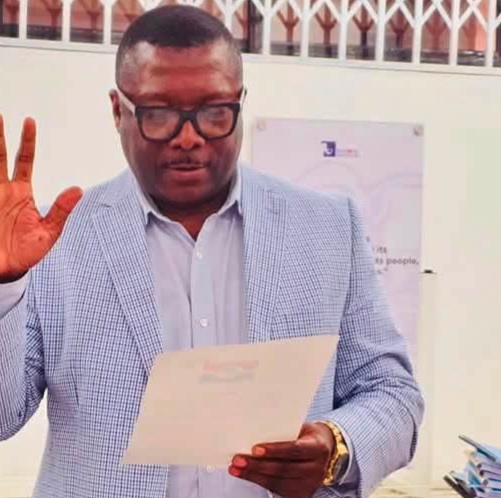
By Daniel Bampoe
The ruling National Democratic Congress (NDC) is embroiled in one of its most explosive internal crises in recent memory following allegations of widespread vote-buying and inducement of delegates during the Ayawaso East parliamentary primary on Saturday February 7, 2026.
In a strong response, the NDC Majority Caucus in Parliament has demanded the immediate annulment of the primary and called for the disqualification of candidates involved in unethical conduct, reflecting deep concerns over the party’s commitment to transparency and internal democracy.
In an official statement, Mahama Ayariga, Majority Leader and Leader of Government Business, explained that caucus members had reviewed reports of cash, electronics, food, and other material incentives given to delegates during the primary.
He described the alleged practices as a serious breach of ethical conduct, stating that they contradict the NDC’s long-standing “Reset Agenda”, which promised moral renewal, probity, and accountability in Ghanaian politics.
The caucus resolution directed the Functional Executive Committee of the NDC to:
Annul the Ayawaso East primary immediately.
Ban any candidate proven to have engaged in vote-buying or inducement from participating in future primaries following annulment.
The statement underscored the caucus’ commitment to restoring integrity to internal party elections and ensuring that democratic principles guide candidate selection.
The Candidates And Political Alignments
The primary was contested by five aspirants, with Baba Jamal Mohammed Ahmed, Ghana’s High Commissioner to Nigeria and alleged candidate of NDC National Chairman Asiedu Nketiah, narrowly defeating Hajia Amina Adam, widow of the late MP Mahama Naser Toure, who was said to have been backed by the Jubilee House under President John Mahama.
Other candidates are Mohammed Ramne, Dr Yakubu Azindow, and Najib Sani.
The contest highlighted deep factional divisions within the party.
Asiedu Nketiah, who is also positioning himself for a future NDC presidential bid, appears to be consolidating influence through Baba Jamal.
Meanwhile, President Mahama and his allies sought to support Hajia Amin Adam, whose candidacy was reinforced by sympathy following the late MP’s death and her status as a board member of Sankofa Gold Mines.
Allegations of Vote Buying
Reports and social media posts following the primary allege that candidates offered cash, television sets, food, and even motorbikes to delegates, raising questions about the fairness of the process:
Baba Jamal allegedly gave GH¢3,000, boiled egg, and a 32-inch TV set.
Hajia Amina Adam reportedly distributed GH¢3,000.
Mohammed Ramne allegedly paid similar amount and motorbikes among other items.
Videos circulating online appeared to show motorbikes being delivered days before the primary to electoral areas, suggesting that inducements were systematic and premeditated.
While all candidates reportedly engaged in some form of gift-giving, public and political criticism has focused on Baba Jamal due to his status as a serving public officer, prompting his recall from the High Commission in Nigeria by President John Mahama.
Critics, however, argue that singling him out while other candidates were not disciplined represents selective accountability.
Polling Predictions vs. Actual Results
The election results also defied pre-election polling, notably the projections of analyst Mussa Dankwa, who had predicted Hajia Amin Adam would secure approximately 50% of the votes, with Baba Jamal around 41%.
Instead, Baba Jamal won narrowly with 431 votes, compared to Hajia’s 399 votes, a deviation Dankwa attributed in part to alleged material inducements, noting: “It took bribes to defeat science and data.”
Other candidates trailed with Mohammed Ramne (88 votes), Dr Yakubu Azindow (45 votes), and Najib Sani (1 vote).
Party Response And Investigations
In response to the scandal, the NDC announced a three-member investigative committee, chaired by veteran party figure Kofi Totobi Quakyi, with Mahama Ayariga and lawyer Emefa Fugah serving as members.
The committee is tasked with reviewing allegations and recommending sanctions, with a report expected by February 10, 2026.
Despite the formation of the committee, public confidence remains low, as many view party-led investigations as insufficient, particularly given that senior cadres, including Asiedu Nketiah and Fifi Fiavi Kwetey, are closely associated with the implicated candidates.
Critics argue that this reinforces a perception of selective justice.
Government And OSP Involvement
The Office of the Special Prosecutor (OSP) has also entered the fray, initiating investigations into vote-buying and related acts, including allegations that Baba Jamal allegedly instigated attacks on an OSP officer during the primary.
While the presidency framed Baba Jamal’s recall as a disciplinary and procedural action, commentators note that no parallel action has been taken against other candidates, raising questions about consistency in upholding public service ethics.
Public Outcry And Political Fallout
The controversy has sparked intense reactions across social media and civil society, with many accusing the NDC of betraying the principles it championed while in opposition.
Observers highlighted the lavish nature of the primary, pointing to cash, gifts, and motorbikes as a betrayal of the party’s “Reset Agenda,” which promised moral and ethical governance..
Civic commentators have emphasized that every Ghanaian has a right to hold political actors accountable, warning that symbolic statements and procedural recalls cannot substitute for substantive enforcement of laws governing electoral conduct.