By Daniel Bampoe
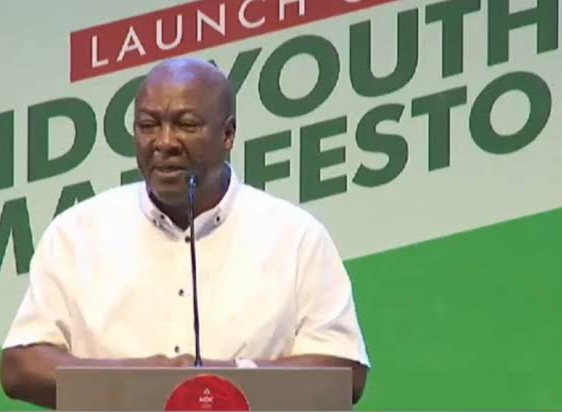
Ahead of the 2024 general elections, the National Democratic Congress (NDC) presented an ambitious Youth Manifesto promising 108 initiatives aimed at transforming the lives of the young people.
The manifesto outlined policies spanning jobs, education, health, digitization, agribusiness, and entrepreneurship, raising expectations among millions of Ghanaian youth.
After a year into the NDC administration, however, analysts and youth organizations have expressed disappointment, noting that the government has only managed to implement seven of the promised initiatives—and even these have had minimal impact on the intended beneficiaries.
The NDC’s Youth Manifesto included headline-grabbing promises such as implementing a 24-hour economy policy dubbed “Formula 1-3-3,” which aimed to ensure that the same jobs could be rotated among three shifts with three employees.
This policy, designed to generate employment opportunities for young Ghanaians, has yet to be rolled out.
Another cornerstone promise was to train one million youth in digital skills, equipping them for the high-demand tech sector.
Coupled with this was the Digital Jobs Initiative, which sought to create at least 300,000 skilled employment opportunities in the digital economy.
Yet, reports indicate that less than 5 percent of these objectives have been realized, leaving thousands of young Ghanaians without the promised skills and career pathways.
The “Adwumawura Programme,” envisioned as a start-up engine to mentor and track at least 10,000 youth-owned businesses annually, has also failed to take off.
Similarly, the “Jobs for You” (J4U) initiative, intended to deliver sustainable and well-paying jobs, remains largely unimplemented, sparking frustration among unemployed youth nationwide.
Other ambitious proposals, including the establishment of a Young Entrepreneurs Microcredit institution with a seed fund of GH¢750 million, the Youth Innovation and Industrial Parks (YIIP) Childspark Initiative, and a Youth-In-Export scheme to boost foreign demand for Ghanaian products, have seen no substantive progress.
Likewise, agricultural interventions such as the Land & Farm Bank Project—intended to provide young farmers with land, inputs, and technical support—remain on paper.
In the education and health sectors, the NDC also promised reforms that could directly affect youth welfare, including the cancellation of the licensure examination for teacher trainees, prompt posting of trained health professionals and teachers, and free Wi-Fi access in all public second-cycle and tertiary institutions. None of these pledges has been fully implemented to date.
The manifesto also committed to initiatives such as the Ghana Green Jobs Project, a migration framework to export surplus Ghanaian labor, and enforcement of rent control regulations limiting advance rent payments to six months.
These measures, aimed at improving economic opportunities and living standards for youth, remain largely unrealized.
Critics argue that the administration’s failure to deliver on even 10 percent of its Youth Manifesto not only undermines the government’s credibility but also leaves young Ghanaians vulnerable in a challenging economic climate.
While government officials have cited broader macroeconomic improvements, including a perceived stabilization of the cedi, these claims ring hollow for youth who continue to face unemployment, limited access to credit, and few opportunities for skill development.
Youth advocacy groups are now calling for urgent accountability, insisting that the government outline a clear, actionable plan to implement the outstanding 101 promises.
“The youth supported the NDC in good faith, expecting transformative policies. Yet, two years in, most of these commitments remain unfulfilled,” said a representative of the National Youth Forum.
However, as Ghana enters 2026, the National Democratic Congress government faces mounting pressure to demonstrate tangible results for young people, whose engagement and productivity are crucial for national development.
Without rapid intervention, the gap between manifesto promises and real-world impact risks alienating a generation of Ghanaians who are already questioning the effectiveness of political pledges.