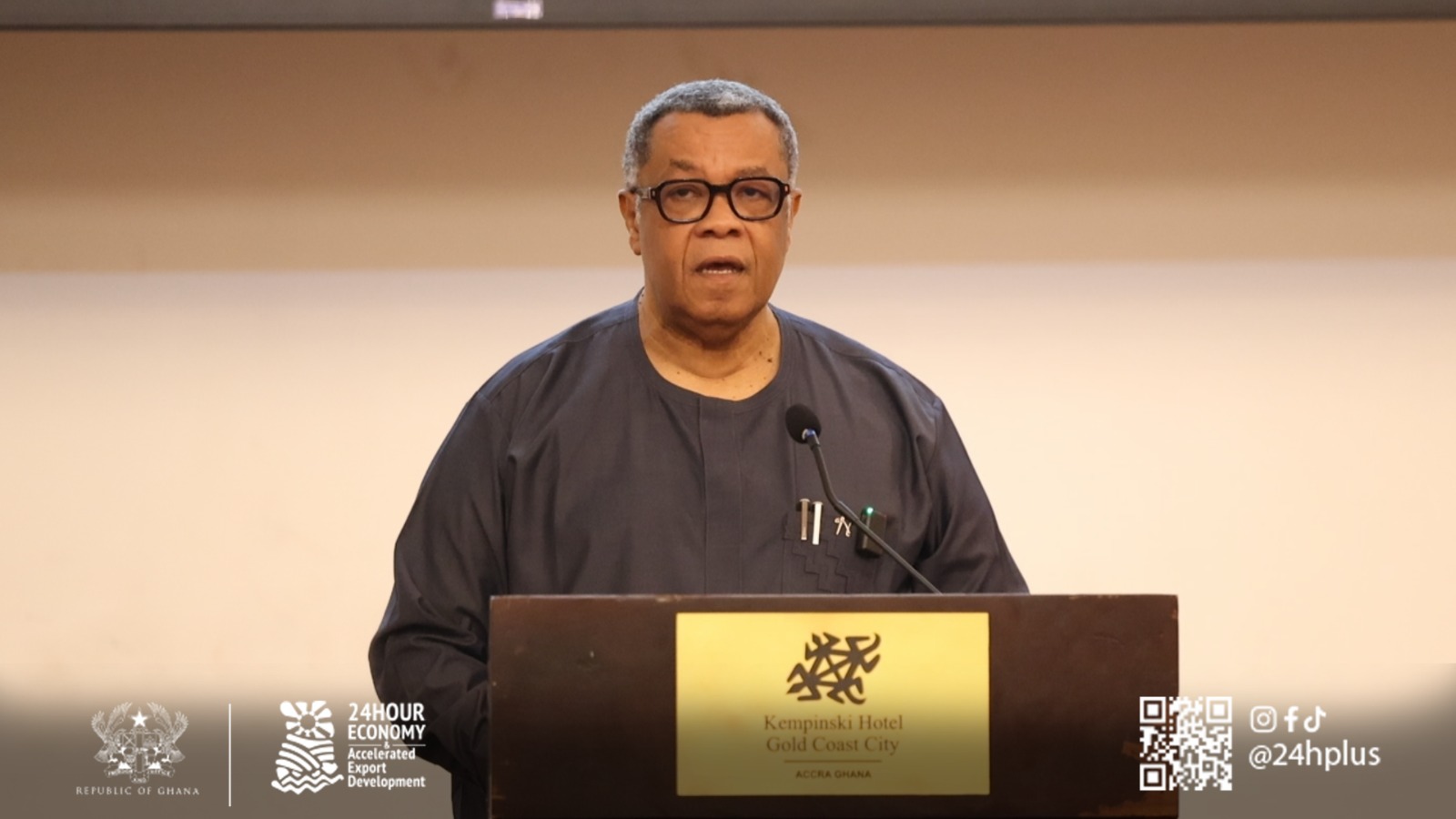
BY GRACE ZIGAH
Presidential Adviser on the 24-Hour Economy Goosie Tanoh has sought to distance the 24-Hour Economy Secretariat from the government’s controversial 24-Hour Markets initiative, insisting that his outfit has neither the authority nor the responsibility to determine where the markets are constructed or how the projects are implemented.
Goosie Tanoh clarified on Wednesday, August 19, 2026, amid growing public and legal controversy surrounding the implementation of the proposed markets, particularly disputes over the demolition of existing structures at some locations earmarked for the projects.
According to him, the apparent association between the two initiatives has created confusion, with the 24-Hour Economy Secretariat increasingly being held responsible for decisions over which it says it has no control.
“The 24-Hour Markets Project is not our responsibility. We are not involved in market development. We don’t know anything about that,” Tanoh told journalists at a media briefing.
His comments represent an attempt to draw a firm line between the government’s broader 24-Hour Economy programme, which falls under his mandate, and the separate 24-Hour Markets initiative being implemented through local government structures.
Goosie disclosed that the Secretariat had already been dragged before the courts over disputes arising from the demolition of buildings connected to the market projects.
“We have been sued for the demolition of buildings. Something that we have nothing to do with. Our lawyer is going to make an application to get our names off those suits,” he said.
He subsequently explained that the legal responsibility and implementation of the markets rest with the Ministry of Local Government, Chieftaincy and Religious Affairs and the district assemblies.
According to Goosie Tanoh, the projects are being financed through the District Assemblies Common Fund, meaning that the 24-Hour Economy Secretariat has no jurisdiction over the allocation or development of the markets.
“The markets are funded by the District Assemblies Common Fund. So, we have no jurisdiction over that,” he stressed.
In a further indication of the extent of the dispute, Goosie Tanoh said the Secretariat had been sued on four or five occasions in connection with market projects despite, in his view, having no formal responsibility for them.
He said the Secretariat’s lawyers were preparing to seek its removal from the list of defendants in the cases.
“Our lawyer is moving a motion in November to get us to be removed from the defendant’s list because we have no jurisdiction. We have no status in the matter,” he said.
The controversy has emerged as the government moves to establish 24-hour markets in districts across the country as part of an initiative associated with its broader 24-Hour Economy agenda.
The planned markets have attracted attention over the selection of locations, the involvement of district authorities and the demolition of existing structures at some proposed sites.
The use of the 24-Hour Economy branding on the markets appears to have contributed to the perception that the 24-Hour Economy Secretariat is directly responsible for the projects.
Tanoh, however, said the branding should not be interpreted as giving his Secretariat control over the projects.
“Although they use a 24-hour logo, we have no control over the markets. We are not part of deciding where it goes, and so on and so forth,” he explained.
Despite distancing his office from the implementation of the markets, Tanoh argued that the initiative could complement the objectives of the broader 24-Hour Economy programme.
He said properly designed markets could strengthen agricultural supply chains, particularly by providing storage and cooling facilities for perishable agricultural products.
Goosie Tanoh pointed to post-harvest losses as one of the major challenges confronting Ghana’s agricultural sector, estimating losses across the supply chain at between 30 and 40 percent.
“If you have cooling facilities, then your vegetables, your perishables, and so on, have somewhere to be stored so that we don’t lose or add to the 30% to 40% post-harvest losses that we have within the supply chain,” he said.