BY Daniel Bampoe
What was intended to be a symbolic show of unity ahead of the New Patriotic Party’s (NPP) January 31 presidential primary instead descended into open tension, public disagreement, and sharp exchanges among leading aspirants, underscoring deep-rooted divisions within the party a year after its 2024 electoral defeat.
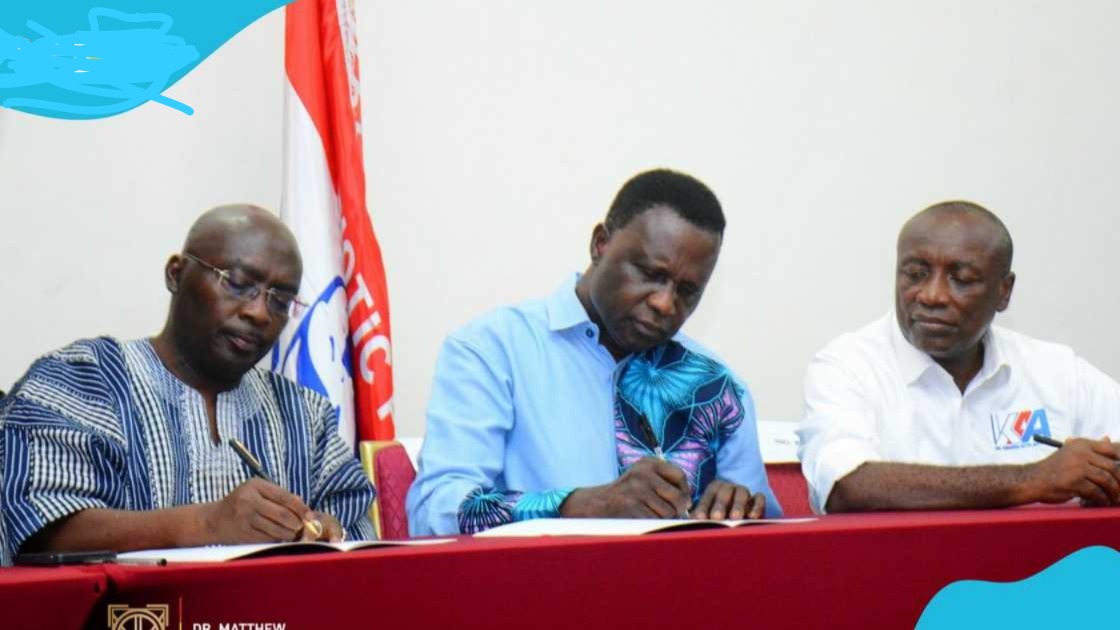
The peace pact signing ceremony, organised by the party’s Presidential Elections Committee (PEC) to ensure a calm, credible and unified primary process, was thrown into disarray when former Assin Central MP Kennedy Ohene Agyapong publicly resisted signing the document, momentarily halting proceedings and drawing the attention of party elders, security officials and the media.
Ken Agyapong’s Protest
Kennedy Agyapong insisted that his stance was not a refusal to sign but a demand for clarification.
He objected strongly to Clause Two of the Memorandum of Understanding (MoU), which binds all aspirants to accept the outcome of the January 31, 2026, presidential primary “irrespective of the result.”
According to Agyapong, the clause failed to provide firm guarantees against alleged electoral irregularities.
He demanded explicit assurances that votes from polling centres found to have experienced intimidation, manipulation, or malpractice would be annulled, citing what he described as his own past experiences in party elections where agents were intimidated, and some polling stations recorded zero votes.
His campaign team further claimed that the final document “woefully skipped” a clause that had allegedly been verbally agreed upon earlier, which would have mandated the cancellation of results from compromised voting centres.
They also maintained that the pact had not been circulated to them in advance of the ceremony, thereby denying them the opportunity to review or correct what they described as errors.
At the height of the standoff, Agyapong openly criticised fellow aspirants for appending their signatures without, in his view, carefully reading the document.
PEC And Bawumia Camp Push Back
The dramatic protest immediately drew a sharp rebuttal from the camp of former Vice President Dr Mahamudu Bawumia.
His Communications Director, Dennis Miracles Aboagye, described the episode as “needless self-embarrassment,” insisting there was no error in the document.
According to Dennis Aboagye, the Presidential Elections Committee circulated copies of the MoU to all aspirants on Sunday, January 18, 2026, including direct transmission to Kennedy Agyapong and members of his campaign team.
He stressed that Clause Two — acceptance of the election results — was the most critical provision of the pact and non-negotiable.
“The drama we witnessed was Hon. Ken’s insistence on removing or altering Clause Two to suit only him,” Aboagye stated, adding that if every aspirant demanded changes to the pact at the ceremony, the entire exercise would have collapsed.
The PEC chairman and secretary later corroborated this account, publicly stating that no error existed in the MoU as speculated at the event.
Bryan Acheampong Questions Commitment To Unity
The controversy deepened in the days that followed when Dr Bryan Acheampong, MP for Abetifi and former Minister of Food and Agriculture, openly questioned Kennedy Agyapong’s commitment to party unity.
Addressing party supporters, Acheampong recounted that Kennedy Agyapong had “squeezed his face in anger” and openly declared he would not sign the pact.
He dismissed claims of document errors, stating that all aspirants had sufficient time to study the MoU and that he personally read and signed exactly where required.
Bryan Acheampong argued that refusal to sign such a pact undermines trust and warned that anyone unwilling to commit to peace before the primary could not be relied upon to support unity after defeat.
“If you refuse to sign, your campaign is gone,” he stated bluntly, adding that the peace pact was essential to preventing chaos within the party.
When asked whether he was confident of victory after signing the pact, Acheampong responded emphatically: “Hands down.”
Kwabena Agyepong’s Cautious Endorsement
Former NPP General Secretary Kwabena Agyei Agyepong, also a presidential hopeful, adopted a more reflective but critical tone.
While he confirmed his readiness to sign the pact, he warned that “too much water has passed under the bridge” for the agreement alone to heal the party’s wounds.
Speaking on Peace FM’s Kokrokoo, Kwabena Agyepong lamented the party’s failure to rein in supporters who had crossed red lines with insults and personal attacks long before the pact was introduced.
He argued that unity is demonstrated through conduct, not signatures, and questioned the effectiveness of ad hoc committees formed late in the process.
He recalled previous peace agreements that failed to prevent post-primary defections, stressing that moral renewal and disciplined leadership mattered more than ceremonial documents.
Bawumia’s Visible Discomfort
Meanwhile, at the ceremony Dr Bawumia appeared visibly unhappy during the signing ceremony.
His supporters cited the party’s failure to sanction what they described as persistent personal attacks against him, particularly from Kennedy Agyapong’s camp.
They also raised concerns about what they viewed as an uneven playing field, including the ban on proxy voting, which they argue disenfranchised supporters living abroad.
Insiders said the former Vice President attended the ceremony primarily in the interest of party unity, despite feeling aggrieved by unresolved grievances.
With the five aspirants — Kennedy Ohene Agyapong, Dr Mahamudu Bawumia, Dr Bryan Acheampong, Dr Yaw Osei Adutwum, and Kwabena Agyei Agyepong — locked in a fiercely contested race, the events of January 22 have raised fresh questions about whether the party can truly close ranks after the ballots are counted.