By Nadia Ntiamoah
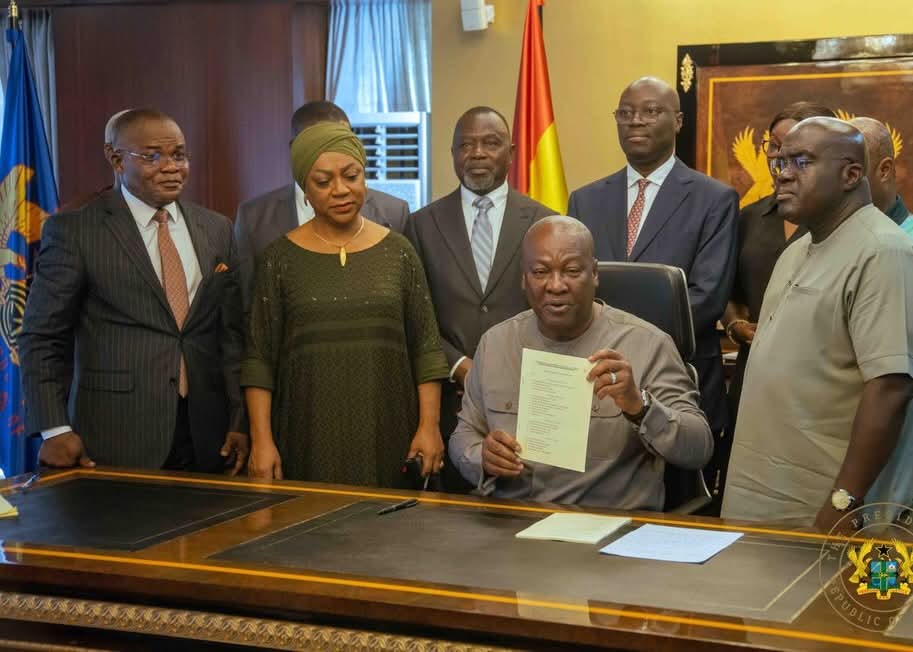
President John Dramani Mahama has assented to three key pieces of legislation aimed at reforming Ghana’s legal education system, strengthening public financial accountability, and enhancing governance structures in the country.
The bills — the Legal Education Act, the Value for Money Office Act, and the Governance Advisory Council Act — were recently passed by Parliament and signed into law by the President before his departure from Accra to Nairobi, Kenya.
Announcing the development, President Mahama described the laws as transformative measures designed to strengthen state institutions and protect the interests of Ghanaians through improved transparency, accountability, and institutional reforms.
According to the President, the Legal Education Act marks a significant turning point in the legal training system by ending the long-standing monopoly of the Ghana School of Law over professional legal education.
For years, access to professional legal education in Ghana has generated widespread public debate, particularly due to the limited admissions capacity of the Ghana School of Law despite increasing numbers of LLB graduates from universities across the country.
President Mahama stated that the new law will introduce competition into legal education by allowing more institutions to offer professional legal training while maintaining high academic and professional standards.
He explained that the reform is expected to create more opportunities for aspiring lawyers who have struggled over the years to gain admission into the professional law programme.
“The Legal Education Act is a game-changer for our justice system,” the President stated, adding that the law will ensure broader access while preserving quality legal education.
The President also signed the Value for Money Office Act into law, a measure government says is intended to tighten oversight over public expenditure and major state contracts.
The establishment of the Value for Money Office forms part of broader efforts by the Mahama administration to address concerns over inflated government contracts, cost overruns, and wasteful spending in the public sector.
Successive governments in Ghana have faced criticism over procurement irregularities and the high cost of some public infrastructure projects, with civil society organisations and anti-corruption advocates consistently calling for stronger expenditure monitoring mechanisms.
President Mahama said the new office will serve as a critical accountability institution tasked with reviewing major government contracts and expenditures to ensure that public funds are used efficiently.
According to him, the office will become the government’s “frontline defence” against financial waste and unnecessary spending, insisting that every cedi spent by the state must deliver value to the Ghanaian people.
In another major governance reform, the President assented to the Governance Advisory Council Act, which establishes an independent body to support accountability and anti-corruption efforts within the public sector.
The Governance Advisory Council was one of the governance-related promises championed by President Mahama as part of his broader agenda to restore public confidence in state institutions and improve transparency in leadership.
The President noted that the council would help strengthen public trust in governance by ensuring that leadership remains accountable to citizens while suinitiatives.4oing anti-corruption initiatives.