

By Daniel Bampoe
Fresh political controversy has engulfed Parliament following the reported arrest and detention of the Independent Member of Parliament for Asante Akyem North, Kwame Ohene Frimpong, in the Netherlands over an alleged international financial crime.
His arrest is linked to the United States Federal Bureau of Investigation (FBI) which has been on the heels of the embattled MP for some time.
The development, which has dominated social media discussions and political debate last night, emerged after Parliament officially confirmed that the legislator had been detained at Schiphol Airport in Amsterdam.
In a statement signed by the Clerk to Parliament, Ebenezer Ahumah Djietror, Parliament disclosed that the Rt. Hon. Speaker and the leadership of the House were already in contact with Ghana’s diplomatic mission in The Hague to obtain detailed information surrounding the incident.
“It has come to the attention of Parliament that the Hon Member for Asante Akyem North Constituency, Mr. Kwame Ohene Frimpong, has been detained at the Schiphol Airport, Amsterdam in the Netherlands,” the statement said, adding that the public would be updated appropriately as more verified information becomes available. 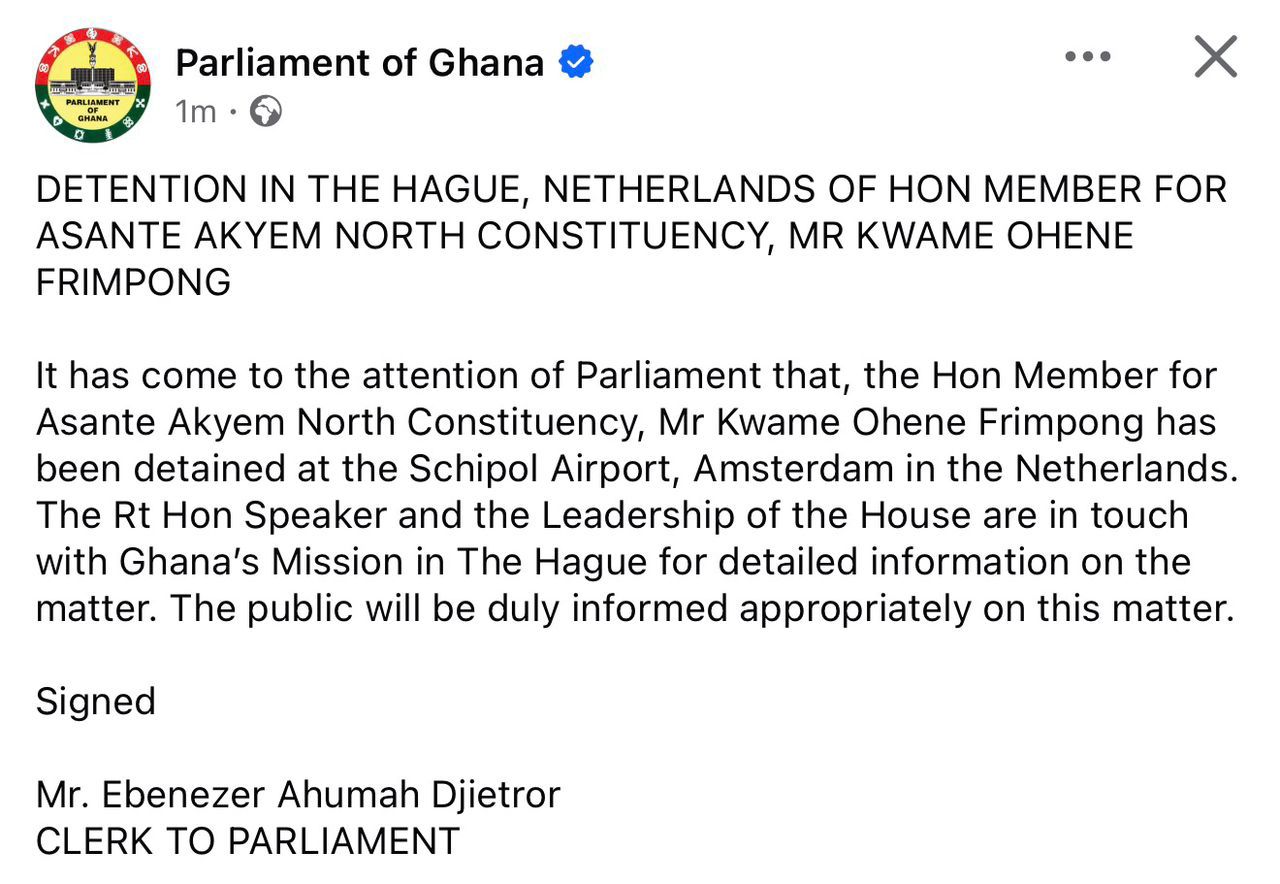
The incident followed widespread rumours on Facebook and other social media platforms, where users circulated claims about the MP’s alleged arrest abroad.
The Independent MP, currently sits with the National Democratic Congress (NDC) Majority Caucus in Parliament.

Kwame Ohene Frimpong entered Parliament after contesting and winning the Asante Akyem North parliamentary seat as an Independent candidate during the 2024 general elections.
His victory was considered one of the major political upsets in the Ashanti Region, traditionally regarded as a stronghold of the New Patriotic Party (NPP).
Following his election, he later aligned himself with the NDC Majority Caucus in Parliament, strengthening the governing side’s numerical advantage in the House.
Ironically, in February 2026, the same MP tabled a Private Member’s Bill in Parliament aimed at strengthening accountability, transparency, and lawful regulation of political financing within the democratic system.
The proposed legislation sought to tighten oversight on campaign financing and promote ethical standards in political fundraising and expenditure.

However, reports indicate that the MP is under investigation in connection with alleged financial crimes involving money laundering and suspected online romance scams amounting to nearly US$32 million.
According to sources familiar with the investigation, authorities in the Netherlands are reportedly collaborating with investigators linked to the FBI as part of a broader international probe believed to have lasted for more than a year.
The Asante Akyem North MP was reportedly picked up over the weekend upon arrival in the Netherlands.
The latest development has also revived public attention on a separate legal issue involving the MP in the United Kingdom.
Reports indicate that on August 14, 2025, he was allegedly arrested by British police following a domestic violence complaint reportedly filed by his wife, who resides in the UK with their children.
Sources claim the complainant accused the MP of assault and battery.
Following that incident, British authorities reportedly informed the Ghana High Commission in the United Kingdom after the legislator identified himself as a Ghanaian Member of Parliament.
The matter, according to reports, remains pending before UK authorities.
Meanwhile, the MP’s detention in the Netherlands has triggered intense constitutional debate over whether his arrest could lead to a by-election in the Asante Akyem North Constituency.
Political commentators have pointed out that under the constitutional framework, the arrest of a sitting Member of Parliament does not automatically result in the loss of his parliamentary seat or trigger a by-election.
The issue has drawn comparisons to the famous case involving former Nkoranza North MP, Eric Amoateng, who was arrested in the United States in 2005 over drug trafficking allegations.
Despite the gravity of the charges at the time, his parliamentary seat was not immediately declared vacant following his arrest.
It was only after his prolonged absence from parliamentary proceedings that constitutional processes were invoked, eventually leading to a by-election on March 13, 2007, which brought Derek Oduro into Parliament.
Under Article 97(1)(c) of the1992 Constitution, a Member of Parliament may lose his seat if he is absent from 15 sittings of Parliament without written permission from the Speaker and fails to provide a reasonable explanation to the Committee on Privileges.
This constitutional provision is further reinforced by Order 18 of the Standing Orders of Parliament, which empowers the Speaker to declare a parliamentary seat vacant only after the constitutional conditions for vacancy have been satisfied.


