By Daniel Bampoe
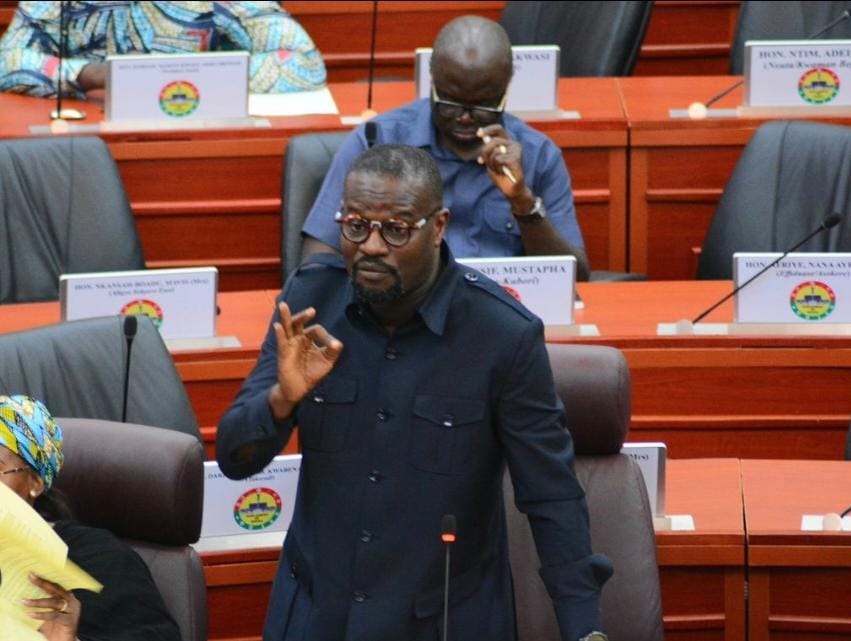
The Minority Chief Whip and Member of Parliament for Nsawam-Adoagyiri, Frank Annoh-Dompreh, has called for an urgent, evidence-based transformation of Ghana’s cities, warning that unplanned urbanization, poor sanitation, and unchecked pollution are pushing the country toward a major environmental and public health crisis.
Delivering a statement on the floor of Parliament titled “Transforming Urban Ghana: Evidence-Based Solutions for Sustainable, Clean, and Resilient Cities,” Annoh-Dompreh said Ghana stands at a defining crossroads where development can no longer be measured merely by skyscrapers or highways, but by the harmony achieved between humanity and nature.
He observed that once-vibrant cities like Accra, Kumasi, Tamale, and Takoradi are now grappling with rising congestion, worsening air quality, and rapid environmental decline — problems he described as the result of the success outpacing its planning capacity.
According to data from the Ghana Statistical Service (GSS), more than 56.7% of the population currently lives in urban areas, up from 50.9% in 2010.
That figure is projected to exceed 60% by 2030, putting unprecedented pressure on land, water, housing, and infrastructure. While cities account for over 70% of the country’s GDP, they also generate more than 12,000 tonnes of waste daily, of which less than 70% is collected and a smaller fraction properly treated.
Frank Annoh-Dompreh referenced World Bank estimates showing that poor sanitation, pollution, and mismanaged waste cost Ghana about 3% of its GDP every year — a loss that directly impacts health, productivity, and tourism.
He further cited data from the Environmental Protection Agency (EPA) attributing about 40% of Accra’s PM2.5 air pollution to vehicle emissions, making respiratory diseases one of the leading causes of outpatient cases in Greater Accra.
“If we continue along this trajectory,” he cautioned, “Accra could have over seven million residents by 2040, trapped in worsening congestion, floods, and rising temperatures. The cost to our economy and our children’s wellbeing will be incalculable.”
The Nsawam-Adoagyiri MP urged Ghana to learn from international best practices that have successfully tackled similar urban crises. He pointed to Kigali, Rwanda, which transformed from a city of chaos into one of Africa’s cleanest capitals through strict urban planning, effective sanitation enforcement, and citizen involvement.
He also cited Singapore’s “City in Nature” initiative — a policy that integrates green design, public transport electrification, and “15-minute neighbourhoods,” where residents live, work, and relax within walking distance. Ghana, he argued, could replicate this model by introducing mandatory green quotas in new building projects and linking urban planning to climate action and public health.
Drawing from Copenhagen’s example in Europe, where cycling accounts for 35% of daily trips, Annoh-Dompreh called for heavy investment in pedestrian-friendly infrastructure and Bus Rapid Transit (BRT) systems to ease congestion, cut emissions, and improve the quality of urban life.
Outlining a blueprint for Ghana’s path forward, the MP proposed several actionable measures. He called for:
Increasing urban tree canopy cover by 10–15% and reserving at least 12% of new developments for green and open spaces;
Modernizing tro-tro fleets and piloting electric buses on key routes such as Kasoa–Accra and Adum–Sofoline;
Decongesting public spaces by establishing multi-level market complexes and peripheral terminals supported by feeder buses;
Promoting the “15-minute city” concept to reduce health inequalities by integrating clinics, schools, and sanitation within walking distance; and
Transitioning from a collection-only waste model to a circular waste economy that creates green jobs and recycles 50% of solid waste by 2030.
Frank Annoh-Dompreh emphasized that the future of Ghana’s cities will depend on “the courage of leadership, the discipline of governance, and the participation of citizens.”
He urged Parliament and all levels of government to commit to a national agenda for “Green, Healthy, and Inclusive Cities” that balances economic ambition with environmental stewardship.
“History teaches us that cities are not just physical spaces; they are moral statements about who we are and what we value,” he said. “Kigali has shown that civic discipline can transform a nation’s image. Singapore has shown that foresight and planning can turn limitations into a global advantage. And Copenhagen has shown that sustainability and prosperity can thrive side by side.”
He concluded his address with a passionate appeal to leadership: “Let this generation be remembered as those who refused to accept decay as destiny. Let us build cities that breathe, move, and heal — for in the end, the true greatness of a nation lies not in its monuments of steel, but in the livability of its cities and the sustainability of its soul.”