
BY Daniel Bampoe
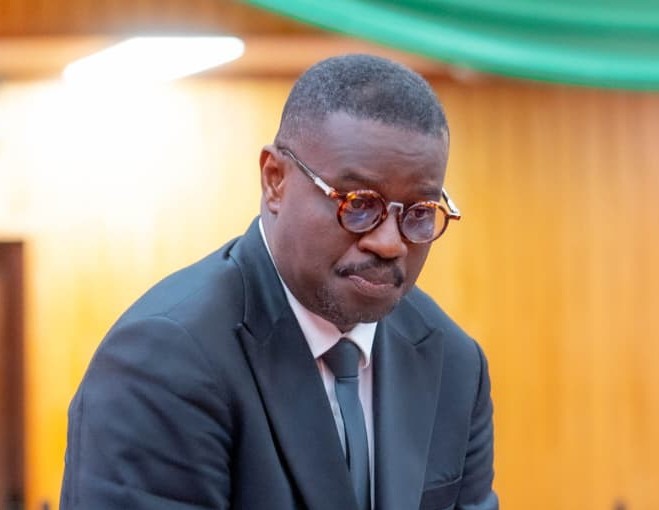
The Minority Chief Whip and Member of Parliament for Nsawam-Adoagyiri, Hon. Frank Annoh-Dompreh, has expressed dissatisfaction with the proposed parliamentary business for the coming week, describing the scheduling of 53 questions as inadequate when more than 200 questions filed by Members of Parliament remain unanswered.
Speaking on the floor of Parliament on Friday, November 6, 2026, during deliberations on the Business Statement for the ensuing week, Annoh-Dompreh challenged the Majority Leader to review the proposed arrangement and increase the number of questions scheduled for ministers to answer.
According to him, although the proposed 53 questions represented an improvement over previous arrangements, the figure remained insufficient considering the growing number of outstanding parliamentary questions and the limited time available before the House becomes occupied with the consideration of the national budget.
Addressing the Speaker and the Majority Leader, the Minority Chief Whip argued that Parliament had previously demonstrated its capacity to handle approximately 70 questions within a week and therefore saw no justification for limiting the coming week’s business to 53 questions.
“Mr. Speaker, I see an arrangement for some 53 questions to be dispensed of for the ensuing week. Well, comparing this to what was presented before, it appears to be good, but not good enough,” he stated.
He reminded the House that parliamentary questions constitute an important mechanism through which elected representatives demand explanations from ministers on government policies, programmes, projects and matters affecting their constituencies.
Annoh-Dompreh stressed that the outstanding questions had been filed by MPs from both sides of the political divide and should therefore not be treated as an issue affecting only the Minority Caucus.
He insisted that every question properly submitted by a Member of Parliament deserved attention and that the government, through its ministers, had a responsibility to provide the necessary responses.
According to him, Parliament could not afford to allow the backlog to continue growing, particularly when the House was approaching a demanding period of budgetary deliberations.
“We have over 200 questions outstanding, and we don’t intend to forget about these questions. These are very important questions filed by members, and some are coming from their side. All these questions must be dispensed of. So, 53 questions, we can do more than that,” he declared.
The Minority Chief Whip consequently urged the Majority Leader to engage the Table Office of Parliament to identify questions that were ready for consideration, including those previously rescheduled following written correspondence from various ministries.
He explained that some ministries had earlier requested changes to the dates on which their ministers were expected to appear before Parliament to answer questions, but maintained that such questions could now be reconsidered for inclusion in the coming week’s parliamentary business.
Annoh-Dompreh suggested that the Majority Leader should take advantage of Order 71 of the Standing Orders of Parliament, which he cited as providing an opportunity for the presentation of a supplementary Business Statement.
He argued that such an arrangement would enable the House to expand the number of questions scheduled for the week without necessarily disrupting the existing parliamentary programme.
The Nsawam-Adoagyiri legislator further warned that the anticipated presentation of the national budget on Thursday, November 12, 2026, would significantly affect the time available for ministers to respond to parliamentary questions.
He explained that following the budget presentation, Members of Parliament would be expected to participate in a post-budget workshop before proceeding to the detailed consideration of the government’s financial proposals.
Annoh-Dompreh supported the position expressed by a fellow legislator, whom he referred to as Hon. Buama, that the post-budget workshop should be held within the parliamentary chamber to serve its intended purpose.
He further drew attention to the volume of parliamentary business associated with the budget approval process, indicating that more than 50 motions would have to be considered as Parliament worked towards the passage of the Appropriation Bill.
According to him, once the House enters that stage of the budget process, the available parliamentary time will become increasingly constrained, making it difficult to accommodate the large number of outstanding questions.
The Minority Chief Whip therefore cautioned that failure to address the backlog immediately could result in several questions remaining unanswered for a prolonged period.
“Once the budget is presented on Thursday and we depart for the post-budget workshop, we have over 50 motions to be taken towards the passage of appropriation. So, when we get to that time, we can’t do questions. The implication is that the outstanding questions will suffer,” he explained.
He maintained that the Minority would continue to insist on ministers appearing before Parliament to answer questions submitted by MPs, arguing that the questions should not be sidelined because of competing government business.
“We insist these questions must be answered by the ministers. So, 53 is not good enough,” Annoh-Dompreh emphasised.
He consequently appealed to the Majority Leader to consult the Table Office, identify additional questions ready for consideration and return to the House with a supplementary Business Statement under Order 71.
Beyond the backlog of parliamentary questions, Annoh-Dompreh also raised concerns about the management of sitting hours, questioning the practice of adjourning parliamentary proceedings earlier than expected when significant business remained outstanding.
He observed that since the commencement of the current sittings, the House had on some occasions adjourned early despite the pressing parliamentary workload.
According to him, Parliament sometimes commenced business after delays, only for proceedings to be brought to an early close, a situation he suggested was inconsistent with the volume of work awaiting consideration.
“Since we came, we’ve been adjourning earlier than we should. We start business, two hours, no business, and we want to adjourn. We’ve been adjourning earlier than planned,” he complained.
His remarks brought renewed attention to the organisation of parliamentary business and the need for effective coordination between the Majority leadership, the Table Office, government ministries and the various parliamentary committees.
Parliamentary questions remain an important part of the legislature’s oversight responsibilities, allowing MPs to seek information and explanations from ministers on matters of public concern. The process also provides an opportunity for constituency representatives to raise issues involving public infrastructure, government expenditure, service delivery and the implementation of national policies.
Under Ghana’s parliamentary system, the Business Committee plays a central role in determining the business to be transacted by the House, while the Majority leadership coordinates government business and works with the relevant parliamentary offices to facilitate proceedings.
The annual budget period traditionally places additional demands on Parliament as MPs examine government revenue and expenditure proposals, participate in committee deliberations and consider the financial measures required for the ensuing fiscal year.


