By Issah Olegor
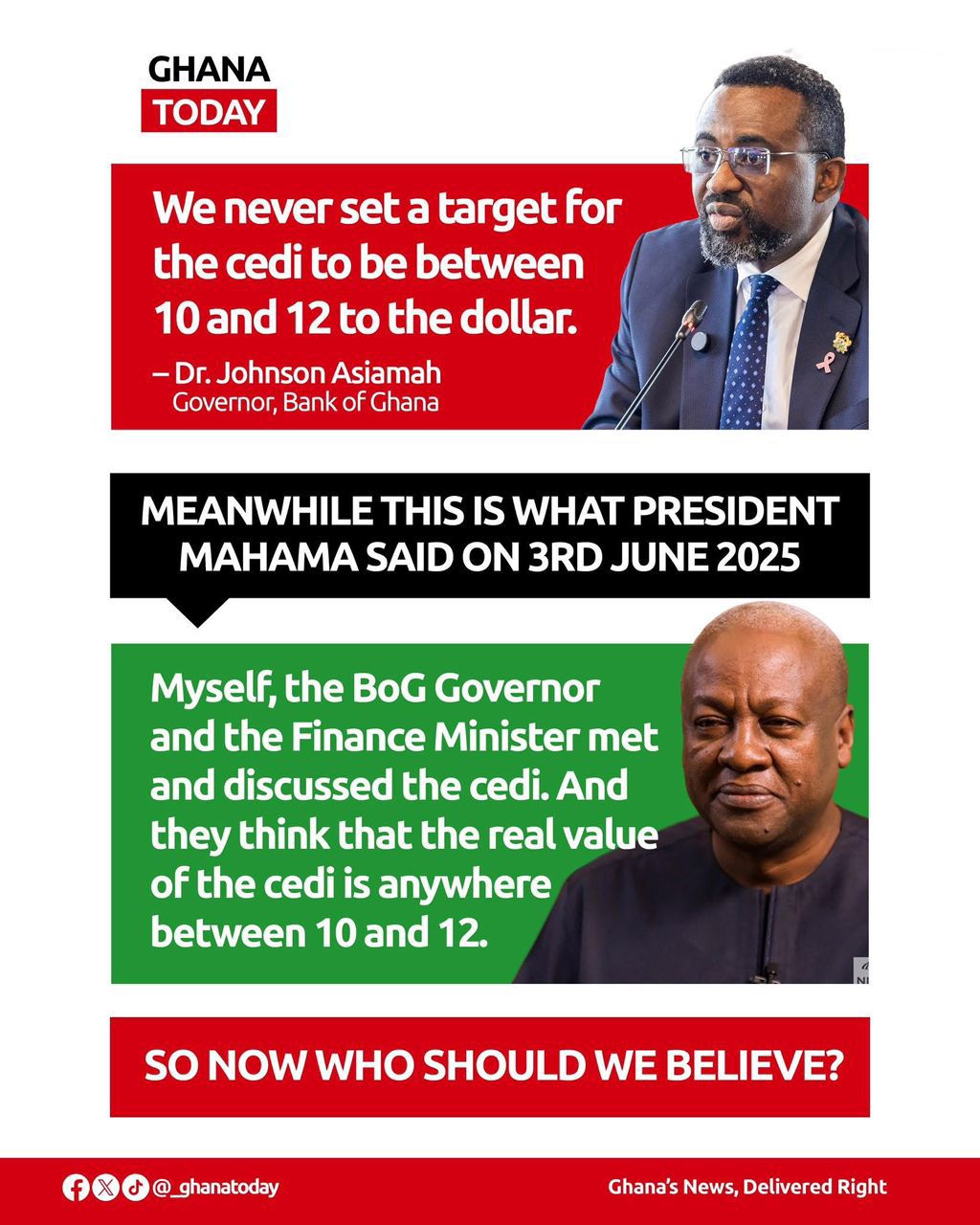
A policy divergence has emerged between the Bank of Ghana and President John Dramani Mahama over the appropriate valuation of the Ghana cedi, following comments suggesting the currency should trade within a defined band of GH¢10 to GH¢12 to the US dollar.
The central bank, through Governor Dr. Johnson Pandit Asiama, has firmly rejected claims that it operates with any such exchange rate target, insisting that Ghana maintains a managed floating exchange rate regime where the cedi is allowed to adjust based on market conditions.
Mahama’s ‘Fair Value’ Argument
The debate traces back to remarks made by President Mahama during a policy dialogue with the Federation of Associations of Ghanaian Exporters (FAGE) in June 2025, where he argued that the cedi should stabilise within a GH¢10–GH¢12 range to strike a balance between imports and exports.
According to the President, an overly strong cedi would make imports cheaper but undermine export competitiveness, while an excessively weak currency would fuel inflation and erode purchasing power.
“Anything between 10, 11 and 12 as a band where the cedi operates will be a fair value—both to encourage our exports and at the same time not make imports so cheap that they flood our markets,” he said, adding that discussions involving himself, the central bank governor and the finance minister had pointed to that range as a reasonable equilibrium.
His comments came at a time when the cedi had begun appreciating sharply, supported by improved macroeconomic conditions, strong gold prices, and central bank interventions in the foreign exchange market.
BoG Runs From Exchange Rate Targeting
However, in a strong clarification, Governor Asiama dismissed suggestions that the central bank had adopted or endorsed any specific exchange rate band.
“We never set a target for the cedi to be between 10 and 12 to the dollar,” he stated, addressing what he described as widespread speculation in the market.
The Governor reiterated that the Bank of Ghana’s policy framework is not built on fixing or targeting the exchange rate, but rather on containing excessive volatility while allowing the currency to respond to economic fundamentals.
This position aligns with earlier central bank communications that emphasised flexibility in the exchange rate as a key tool for absorbing external shocks and maintaining macroeconomic stability.
Cedi Recovery And Policy Reforms
The disagreement comes against the backdrop of Ghana’s broader economic recovery in 2025, when the cedi recorded one of its strongest performances in recent years.
The currency’s appreciation was supported by a combination of tight monetary policy, fiscal consolidation, improved reserve accumulation, and favourable commodity prices—particularly gold.
The Bank of Ghana also implemented a series of foreign exchange market reforms, including auction-based dollar sales and tighter controls on speculative positions, which helped stabilise the currency and rebuild confidence.
At the same time, international analysts such as Fitch Solutions revised Ghana’s currency outlook positively, citing stronger fundamentals and improved external balances.
The firm projected a more stable cedi trajectory, supported by export earnings and easing inflationary pressures.
Balancing Exports, Imports And Stability
While the central bank rejects a fixed band, the underlying concern raised by President Mahama—maintaining a balance between export competitiveness and import affordability—remains central to the economic policy debate.
A stronger cedi reduces the cost of imports such as fuel and raw materials, helping to ease inflation.
However, it can also make Ghanaian exports less competitive on the global market, particularly for sectors like agriculture and manufacturing.
Conversely, a weaker currency supports exports but increases the cost of living and production.