BY Daniel Bampoe
A British actress who once appeared in an EastEnders spin-off and starred alongside Hollywood action actor Jason Statham has found herself at the centre of a major international drug trafficking investigation after Australian authorities charged her over an alleged attempt to smuggle hundreds of kilograms of methamphetamine into the country.
Emaa Hussen, a 34-year-old actress known for her role as Naz in the EastEnders spin-off series E20, appeared before a Sydney court after being accused of participating in a sophisticated drug importation scheme involving a shipment originating from Ghana.
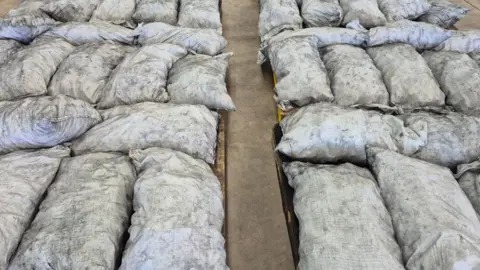
Australian authorities allege that Hussen, together with an Adelaide-based couple, attempted to import approximately 320 kilograms of methamphetamine concealed within bags of charcoal transported in shipping containers from Ghana to Australia.
According to investigators, the seized narcotics had an estimated street value of approximately A$296 million (US$208 million), making it one of the most significant methamphetamine seizures recorded in recent months.
The actress has been charged with attempting to import a commercial quantity of methamphetamine into Australia, an offence that carries a maximum penalty of life imprisonment under Australian law.
Court records indicate that Hussen was refused bail during an earlier hearing and remains in custody pending further legal proceedings.
She is expected to reappear before the court in August as investigations continue.
Before her arrest, Hussen was known within the British entertainment industry for her role in E20, a spin-off of the popular British television soap opera EastEnders, which first aired in 2010. She also appeared in the 2013 action thriller Hummingbird, starring Jason Statham. The film was later released in the United States under the title Redemption.
The case emerged following an extensive investigation launched by the Australian Federal Police (AFP) and the Australian Border Force (ABF) in April 2026.
Authorities became suspicious after detecting irregularities during routine screening of two shipping containers that arrived at Sydney’s Port Botany from Ghana.
The containers were declared as carrying charcoal. However, advanced X-ray examinations reportedly revealed anomalies that prompted further inspection by customs officials.
Subsequent searches led officers to discover a white crystalline substance hidden among the charcoal bags. Laboratory testing later confirmed the substance was methamphetamine.
Investigators subsequently removed the drugs from the shipment before allowing the containers to continue their journey under police surveillance as part of a controlled operation.
The shipment was eventually transported to a storage facility in Girraween, a suburb in western Sydney, where authorities closely monitored activities surrounding the delivery.
Police allege that Hussen later arrived at the storage facility and supervised the unloading of the containers while several individuals unpacked the contents.
Investigators claim that a number of the charcoal bags were subsequently loaded into a vehicle and transported to a residence in Blacktown, another suburb in western Sydney.
It was at that location that police moved in and arrested Hussen. During the operation, officers reportedly seized electronic devices, documents and a notebook believed to be relevant to the investigation.
The probe also extended beyond New South Wales, leading to the arrest of a 30-year-old woman and a 32-year-old man in Adelaide, South Australia.
Authorities allege the pair used false identities to rent storage facilities in Sydney where the shipment was delivered.
The Australian Federal Police have described the seizure as a major blow to organised crime syndicates seeking to profit from the illicit drug trade.
Detective Acting Superintendent Trevor Robinson noted that the operation prevented an estimated 3.2 million individual street-level drug deals from reaching Australian communities.
“The seizure of these drugs, with an estimated street value of $296 million, has prevented a potential 3.2 million deals from reaching Australian streets,” he stated.
Australian Border Force Superintendent Jared Leighton also praised officers involved in the operation, noting that criminal networks continue to employ increasingly sophisticated methods to conceal illegal narcotics.
According to him, drug trafficking organisations frequently hide prohibited substances in ordinary commercial goods in an attempt to evade detection.
“Criminal syndicates will go to great lengths to disguise illicit drugs, including embedding them in everyday goods like charcoal, but our highly skilled officers are trained to see beyond these attempts,” he said.