BY Grace Zigah
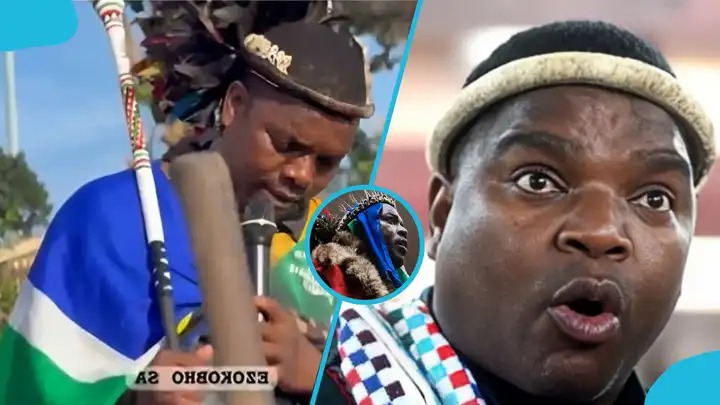
South African anti-immigrant activist Ngizwe Mchunu has come under intense public criticism after admitting before a Johannesburg court that he is unemployed and unable to afford legal representation, a revelation many critics say undermines his long-standing campaign accusing foreign nationals of taking jobs from South Africans.
The controversial activist, who has emerged as one of the most visible faces of South Africa’s anti-immigration movement, made the admission while appearing before the Johannesburg High Court, sitting as the Equality Court, during proceedings in a hate speech case brought against him by LGBTQ+ advocacy groups.
The courtroom remarks have since triggered widespread reactions across social media platforms, with many Africans questioning the credibility of Mchunu’s anti-immigrant rhetoric and highlighting what they describe as contradictions in his public messaging.
For months, South Africa has witnessed growing anti-immigrant demonstrations spearheaded by groups such as eZokobho SA and Amabhinca Nation, both associated with Mchunu. Alongside fellow activists including Jacinta Ngobese-Zuma and Nkosikhona Phakel’umthakathi Ndabandaba, Mchunu has led campaigns calling for the removal of undocumented migrants from South Africa.
The movement has consistently argued that illegal immigration places pressure on public services, contributes to crime, and deprives South Africans of employment opportunities.
However, critics have accused the groups of targeting both documented and undocumented migrants, with some demonstrations reportedly resulting in the intimidation of foreign-owned businesses.
The latest controversy surrounding Mchunu emerged after the Johannesburg High Court found him guilty of hate speech, harassment and unfair discrimination against members of the LGBTQ+ community.
The case was initiated by LGBTQ+ advocacy organisation TransHope and supported by the South African Human Rights Commission and the Hate Crimes Working Group following comments Mchunu allegedly made on social media after photographs of LGBTQ+ couple Crosby Jodwana and Sean Nhlapo’s traditional wedding circulated online.
According to court documents, Mchunu’s remarks were deemed discriminatory and inflammatory, prompting legal action from rights groups who argued that his comments violated provisions of South Africa’s Equality Act.
In delivering judgment, the court concluded that Mchunu’s statements constituted hate speech and unlawful discrimination.
As part of the ruling, the activist was ordered to pay a R250,000 penalty, issue an unconditional public apology to the LGBTQ+ community, and undergo 20 hours of human rights sensitisation training. He was also directed to bear legal costs associated with the case.
The ruling represented one of the most significant legal setbacks for the anti-immigrant campaigner, who has increasingly found himself battling multiple court actions in recent months.
However, it was Mchunu’s remarks during the proceedings that generated perhaps the strongest reaction from the public.
Addressing the court, he claimed he had not been formally served with court documents and only became aware of the case through social media reports. He further explained that he was representing himself because he was unemployed and could not afford legal counsel.
“I don’t have lawyers because I don’t work. Now I’m here to represent myself,” Mchunu told the court. The statement quickly went viral online, prompting an avalanche of criticism.
Many social media users pointed to the irony of an activist who has built much of his public profile around claims that immigrants are taking employment opportunities from South Africans, while simultaneously admitting he is unemployed.
Others argued that his admission helped explain why he spends significant time organising demonstrations and public campaigns.
Several commentators described the revelation as evidence that the anti-immigrant movement’s frustrations may be rooted in broader socio-economic challenges rather than immigration alone.
The backlash follows a series of recent difficulties confronting Mchunu and his movement.
Only weeks earlier, he was reportedly chased away from a migrant encampment in Durban after attempting to visit Malawian nationals who had gathered while awaiting transportation back to their home country.
He has also faced separate legal battles, including a contempt application reportedly filed by Economic Freedom Fighters leader Julius Malema.
Despite the criticism, Mchunu continues to command support from sections of South African society who share concerns about immigration and unemployment.
Supporters argue that while his methods and rhetoric may be controversial, the broader issues he raises regarding border security, unemployment and public service delivery remain legitimate national concerns.
Critics, however, contend that scapegoating migrants does little to address South Africa’s deeper structural economic problems and instead fuels xenophobia and social division.