By Daniel Bampoe
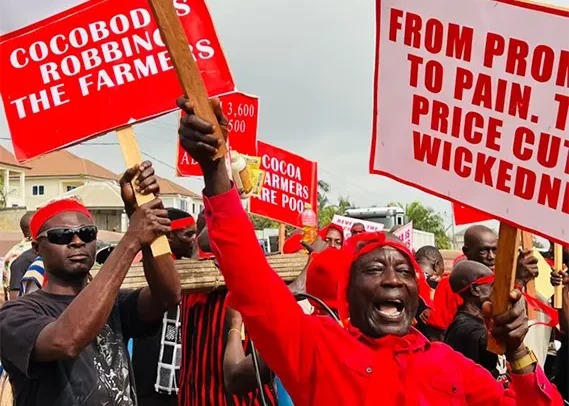
The New Patriotic Party (NPP) has launched a strong challenge against the government’s newly announced cocoa producer price of GH¢2,650 per 64-kilogramme bag, describing the increase of GH¢63 as inadequate and demanding full disclosure of how the figure was calculated.
At a press conference, addressed by Dr Isaac Yaw Opoku, Co-chair of the Policy Committee on Agriculture, the party accused the NDC government of failing to meet expectations it created among cocoa farmers during the 2024 election campaign, particularly over an alleged commitment to pay farmers GH¢6,000 per bag.
The NPP argued that the latest announcement should be assessed against the promises made to farmers before the 2024 election and the subsequent changes to the producer price since the NDC assumed office.
COCOBOD announced on September 25, 2026, that the producer price for the 2026/27 season had been increased from GH¢41,392 to GH¢42,400 per tonne, translating into GH¢2,650 per 64kg bag. The increase amounts to GH¢1,008 per tonne, or GH¢63 per bag, and represents about 2.4 per cent over the previous rate. COCOBOD says the new price represents 71.18 per cent of the realised gross FOB value.
The NPP, however, contends that the announcement falls significantly short of what it says farmers were promised during the 2024 campaign. According to the party, senior NDC figures, including President John Dramani Mahama and current government ministers, campaigned in cocoa-growing communities on the basis that farmers deserved a substantially higher return.
The party’s statement described the latest price as a “complete deceit” and an “all-time ‘FRAKADAM’” for cocoa farmers, using the language of its political criticism to argue that the government has failed to fulfil its campaign assurances.
The NPP also pointed to the government’s earlier pricing decisions during the 2025/26 season.
In October 2025, the producer price was announced at GH¢3,625 per 64kg bag, equivalent to GH¢58,000 per tonne. Four months later, the Producer Price Review Committee announced a revised price of GH¢2,587 per bag, or GH¢41,392 per tonne, for the remainder of the season. Contemporary reporting put the reduction at GH¢1,038 per bag.
The February reduction generated opposition from sections of the cocoa-farming community. Farmers from the Western North Region subsequently petitioned the government in Accra, calling for the previous price to be restored. The Ghana News Agency reported that the reduction represented a 28.6 per cent cut from GH¢3,625 to GH¢2,587 per bag.
The NPP’s latest statement argues that the reduction was particularly problematic because the producer price announced at the beginning of a cocoa season had traditionally been regarded as a guaranteed minimum. The party therefore questioned the decision to reduce the price during the 2025/26 season and called for payment of what it describes as the outstanding “shave-off” owed to farmers.
A major part of the party’s new argument concerns the calculation behind the 71.18 per cent figure announced by COCOBOD.
Under the newly enacted Ghana Cocoa Board Act, 2026 (Act 1182), the government says farmers are guaranteed a minimum of 70 per cent of the realised gross FOB price. COCOBOD has explicitly said the GH¢2,650 price represents 71.18 per cent of the realised gross FOB value.
The NPP is demanding greater transparency over that calculation. It questioned the basis for the realised FOB value used by COCOBOD and argued that farmers should be given a detailed explanation of how the Board arrived at the figure.
The party’s calculation, based on assumptions stated in its press statement, uses an international cocoa price of US$5,500 per tonne, adds a US$400 Living Income Differential, and applies an exchange rate of GH¢11.50 to the US dollar. On that basis, the NPP arrives at an estimated 70 per cent farmer share of approximately GH¢47,495 per tonne, or about GH¢2,968 per 64kg bag.
The party consequently argues that farmers could be receiving approximately GH¢318 less per bag than what its calculation suggests they should receive.
That calculation, however, represents the NPP’s own methodology and assumptions. COCOBOD’s announced methodology is based on the realised gross FOB value, which the Board says incorporates its actual forward and spot sales arrangements. COCOBOD has maintained that the GH¢42,400 per tonne price represents 71.18 per cent of that realised value.
The difference between the two positions has therefore placed the calculation of the farmer’s statutory share at the centre of the latest cocoa-pricing controversy.
The NPP also raised concerns about outstanding payments within the cocoa supply chain. It cited reports of approximately GH¢4 billion in unpaid cocoa purchases and questioned whether the financial obligations from the previous season could affect the ability of Licensed Buying Companies and farmers to receive timely payment during the new season.
The party said the concern was particularly relevant given the payment difficulties reported during the 2025/26 season and called on government and COCOBOD to provide assurances about financing for the new crop.
Beyond the immediate price dispute, the NPP framed the controversy around four issues it said were fundamental to the survival of the cocoa industry: fair pricing, certainty, timely payment and transparency.
“The cocoa farmer is not asking for charity,” the party said, arguing that farmers were instead seeking predictable returns and a government that honours its commitments.
COCOBOD, meanwhile, has presented the new pricing arrangement as part of broader reforms under the 2026 Act aimed at strengthening the financial and institutional sustainability of the cocoa sector. The Board says the new framework guarantees farmers at least 70 per cent of realised gross FOB while introducing changes to financing, governance and domestic value addition.
The Board has also said the new season will continue to benefit from productivity programmes, including free fertiliser, hybrid seedlings and disease and pest-control interventions.