BY Daniel Bampoe
In the early hours of Saturday, Venezuela awoke to explosions, blackouts and the most dramatic turn yet in its long-running standoff with the United States: President Nicolás Maduro had been seized and flown out of the country in a US-led military operation.
Within hours, US President Donald Trump confirmed the capture, declaring that Washington now intended to oversee Venezuela’s transition and take control of its vast oil resources.
The arrest followed a coordinated US strike on strategic targets around the capital, Caracas, including military installations, ports and airfields.
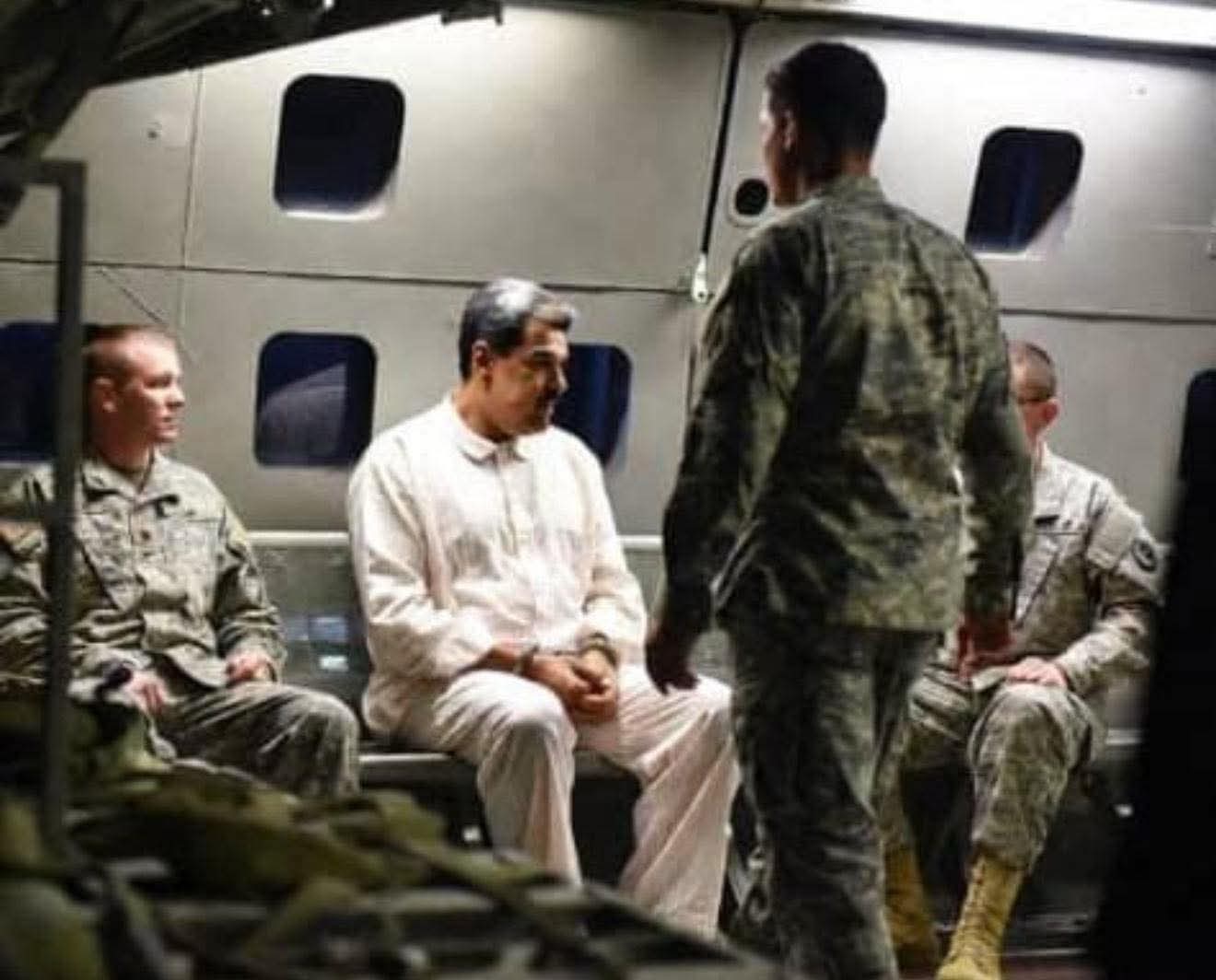
According to Trump and senior US officials, Maduro and his wife, First Lady Cilia Flores, were extracted alive and transported under heavy security to the United States, where both now face criminal charges in New York.
A Night Of Explosions And A President Taken
Residents of Caracas reported loud blasts shortly after midnight, as plumes of smoke rose from parts of the capital.
Power was cut across large sections of the city. The Venezuelan government later confirmed that sites in Caracas and surrounding states, including Miranda and La Guaira, had been hit, prompting the declaration of a national emergency and the full deployment of the armed forces.
Hours later, Donald Trump announced that Maduro had been captured in what he described as a “precision operation” involving US Special Forces and intelligence agencies.
He said the operation, code-named Operation Absolute Resolve, had been months in planning and was carried out with detailed intelligence on Maduro’s movements.
US officials said the mission involved more than 150 aircraft and elite Delta Force troops, who entered what Trump described as a heavily fortified presidential compound at around 2:01am local time.
Maduro, he claimed, attempted to retreat to a reinforced safe area but was intercepted before he could secure himself inside.
No US troops were reported killed, and only limited injuries were acknowledged.
Maduro and his wife were subsequently transferred onto a US military vessel and flown to New York to face trial.
Charges, Accusations And A Long-simmering Conflict
US Attorney General Pam Bondi confirmed that Maduro and Flores had been indicted in the Southern District of New York on charges including conspiracy to commit narco-terrorism, cocaine trafficking, and possession of machine guns and destructive devices.
The US has long accused Maduro of leading or protecting powerful drug networks, including the so-called Cartel de los Soles—allegations he has consistently denied.
Washington’s hostility toward Maduro predates this operation by years.
The US has refused to recognise his legitimacy since disputed elections, most recently the 2024 vote, which the opposition says was won decisively by its candidate, Edmundo González Urrutia.
Maduro’s government, backed by the military, rejected those claims and tightened its grip on power.
Under Trump, tensions escalated further. The US designated major Venezuelan criminal gangs as foreign terrorist organisations, imposed sweeping sanctions, and offered a reward reportedly worth $50m for information leading to Maduro’s arrest. In parallel, US forces increased operations in the Caribbean, striking vessels accused of drug trafficking.
Maduro, for his part, repeatedly accused Washington of using the “war on drugs” as a pretext to overthrow his government and seize Venezuela’s oil, the largest proven reserve in the world.
Washington’s next move: running Venezuela
At a news conference following the operation, Trump said the US would “run” Venezuela until a “safe and proper and judicious transition” could be achieved.
He confirmed that Vice President Delcy Rodríguez had been sworn in and was already in contact with US Secretary of State Marco Rubio.
Trump made clear that oil was central to Washington’s plans. He said US companies would move in to rehabilitate Venezuela’s collapsing energy infrastructure, investing billions of dollars and restarting production.
Venezuela, he argued, had been mismanaged for decades, with output collapsing despite the country sitting atop an estimated 303 billion barrels of crude.
“We’re going to be taking a tremendous amount of wealth from the ground,” Trump said, adding that the US expected to recoup the costs of its intervention while also benefiting the Venezuelan people.
Energy analysts note that reviving Venezuela’s oil sector would take years and tens of billions of dollars, given the decay of pipelines, refineries and export facilities under sanctions and chronic underinvestment.
Still, access to Venezuela’s heavy crude could reshape regional energy markets if production is restored.
Venezuela And The World React
Venezuela’s defence minister, Vladimir Padrino López, condemned the strikes as an “extremely serious military aggression,” accusing the US of hitting civilian areas and threatening international peace.
The government demanded proof of life for Maduro and vowed resistance to any foreign military presence.
International reaction was swift and sharply divided.
Russia, China and Iran denounced the operation as a violation of Venezuelan sovereignty. Regional leaders in Brazil, Colombia, Cuba and Chile warned that the strikes crossed a dangerous line and could destabilise Latin America.
The United Nations Secretary General António Guterres said he was deeply alarmed and cautioned that the action set a troubling precedent under international law.
Others were more supportive. Argentina’s libertarian president, Javier Milei, welcomed the news as a victory for “freedom,” reflecting a broader ideological split in the region over Maduro’s rule.
Who Is Cilia Flores?
Alongside Maduro, US authorities detained First Lady Cilia Flores, a powerful political figure in her own right.
A former attorney general and head of the National Assembly, Flores has long been regarded as one of the most influential actors within Venezuela’s ruling establishment.
She has previously been sanctioned by the US, and members of her family were convicted on drug charges in the United States before being released in a prisoner swap in 2022.