
By Issah Olegor
The Minister for Finance Dr. Cassiel Ato Forson, who was vetted by Parliament’s Appointments Committee on 13 January 2025, pledged ambitious improvements in the country’s tax revenue mobilization.
During the vetting, Ato Forson emphasized Ghana’s untapped potential in generating tax revenue, asserting that the country could boost collections without raising tax rates.
He stated, “We don’t necessarily have to increase taxes before you rake in revenue. We have the handles, what we need to do is to improve compliance.”
At the time, Dr. Forson committed to raising the tax revenue-to-GDP ratio from the inherited 13.8 percent to a medium-term target range of 16 to 18 percent.
The pledge was presented as a central part of his strategy to strengthen Ghana’s fiscal position and reduce reliance on debt, signaling optimism about improving domestic revenue mobilization through better compliance and efficiency.
However, the latest figures for the 2025 fiscal year reveal a significant shortfall as the Ghana Revenue Authority missed its revenue target.
According to the Bank of Ghana’s Summary of Economic and Financial Data, by the end of November 2025, Ghana’s tax revenue amounted to only 10.8 percent of GDP.
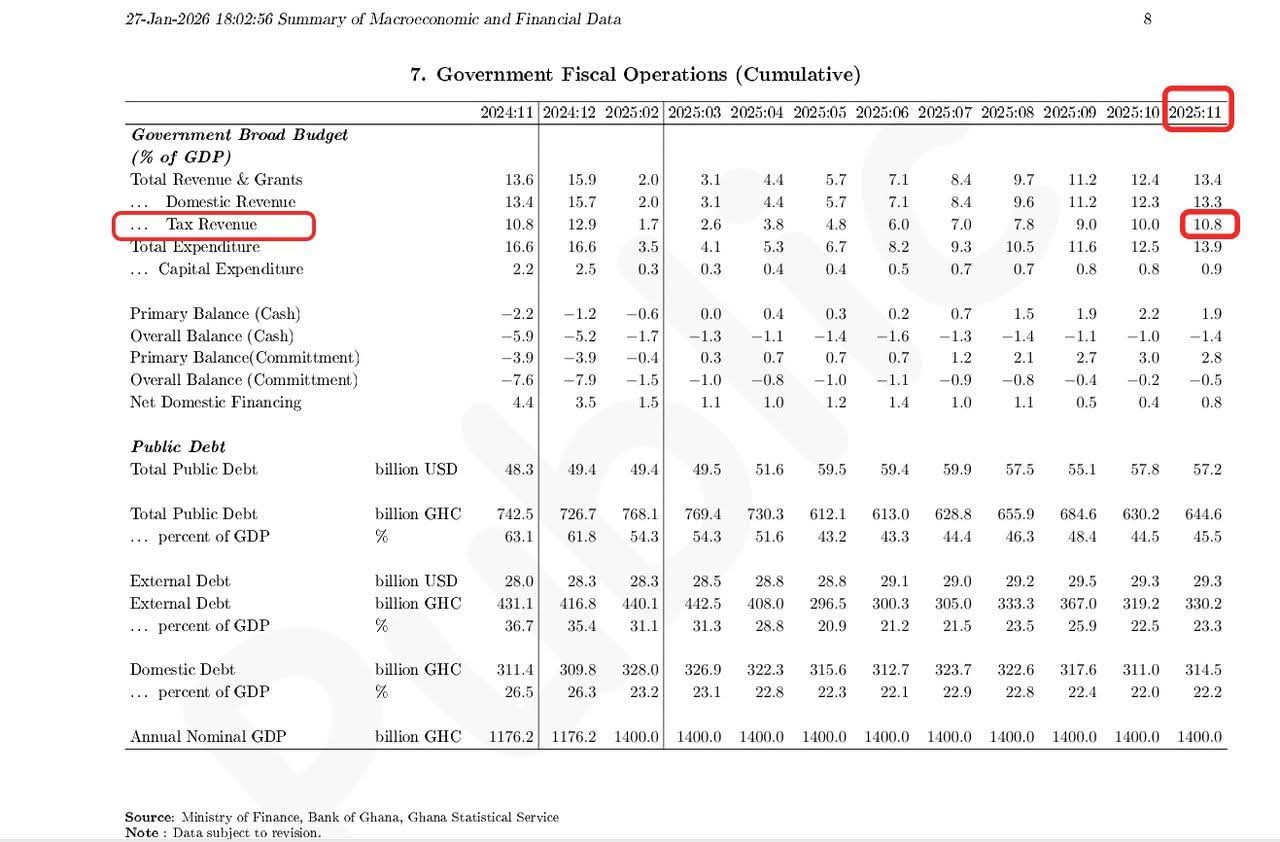
This level is 3 percentage points below the inherited benchmark of 13.8 percent and falls 5.2 to 7.2 percentage points short of Dr. Forson’s pledged target range.
Analysts note that this gap indicates a clear disconnect between the Minister’s initial pledge and actual performance, raising concerns about the effectiveness of revenue mobilization efforts during his first year in office.
Given that the data reflect cumulative performance over eleven months of the year, any adjustment from December 2025 is expected to be marginal.
Experts therefore predict that the final tax revenue-to-GDP ratio for 2025 will likely remain close to the November figure, underscoring the challenge faced by the Finance Ministry in achieving its revenue targets.
The shortfall in tax collections has broader implications for the fiscal planning, potentially affecting the country’s ability to meet budgetary commitments, service debt, and fund development projects.
They suggest that unless compliance and revenue mobilization strategies are urgently strengthened, the government may struggle to bridge the growing fiscal gap.
Video evidence of Dr. Forson’s vetting statements and the Bank summary of economic and financial data substantiate these findings, providing a factual basis for ongoing public and parliamentary discussions about the fiscal trajectory.