BY Daniel Bampoe
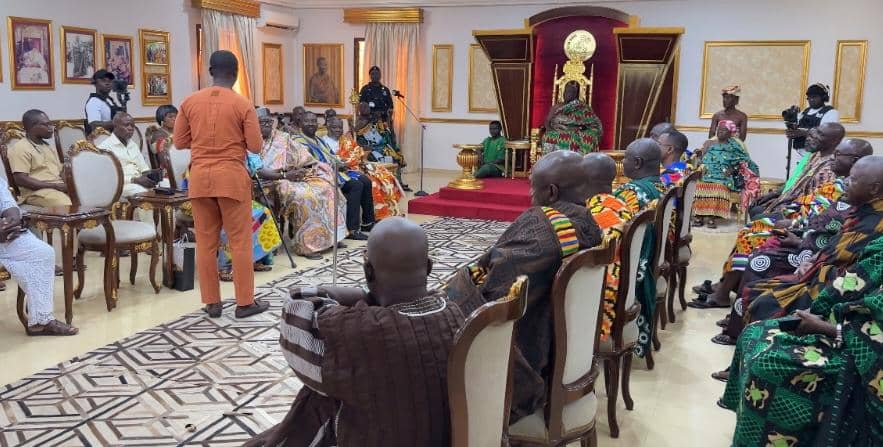
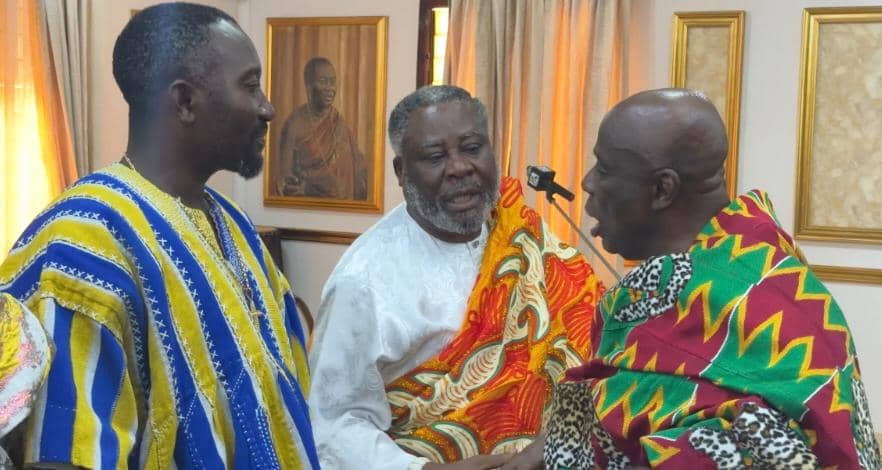
In a proactive move to address rising public concern over alleged land evictions in the Eastern Region, the President of the Greater Accra Regional House of Chiefs, Prof. King Nii Odaifio Welentsi III, led a delegation to Kyebi to meet with the Okyenhene, Osagyefuo Amoatia Ofori Panin II.
The visit, which took place at the Ofori Panin Fie, included the Vice President of the House, HRM Nene Tetteh Wakah III, and other selected members of the House, underscoring the seriousness of the engagement.
The meeting was prompted by a viral video claiming that individuals identifying as indigenes of the Eastern Region were using threats, harassment, and force to evict Ga-Dangme families from their long-settled lands in Okanta and Otwebedidua.
The video further suggested that the lands were being appropriated for illegal mining, commonly referred to as galamsey.
These claims quickly sparked national debate, raising fears of ethnic tension, land insecurity, and illicit exploitation of natural resources.
Prof. King Nii Odaifio Welentsi III emphasized the long-standing peaceful coexistence between the Ga-Dangme settlers and Akyem communities.
He noted that Ga-Dangme families had migrated from the Greater Accra Region to the area nearly 200 years ago, establishing homes, cultivating farms, and contributing to social and economic development without contestation.
The delegation’s purpose was to hear directly from the Okyenhene, seeking clarity and an amicable resolution to preserve inter-ethnic harmony.
Responding to the delegation, the Okyenhene firmly denied that the Akyem Abuakwa Traditional Council had authorized any eviction or land transfer to illegal mining operators.
He described any such actions as criminal, insisting that no traditional authority sanctioned the use of force against any community.
Osagyefuo Amoatia Ofori Panin II cautioned against the circulation of unverified information on social media, warning that misinformation could harm decades of peaceful relations between the two groups.
Following the palace meeting, the Okyenhene directed local chiefs from Okanta and surrounding areas to accompany the Greater Accra delegation to the affected communities for an on-the-ground assessment.
At Otwebedidua, the delegation observed calm conditions. Community members refuted claims of illegal mining or forced evictions, attributing tensions instead to chieftaincy matters unrelated to land or galamsey activities.
In Okanta, where the viral video was reportedly recorded, both community leaders and residents denied harassment or forced removal of Ga-Dangme families.
Youth leaders explained that recent disputes stemmed from community regulations addressing public safety, teenage pregnancy, and social order, such as restrictions on late-night movement and unauthorized gatherings.
They stressed that these rules applied to all residents, regardless of ethnicity, and that misunderstandings arose when some individuals violated them.
The delegation also noted that several houses in the communities were abandoned or in disrepair, with some claims of property damage or previous altercations.
The Ga-Dangme residents acknowledged that conflicts had persisted for about a year and a half and involved police interventions, but maintained that illegal mining was not a factor.
Reports of assaults and a single fatality were also mentioned, though the incidents were described as isolated and not linked to ethnic targeting.
At the conclusion of the fact-finding exercise, both the Greater Accra and Akyem Abuakwa traditional authorities agreed that the matter should be resolved through dialogue facilitated by local traditional leaders and, where necessary, with law enforcement support.
The chiefs reaffirmed their commitment to peace, coexistence, and preservation of the historically harmonious relationship between Ga-Dangme and Akyem communities.
A joint meeting was scheduled after the Christmas festivities to resolve outstanding issues and restore long-term stability in the affected areas.