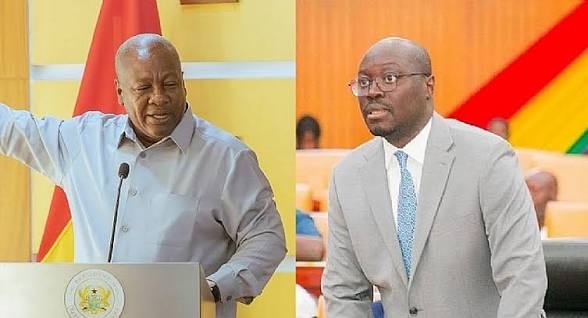
By Daniel Bampoe
Thousands of customers affected by the financial sector clean-up are still waiting for full payment of their locked-up funds, despite a campaign promise by President John Dramani Mahama and the governing National Democratic Congress to settle all outstanding claims within their first year in office.
The issue has resurfaced strongly in the national debate following comments by Finance Minister Cassiel Ato Forson, who suggested that the government currently lacks the financial capacity to fully absorb the liabilities arising from the collapse of private financial institutions during Ghana’s banking sector reforms.
The banking sector clean-up, initiated under the previous New Patriotic Party administration between 2017 and 2020, led to the revocation of licenses of several banks, savings and loans companies, microfinance firms, and fund management institutions.
The exercise was justified by authorities as necessary to restore confidence and stability in the financial system after years of regulatory breaches, weak corporate governance, and insolvency challenges.
However, the clean-up also left thousands of customers, investors, and workers devastated, with many losing access to life savings, investments, businesses, and jobs. The political fallout from the exercise became a major campaign issue ahead of the 2024 general elections.
During the 2024 election campaign, then-candidate John Mahama strongly criticized the handling of the financial sector clean-up and sympathized with victims whose funds remained locked up.
Addressing affected customers at campaign events, Mahama accused the previous administration of destroying livelihoods and pledged that an NDC government would settle all outstanding claims within its first year in office.
“I pledge on behalf of the NDC that we shall, within one year of being in office, pay all funds locked up in the collapsed financial institutions,” Mahama declared during one of his campaign engagements.
He further assured victims that his administration would not introduce a long-term payment arrangement that would worsen their economic hardships.
The promise generated hope among many affected depositors who had waited years for reimbursement and compensation after the collapse of several financial institutions.
But sixteen months after assuming office, concerns are growing among victims over the pace of payments and the government’s ability to fulfill the pledge.
The debate intensified after Finance Minister Cassiel Ato Forson, speaking in an interview on Joy News PM Express with broadcaster Evans Mensah, questioned the principle of using taxpayers’ money to absorb liabilities created by failed private businesses.
According to the Finance Minister, government must carefully weigh the financial implications of committing additional billions of cedis to settle claims linked to collapsed private institutions at a time the country is recovering from economic distress and debt restructuring challenges.
“Government has no business collapsing companies and taking liabilities and using taxpayers’ money to fund it,” Dr. Ato Forson stated during the interview.
He argued that many of the collapsed institutions were privately owned entities that entered agreements with customers but failed to honor their obligations.
The Finance Minister stressed that committing another GH¢20 billion to GH¢30 billion to settle outstanding obligations could affect critical national spending priorities, including education, healthcare, and infrastructure development.
He explained that government is currently balancing competing national demands and must avoid further borrowing that could worsen the already difficult debt situation.
His comments have since triggered strong reactions from victims of the financial sector clean-up, many of whom insist they relied on the campaign assurances of the NDC before supporting the party in the elections.
Some affected customers argue that government cannot now distance itself from responsibility after making direct promises to settle all locked-up funds within a specific timeline.
Meanwhile, government officials maintain that the financial burden inherited from the clean-up exercise remains substantial.
Authorities now estimate the total cost of managing the impact of the banking sector collapse at about GH¢21 billion, covering payments to depositors, resolution costs, and other financial obligations.