By Issah Olegor
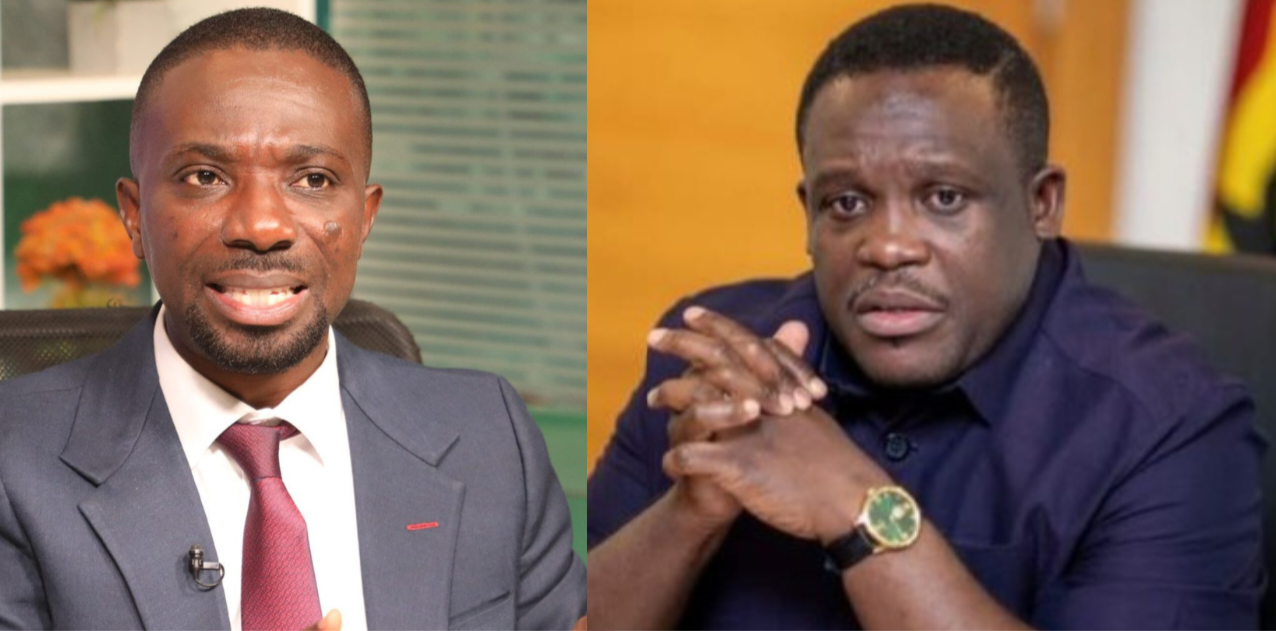
A senior aide to former Vice-President Mahamudu Bawumia, Dennis Miracles Aboagye, has launched a scathing attack on the Minister for Communications, Digital Technology and Innovations, Samuel Nartey George, accusing him and the governing National Democratic Congress (NDC) of political hypocrisy and deliberate deception in their quest for power.
His reaction follows a defiant social media post by Sam George, in which the Ningo-Prampram MP defended his vocal role during the NDC’s years in opposition, insisting he had “paid his dues” in helping return the party to government under former President John Dramani Mahama.
However, Miracles Aboagye, a known communicator for the opposition New Patriotic Party (NPP), interpreted the Minister’s remarks differently, describing them as a troubling admission that political messaging during the opposition years was driven more by the desire to win power than by principle.
“In summary, the Hon. Minister is telling citizens he had to say whatever he had to say just to win power,” he argued, labelling the statement as one of the most scandalous political admissions in recent times.
From Opposition Rhetoric To Political Power
The exchange brings back into focus the fiercely contested political landscape following the NDC’s heavy defeat in the 2016 general elections. At the time, the party was reduced to a minority in Parliament, holding just 106 seats against the NPP’s commanding majority.
During those years, Sam George emerged as one of the most visible and combative voices defending the NDC on media platforms and on the floor of Parliament.
Together with other party communicators, he consistently criticised the NPP government over issues such as alleged sole-sourcing practices, illegal mining (galamsey), economic hardships, and accusations of state capture. The NDC also championed what it termed a “Reset Agenda,” promising swift economic recovery and governance reforms should it return to power.
Sam George himself took strong personal positions during this period, including public resistance to policies such as the national digital identity system and SIM card re-registration exercise—positions that have now resurfaced in public discourse.
Allegations Of Contradictions In Government
Miracles Aboagye’s critique centres on what he describes as glaring inconsistencies between the NDC’s opposition rhetoric and its current governance record since returning to power in 2026 with a significantly larger parliamentary majority.
According to him, many of the issues the NDC once condemned have either persisted or re-emerged under its administration.
He pointed to continued concerns over sole-sourcing in government contracts, the ongoing environmental impact of illegal mining, and the reintroduction and enforcement of biometric SIM re-registration under the Communications Ministry now headed by Sam George.
He further argued that economic conditions, particularly rising prices, remain a major concern for Ghanaians despite earlier assurances by the NDC that such challenges would be swiftly addressed upon assuming office.
“Old videos are not agenda-setting,” he stressed.
“They are receipts,” suggesting that archival footage of opposition-era statements serves as evidence of what he calls a disconnect between promises and current realities.
A Debate Over Political Credibility
While Sam George maintains that his past efforts were part of a broader struggle to return his party to power, critics like Miracles Aboagye argue that the justification risks undermining public trust if it is seen as an admission of expedient politics.
The NPP communicator further challenged the Minister’s assertion of political sacrifice, insisting that the central issue is not his visibility during the opposition years, but the substance of what was advocated at the time.
He accused the NDC of abandoning key campaign promises immediately after winning power, arguing that Ghanaians were sold unrealistic expectations about rapid economic recovery and systemic change.