
By Issah Olegor
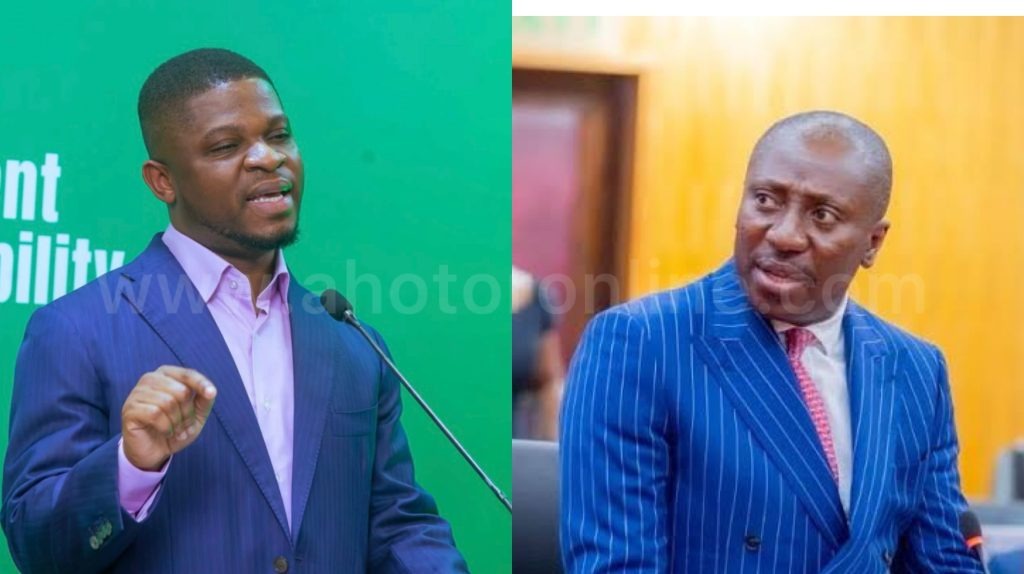
The political battle over the gold trade has escalated into a bitter war of words between Ghana Gold Board (GoldBod) Chief Executive Officer Sammy Gyamfi and Minority Leader Alexander Afenyo-Markin, with Gyamfi dismissing the latter’s warning about possible criminal prosecution of GoldBod officials as political intimidation.
Gyamfi fired back at the Minority Leader during the Government Accountability Series on Wednesday, August 19, 2026, after Afenyo-Markin warned that executives of GoldBod and other officials of the current administration could face what he described as “scary” bail conditions should the New Patriotic Party (NPP) return to power.
The warning by the Minority Leader formed part of a broader attack on GoldBod over allegations concerning the financial implications of the Domestic Gold Purchase Programme and reported losses of about GH¢22 billion associated with the Bank of Ghana’s gold operations.
But rather than accept the political threat, Gyamfi turned the spotlight on GoldBod’s reported achievements and challenged Afenyo-Markin to assess the institution’s performance based on evidence rather than political rhetoric.
In a particularly combative response, the GoldBod CEO mocked the Minority Leader’s suggestion that he could end up in prison, saying that such a scenario existed only in Afenyo-Markin’s imagination.
“So I will go to prison in his brain, and I will have onerous bail terms in his brain,”
Gyamfi said, while insisting that he was not intimidated by the warning.
He maintained that GoldBod officials were carrying out their responsibilities in what they believed was the national interest and that the institution’s performance would ultimately be judged by its results and by history.
The clash comes against the background of an increasingly heated parliamentary and public debate over GoldBod, the government’s gold purchasing strategy and the financial consequences of the Domestic Gold Purchase Programme.
Afenyo-Markin has repeatedly questioned the financial arrangements surrounding the programme and has demanded greater accountability over the reported losses.
The Minority has argued that the scale of the financial exposure warrants a deeper examination of the roles played by GoldBod, the Bank of Ghana and other actors in the gold-trading chain.
Gyamfi, however, has rejected the suggestion that GoldBod itself suffered a GH¢22 billion loss.
In his broader response to the Minority’s allegations, he has pointed to GoldBod’s audited 2025 accounts, which he says recorded an operational surplus of GH¢907 million and an overall surplus exceeding GH¢5.4 billion.
He has also argued that the reported US$1.7 billion loss cited in the IMF’s assessment relates to the Bank of Ghana’s Domestic Gold Purchase Programme and should not automatically be attributed to GoldBod.
That distinction has become central to the political dispute.
The Minority has focused on the economic loss associated with the programme, while GoldBod has insisted that the accounting position of the institution itself is fundamentally different from the losses reported by the central bank.
Gyamfi has repeatedly challenged critics to distinguish between GoldBod’s financial performance and the Bank of Ghana’s accounting losses under the DGPP.
The GoldBod CEO also used his response to point to what he described as major improvements in Ghana’s gold value chain under the current administration.
He argued that previous administrations failed to establish significant domestic refining capacity, whereas GoldBod’s operations had contributed to the expansion of local gold refining.
“Under your tenure, not a gram of gold was refined in Ghana, but today over 9 million tonnes of gold we have bought is refined here in Ghana, and we are changing the value addition story of the country,” he said.
The claim formed part of Gyamfi’s broader argument that the GoldBod debate should not focus exclusively on alleged losses without considering the institution’s contribution to value addition and the restructuring of Ghana’s gold sector.
He accused Afenyo-Markin of failing to properly assess these developments before launching attacks against the institution.
The GoldBod CEO then took aim at the style and substance of the Minority Leader’s criticism, describing what he called Afenyo-Markin’s “fanciful efficiency” as comparable to that of a palm-wine bar.
Gyamfi argued that such remarks should be treated more as comic relief than serious parliamentary commentary, escalating an already tense political confrontation between the two men.
He further suggested that the tone of the current Minority leadership differed significantly from that of previous occupants of the position.
In particular, he referenced former Minority Leaders J.H. Mensah, Papa Owusu-Ankomah and Osei Kyei-Mensah-Bonsu, implying that their approach to parliamentary debate represented a higher standard than what he currently sees from Afenyo-Markin.
The exchange illustrates how the GoldBod controversy has moved beyond financial analysis and into an increasingly personal political confrontation.
Afenyo-Markin’s warning about future bail conditions has been interpreted by Gyamfi as an attempt to intimidate officials involved in GoldBod’s operations. Gyamfi, however, has sought to project confidence, insisting that neither he nor his colleagues are frightened by threats of prosecution.
The GoldBod CEO’s response also reflects a broader defence of the government’s gold policy, which officials have linked to efforts to strengthen Ghana’s international reserves, support the cedi and increase value addition within the domestic gold industry.
The Minority’s criticism, on the other hand, centres on whether the economic gains associated with gold accumulation were achieved at an excessive financial cost and whether adequate safeguards were in place to protect public funds.
That disagreement has intensified following the IMF’s report on the Bank of Ghana’s Domestic Gold Purchase Programme, which reported a US$1.7 billion loss in 2025.
The Minority has seized on the figure as evidence that the programme requires deeper scrutiny, while GoldBod has maintained that the figure should not be presented as a loss suffered by GoldBod itself.
The competing interpretations have created a politically charged debate over what constitutes a GoldBod loss, what constitutes a Bank of Ghana loss and whether the two can properly be linked because of the institutions’ respective roles in the gold purchasing arrangement.
Gyamfi has insisted that GoldBod’s audited accounts provide evidence of a positive financial performance and has challenged Afenyo-Markin to substantiate his claims through the appropriate parliamentary processes.


