By Nadia Ntiamoah
The Government and three major pre-tertiary teacher unions have reached an agreement on outstanding conditions of service issues, including promotion-related arrears and allowances, following negotiations aimed at resolving concerns that triggered the unions’ two-week strike action.
The agreement, reached at a meeting on Friday, October 9, 2026, outlines specific deadlines for payments owed to teachers and the implementation of allowances that have remained key issues in discussions between the government and organised labour.
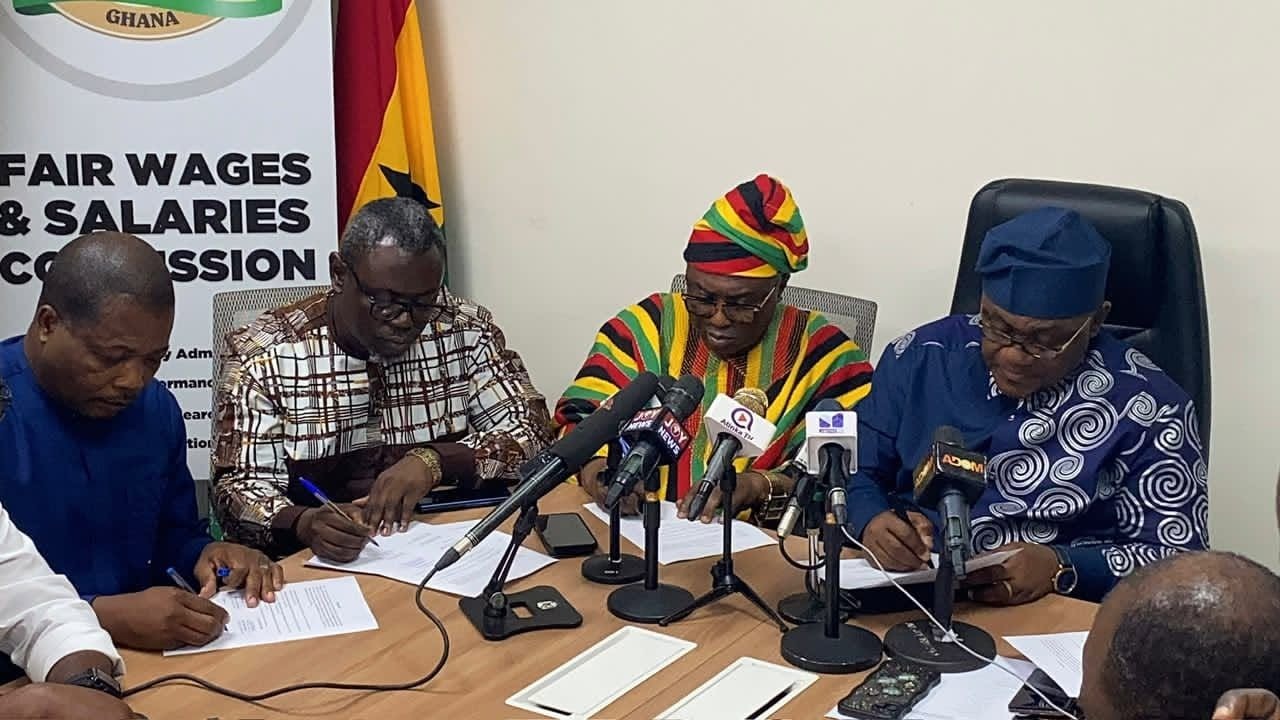
The negotiations brought together the Government Team, represented by the Fair Wages and Salaries Commission (FWSC) in collaboration with the Ghana Education Service (GES), and the leadership of the Ghana National of Teachers (GNAT), the National Association of Graduate Teachers (NAGRAT) and the Pre-TertiaryTeachers Association of Ghana (PRETAG).
The outcome was documented in a communique signed by the Chief Executive of the FWSC, Dr George Smith-Graham, on behalf of the government, and GNAT General Secretary Thomas Musah, representing the teacher unions.
Under the agreement, the government has committed to developing the modalities for implementing the Deprived Area Allowance in January 2027. The commitment is intended to advance discussions on allowances associated with service in deprived areas, although the communique does not specify the final payment arrangements or the categories of beneficiaries.
Another major issue addressed during the negotiations was the payment of promotion-related placement arrears owed to teachers.
The parties agreed that 51,000 teachers would receive their outstanding payments by October 16, 2026, while payments to the remaining affected teachers are expected to be completed by the end of October.
The payment schedule establishes two deadlines for settling the outstanding obligations and provides a timeline against which teachers and their unions can assess the government’s compliance with the agreement.
The negotiations also addressed the Complimentary Digital Instruction Support Allowance, with the parties confirming that discussions on the allowance had been concluded. Payments are scheduled for November 2026.
Similarly, negotiations on the Continuous Professional Development Allowance have been completed, with payments expected to commence in December 2026.
The timelines represent key elements of the agreement, particularly for teachers awaiting outstanding financial benefits and those seeking clarity on the implementation of allowances linked to their professional responsibilities.
However, the parties acknowledged that not all issues concerning the teachers’ conditions of service had been resolved. They agreed to continue negotiations on the remaining outstanding matters.
The latest engagement follows disagreements between the government and the teacher unions over outstanding obligations under their collective bargaining agreement and conditions of service. Those unresolved issues contributed to the industrial action that prompted further negotiations.
The involvement of all three unions in the latest discussions underscores their collective position in engagements with the government over the concerns affecting pre-tertiary teachers.
The FWSC Chief Executive, Dr George Smith-Graham, expressed appreciation to the union leaders for their commitment to finding a resolution, acknowledging the difficulties both sides had encountered during the dispute.
“It has been a difficult period for both parties,” he said.
The Director-General of the Ghana Education Service, Professor Ernest Kofi Davis, also welcomed the agreement, describing the development as a relief for the service.
“This is a relief for those of us at GES,” Professor Davis said.
agreement is expected to provide a framework for addressing some of the financial and administrative concerns raised by the unions, particularly the outstanding promotion-related payments and allowances.
For teachers awaiting arrears, the immediate priority will be whether the government meets the October deadlines. The subsequent November and December payment schedules will also be important in determining whether the agreed arrangements are implemented as outlined.
The development highlights the role of collective bargaining in resolving disputes between public-sector workers and the government. It also places responsibility on the negotiating parties to ensure that commitments made during discussions translate into actual payments and administrative action.
While the agreement marks progress on several outstanding matters, the continuation of negotiations means that the broader conditions-of-service dispute has not been fully settled.
The government and the teacher unions are therefore expected to maintain their engagement to resolve the remaining issues and address the concerns that led to the industrial action.