BY Daniel Bampoe
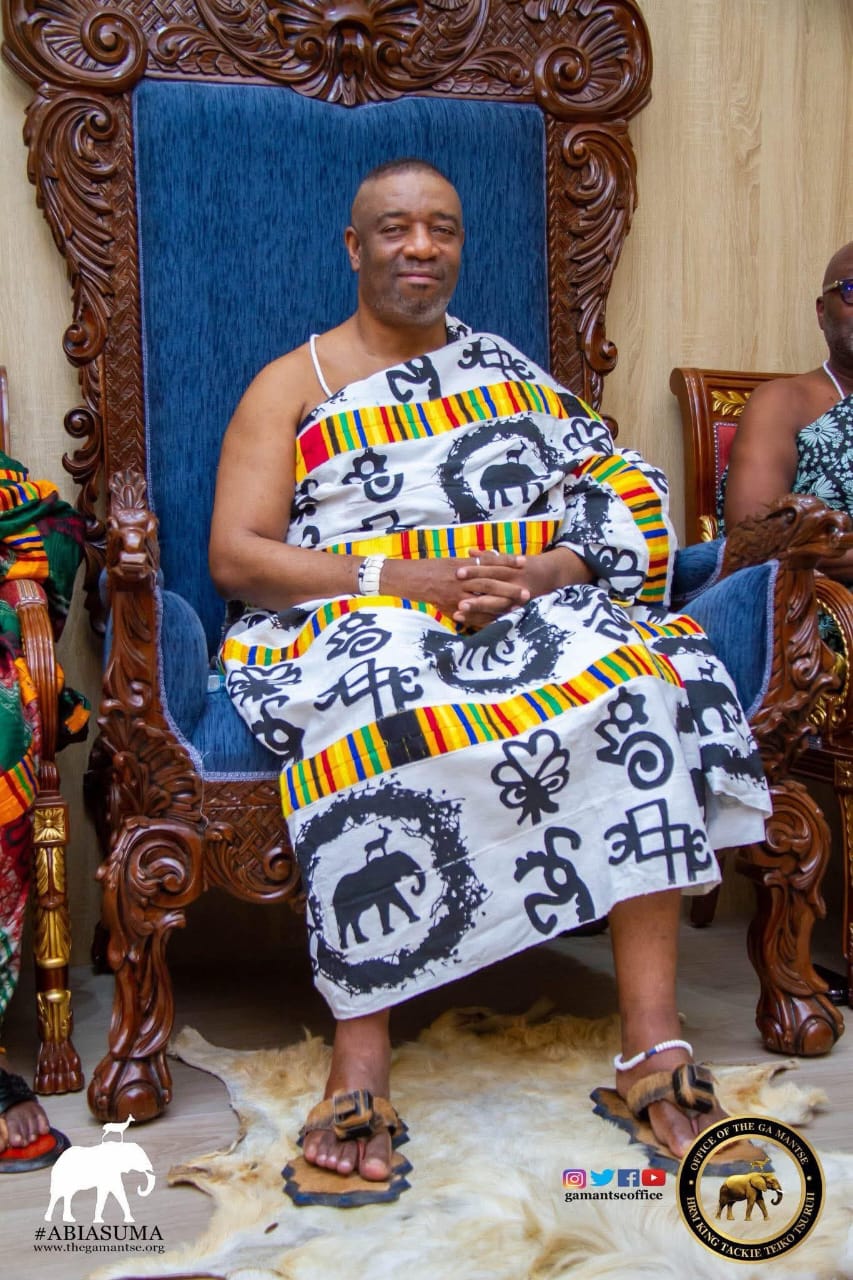
In a landmark ruling that could have significant implications for traditional leadership disputes in Ghana, the Supreme Court has quashed earlier decisions by both the Kumasi High Court and the Court of Appeal that sought to remove King Tackie Teiko Tsuru II from the Ga Mantse stool.
The court, in a decisive judgment, held that the High Court and Court of Appeal erred by failing to afford King Tackie Teiko Tsuru II a fair hearing, despite the fact that their decisions directly impacted his status as the recognized Ga Mantse.
The court emphasized that procedural fairness and the right to be heard are fundamental principles of justice, especially in chieftaincy matters where statutory rights are involved.
The Supreme Court also upheld the argument advanced by the applicant that at the time of the challenge, his name—King Tackie Teiko Tsuru II—had already been formally entered into the National Register of Chiefs.
This registration, according to the court, conferred upon him personal statutory rights under Section 57(5) of the Chieftaincy Act, 2008 (Act 759), which could not be invalidated without due process.
This ruling reverses a decision by the Court of Appeal issued in June 2025, which had directed the National House of Chiefs to reinstate Nii Tackie Adama Latse II as Ga Mantse.
That appellate decision was rooted in an earlier 2021 High Court ruling, which declared that the removal of Nii Latse II from the register was procedurally defective due to the absence of evidence of a lawful destoolment process.
The Court of Appeal, in its judgment, emphasized that there was no documented evidence that Nii Adama Latse II had been properly destooled, which is a legal precondition for the removal of any chief from the National Register.
On that basis, the court directed that Nii Latse II be reinstated as the legitimate Ga Mantse, describing the prior actions of the National House of Chiefs as lacking legal justification.
In response to that decision, King Tackie Teiko Tsuru II filed an application for certiorari at the Supreme Court, invoking the court’s supervisory jurisdiction to quash what he described as a miscarriage of justice.
The Supreme Court has now granted that request, effectively restoring his legitimacy as the Ga Mantse.
This ruling is likely to bring some clarity to a longstanding leadership tussle within the Ga State, a key traditional area in the Greater Accra Region.
However, it may also reignite political and traditional tensions, given the complex nature of chieftaincy disputes and the deeply entrenched loyalties within the Ga community.