BY Daniel Bampoe
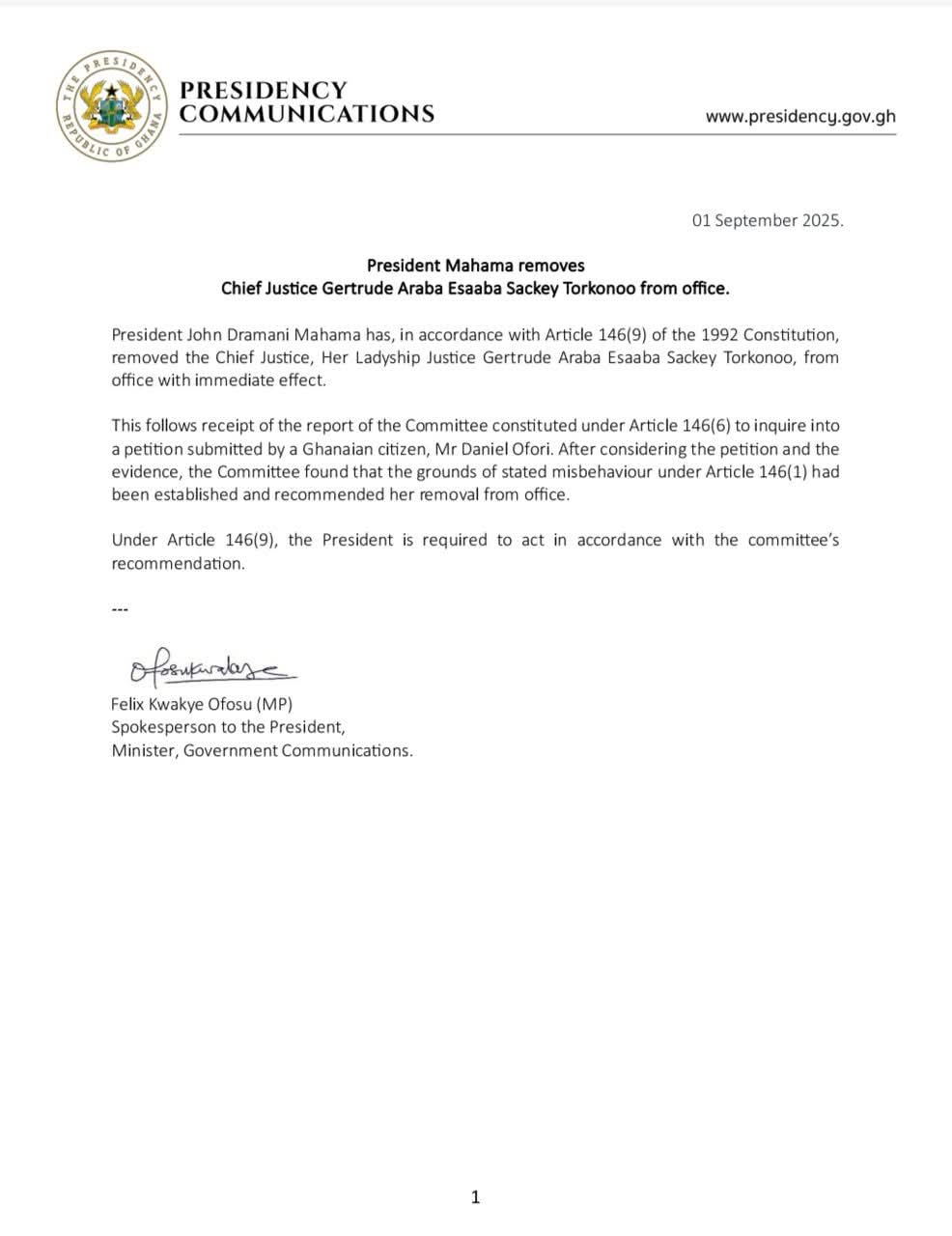
President John Dramani Mahama has for the first time in the history of Ghana removed a Chief Justice, with the removal of Gertrude Araba Esaaba Sackey Torkornoo from office, following the recommendation of a constitutional committee set up to investigate petitions seeking her removal.
The decision, announced on September 1, 2025, marks a historic and controversial moment in Ghana’s judicial history.
The dismissal was carried out under Article 146(9) of the 1992 Constitution, which mandates the President to act in accordance with the recommendations of a committee of inquiry once it establishes grounds of stated misbehaviour or incapacity against a superior court judge.
Petition and Committee’s Findings
The petition that triggered the Chief Justice’s removal was filed by Ghanaian businessman, Daniel Ofori, who alleged misconduct on the part of Justice Torkornoo.
Following the constitutional procedure, President Mahama referred the petition to the Chief Justice for her response. With the subject of the petition being the Chief Justice herself, the process was escalated to the Council of State, which advised the President to set up a committee under Article 146(6).
The five-member committee, chaired by Supreme Court Justice Gabriel Pwamang, held its proceedings in camera as required by law.
Despite criticisms and public speculations, the committee emphasized that “in camera” hearings did not mean secrecy, but rather a restricted process to protect the integrity of the inquiry.
Over several months, the committee heard testimony from 13 witnesses presented by the petitioner and 12 witnesses, including experts, presented by the Chief Justice in her defense.
Both sides were represented by four lawyers each, and the panel reviewed nearly 10,000 pages of documentary evidence.
After what it described as a “critical and dispassionate examination” of the evidence, the committee concluded that the petition had merit and established grounds of misbehaviour.
It therefore recommended the removal of Justice Torkornoo from office, a recommendation the President was constitutionally bound to accept.
Presidential Action
In a statement issued by the Presidency, Presidential Spokesperson Felix Kwakye Ofosu confirmed that the President had acted in line with Article 146(9).
“The President has, with immediate effect, removed Chief Justice Gertrude Araba Esaaba Sackey Torkornoo from office, following the recommendation of the Article 146 Committee,” the statement said.
This marks the first time in Ghana’s history that a sitting Chief Justice has been removed from office under the 1992 Constitution.
Background of the Petitions
The case against Chief Justice Torkornoo is part of a broader controversy that has surrounded her tenure since her appointment in 2023.
She faced a total of three petitions from different citizens, alleging misconduct and breaches of judicial ethics.
The report submitted to President Mahama on September 1 covered only the first petition filed by Ofori.
According to Justice Pwamang, the second and third petitions remain pending after requests for adjournments by the petitioners and the Chief Justice herself.
The committee is expected to deliver separate reports on those in due course.
Reactions and Implications
The removal of Justice Torkornoo is expected to spark intense debate over judicial independence and the balance of power between the Executive and Judiciary.
Already, legal experts and political actors have raised questions about the broader implications of Article 146 inquiries, with some warning that the process could be politicized if not handled carefully.
While the Presidency insists it acted strictly within constitutional provisions, critics argue that the timing of the decision—coming just months after the heated controversy over her suspension—could further polarize the political landscape.
For now, Ghana’s judiciary enters a transitional phase as the country awaits the appointment of a new Chief Justice to replace Gertrude Torkornoo, whose tenure has been cut short by one of the most consequential constitutional processes in recent history.