
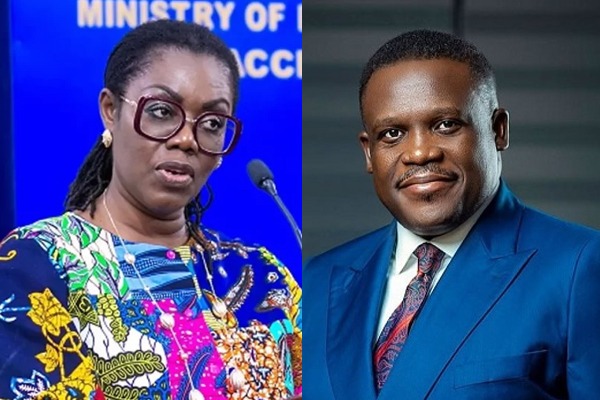
BY Daniel Bampoe
A growing political storm is brewing over the planned SIM card re-registration exercise, with critics accusing the Minister for Communication, Digital Technology and Innovation, Samuel Nartey George, of hypocrisy following a dramatic shift in his position from opposition to government.
At the heart of the controversy is the stark contrast between George’s previous criticisms of the SIM registration exercise under the Akufo-Addo administration and his current role as the chief architect of a fresh nationwide re-registration scheduled to begin in 2026.
Between 2021 and 2024, while serving in opposition, Sam George was one of the most outspoken critics of the SIM card registration programme.
He consistently described the process as “cumbersome” and “narrow,” pointing to long queues across the country and the insistence on the Ghana Card as the sole identification document as major flaws.
He further argued that instead of forcing citizens to re-register their SIM cards, government could have relied on existing biometric databases, including those of the Electoral Commission and the National Identification Authority (NIA), to validate and clean up subscriber data.
He also raised serious concerns about what he perceived as an overemphasis on procurement, alleging that the exercise was driven more by contracts and financial interests than by genuine concerns for consumer protection and national security.
However, barely a year into office, George has taken a markedly different stance. Now leading policy from within government, he has announced a new SIM re-registration exercise, declaring previous data invalid and insisting that a fresh process is necessary to restore integrity to the telecommunications system.
Speaking at a stakeholder engagement in Accra, he assured Ghanaians that the upcoming exercise would be the last, promising a more efficient, technology-driven system that eliminates the frustrations associated with earlier efforts.
He emphasised that the new process would be largely digital, allowing users to complete registration from their homes using smartphones, while also introducing appointment systems and mobile teams to improve accessibility nationwide.
According to him, the new registration regime will incorporate advanced biometric verification systems, including facial recognition and “liveliness tests,” to prevent fraudulent registrations. It will also be supported by a Central Equipment Identity Register (CEIR) to block stolen devices and strengthen security within the mobile ecosystem.
Sam George has defended his apparent change in position, arguing that the new system is fundamentally different from the previous one.
He maintains that the current approach prioritises data integrity, inter-agency collaboration and user convenience, rather than the structural inefficiencies he once criticised.
Yet, critics remain unconvinced.
They point to what they describe as clear inconsistencies in his public posture, arguing that the same methodology he once condemned is now being repackaged under his leadership.
Questions are also being raised about why the government has opted for a complete re-registration rather than leveraging existing data already captured during the previous exercise.
Some analysts have noted that SIM registration data from the earlier exercise is reportedly stored by the National Information Technology Agency (NITA), raising concerns about why such data cannot simply be integrated with the NIA database instead of subjecting citizens to another nationwide process.
The debate has been further intensified by remarks from President John Dramani Mahama, who has defended the new registration exercise, describing the previous one as ineffective due to poor institutional coordination.
Both the President and his communications minister have repeatedly suggested that SIM cards registered under the previous administration were not properly linked to the Ghana Card system.
However, this narrative has been challenged by former Communications Minister Ursula Owusu-Ekuful, who insists that nearly 30 million SIM cards were successfully linked to Ghana Cards, forming a solid foundation for the digital identity system.
She has also dismissed claims of any personal rift with former NIA boss Professor Kenneth Agyemang Attafuah affecting the process, describing such assertions as misleading.
The unfolding controversy has therefore evolved beyond a technical debate into a broader political contest over credibility, policy continuity and accountability.
Critics argue that if indeed the current administration enjoys better inter-agency relationships—as has been suggested between key officials—then the logical step would be to complete the integration of existing data rather than discard it entirely and restart the process.
Others have gone further to question whether the new registration exercise may be influenced by procurement interests—the very concern Sam George himself raised while in opposition.
However, as Ghana prepares for yet another SIM registration exercise, the central question remains whether this new approach will deliver the credibility and efficiency promised, or whether it will reinforce concerns about policy inconsistency and political expediency.
For now, the issue continues to generate intense public debate, with many Ghanaians watching closely as the government attempts to justify a policy shift that critics say exposes a clear case of political hypocrisy.


