
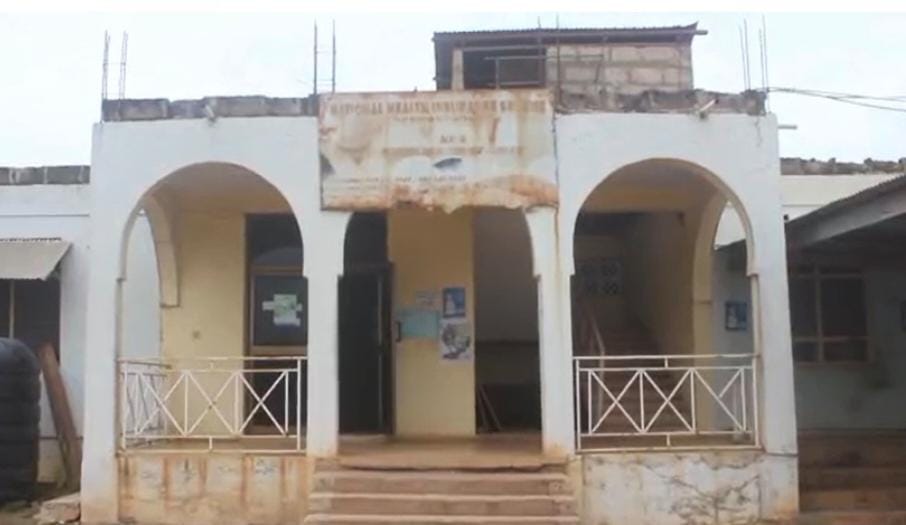
The National Health Insurance Authority (NHIA) office in the Berekum East Municipality of the Bono Region has deteriorated to such an extent that it now poses a significant safety threat to its workers and the public.
The alarming state of disrepair has compelled staff to vacate the main office building and conduct operations from a small, overcrowded temporary room on the premises.
Years of neglect have left the original office structure with severe structural defects, including persistent roof leakages, damaged electrical systems, and non-functioning air conditioners.
The building’s condition has worsened steadily, despite repeated appeals for rehabilitation, raising fears of a potential collapse.
Assistant Manager of the NHIA office, Richard Asomani Appah, told Adom News that the staff’s current working environment is not only uncomfortable but hazardous.
According to him, the lack of air circulation and frequent power faults have made it difficult for the team to deliver quality service to clients.
“We have done our best under the circumstances, but without urgent intervention, a disaster is just a matter of time,” he warned.
The dire situation has prompted local authorities and stakeholders to step in.
The Member of Parliament for the Berekum East Constituency, Simon Ampaabeng Kyeremeh, has shown support by donating two air conditioners and a desktop computer to the NHIA and the local Pensioners Association.
He earlier provided two additional air conditioners to support the temporary workspace, recognizing the urgent need for improved working conditions.
Mr. Kyeremeh also paid a visit to the NHIA facility to assess the situation firsthand.
During his visit, he assured staff and constituents that he would engage the Ministry of Health and relevant state bodies to push for the renovation—or possible reconstruction—of the NHIA building.
Despite these interventions, the situation remains critical. Clients are now directed to the makeshift office for all NHIA-related services.
Staff continue to endure uncomfortable and constrained conditions in order to maintain access to health insurance for the local population.
The NHIA office in Berekum once served as a pivotal administrative hub for health insurance services in the municipality.
However, like many public sector facilities in rural and semi-urban Ghana, inadequate maintenance and lack of timely government intervention have turned a once-functional institution into a cautionary tale of infrastructure neglect.
Community members and NHIA beneficiaries are now calling on national authorities to treat the issue with the urgency it deserves, before poor working conditions compromise service delivery—or worse, cause avoidable harm to the dedicated public servants still manning the station.


