By Grace Zigah
Just weeks after a widely publicised and forceful decongestion campaign by the Accra Metropolitan Assembly (AMA), the Central Business District (CBD) of Accra is once again overwhelmed by traders who have returned to the streets, pavements, and road shoulders, defying municipal orders and reshaping the city’s commercial core.
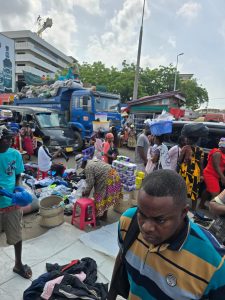
This resurgence of street vending comes exactly a month after the AMA, in collaboration with the Korle Klottey Municipal Assembly, began a citywide decongestion operation.
The exercise targeted high-traffic commercial zones such as Kinbu Street, Makola, CMB, Railways, Circle, Opera Square, and Kaneshie, aiming to restore pedestrian access, improve vehicular flow, and enforce city planning regulations.
Renewed Vision for Accra
At the heart of the AMA’s initial efforts was the Mayor of Accra, Michael Kpakpo Allotey, who insisted that the campaign was “not a nine-day wonder” and vowed to persist until the city reclaimed its spaces.
The operation was also part of the AMA’s broader plan to roll out a 24-hour economy, which included initiatives like solar-powered street lighting, a rotational trading system, and clearly demarcated red lines to preserve pedestrian zones.
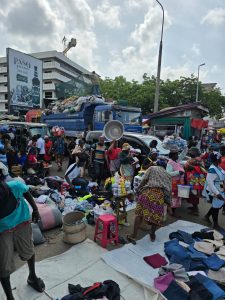
However, a visit to the CBD indicates that traders have returned to the roads making vehicular movements difficult.
Speaking at the launch, the mayor assured residents that the exercise was not designed to harm livelihoods but rather to improve safety, sanitation, and organization for all stakeholders.
“We are on the streets to make sure the roads are clear,” he emphasized.
Despite these promises, the city’s pavements are once again congested. Makeshift stalls, hawkers, and vendors have reclaimed their positions—many within weeks of being forcibly removed.
The creeping return raises critical questions about enforcement sustainability, urban planning strategy, and the availability of viable alternatives for displaced traders.
Ground Challenges and Stakeholder Frustration
Traders who spoke to reporters cited lack of designated alternative trading spaces and declining sales in offsite locations as key motivations for returning.
“We were promised places to trade, but many of us have nowhere to go. We need to feed our families,” said a vendor at CMB who returned barely two weeks after the clearance.
Meanwhile, pedestrians and motorists express frustration over the rapid reversal of the AMA’s gains.
The Korle Klottey Municipal Chief Executive, Alfred Allotey Gaisie, had previously assured that alternative trading zones would be created and that the exercise would continue until the end of the year.
But even he acknowledged the scale of resistance during the operation, saying, “We had to revisit certain sites two to three times a day to keep the pavements clear.”
A Culture of Return?
This cyclical battle between traders and city authorities is not new.
Over the years, multiple decongestion drives have met similar fates: a brief period of calm, followed by a full-scale reoccupation.
The AMA’s challenge appears to lie not only in enforcement but in building a collaborative system that meets the economic needs of informal traders while maintaining civic order.