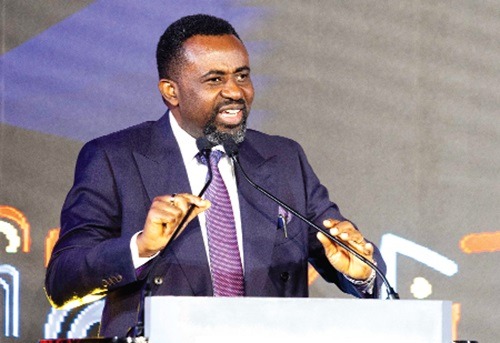
By Issah Olegor
Ghana’s economic crisis in 2022 did not emerge suddenly, according to a new policy analysis by former First Deputy Governor of the Bank of Ghana, Dr. Maxwell Opoku-Afari.
Instead, the country’s eventual descent into debt distress was preceded by several years of worsening fiscal and debt indicators that, while visible in successive assessments, were not sufficiently reflected in judgments about how rapidly Ghana could move from vulnerability to a full-blown crisis.
The study, published by the Finance for Development Lab, shifts the focus from the question of whether Ghana received warnings to whether the international surveillance and debt-assessment framework adequately interpreted the severity of those warnings.
Dr. Opoku-Afari argues that successive IMF-World Bank Debt Sustainability Analyses had identified significant vulnerabilities, with Ghana classified as being at high risk of debt distress as far back as 2015. Yet, despite the warning signs, the country’s debt continued to be considered sustainable under assumptions that included continued access to financial markets and successful implementation of fiscal consolidation measures.
At the heart of the analysis is the argument that Ghana’s debt problem was not simply a case of policymakers being unaware of the dangers. Rather, the danger was visible in the numbers, but the assessments did not fully capture the speed and intensity with which those vulnerabilities could interact and trigger a crisis.
The deterioration in Ghana’s debt position became particularly pronounced after 2014. The present value of public debt-to-GDP, which had remained below the 55 percent benchmark in the early 2010s, climbed sharply and approached 93 percent by 2022. That increase was accompanied by mounting debt-servicing pressures, suggesting that the problem was evolving beyond a simple accumulation of debt into a growing liquidity challenge.
The pressure was particularly evident in government revenues being consumed by debt obligations. According to the study, the external debt-service-to-revenue ratio had already breached its benchmark in 2013 and eventually exceeded 40 percent of government revenue by 2022.
Interest payments also remained above 20 percent of government revenue throughout the period assessed. At the same time, Ghana’s international reserves remained around the conventional minimum of three months of import cover.
Taken together, these indicators painted a picture of an economy becoming increasingly constrained by its debt obligations, limited fiscal space and vulnerability to external shocks.
Dr. Opoku-Afari’s most significant criticism concerns the treatment of domestic debt. His analysis argues that the Low-Income Country Debt Sustainability Framework did not adequately adapt to Ghana’s transformation into a frontier economy with substantial access to international capital markets and a more developed domestic financial market.
The increasing reliance on domestic borrowing created the impression that the country was reducing some of the risks associated with foreign-currency debt, but the study argues that the danger had not disappeared. Instead, it had changed form and created new vulnerabilities within the domestic financial system.
Government securities had increasingly become important assets for commercial banks, pension funds, insurance companies and foreign investors. This meant that a deterioration in the government’s ability to service its obligations could potentially transmit stress into the financial sector.
The analysis therefore presents Ghana’s debt challenge as a problem involving both the government and the wider financial system. The weighted-average interest rate on public debt during the period examined was estimated at 10.7 percent, while 17.5 percent of the debt stock was due to mature within one year.
Meanwhile, foreign-currency-denominated debt averaged 54.5 percent of total public debt, leaving the country substantially exposed to exchange-rate depreciation.
The interaction between these factors created a particularly difficult cycle. Higher interest costs increased government’s financing requirements, forcing further borrowing.
New borrowing, meanwhile, increasingly came at expensive rates, raising the cost of refinancing existing obligations. At the same time, depreciation of the Ghanaian cedi increased the local-currency value of external debt.
In effect, the country was facing simultaneous pressure from interest rates, refinancing requirements and exchange-rate movements. Dr. Opoku-Afari’s analysis suggests that assessing these risks individually could obscure the danger created when they occur at the same time.
The paper identifies three broader weaknesses in the surveillance and adjustment architecture. First, baseline projections were often built around optimistic assumptions of continued fiscal consolidation, stronger revenue mobilisation and sustained economic growth.
Second, the analysis argues that domestic-debt dynamics and the feedback relationship between government finances and the financial sector were not sufficiently incorporated into assessments.
Third, successive adjustment programmes were seen as placing considerable emphasis on short-term fiscal consolidation without fully resolving structural weaknesses that repeatedly generated new fiscal pressures.
These weaknesses included inefficiencies in the energy sector, governance challenges within state-owned enterprises and persistent shortcomings in taxation and revenue administration.