BY Daniel Bampoe
A decade ago, Lionel Messi stood before the world heartbroken and defeated, convinced that his journey with Argentina had reached its end.
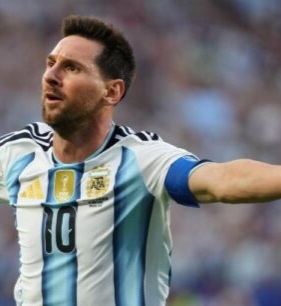
Today, at the age of 38 and just days away from his 39th birthday, the Argentine captain is not only still wearing the famous sky-blue and white jersey but is rewriting football history as the FIFA World Cup’s all-time leading goalscorer.
The remarkable transformation from despair to immortality is one of the greatest comeback stories in modern sports.
In June 2016, following Argentina’s painful Copa America final defeat to Chile, Messi shocked the football world by announcing his retirement from international football.
The loss was particularly devastating because it represented Argentina’s fourth major final defeat in nine years. To make matters worse, Messi missed a penalty during the shootout, adding to the burden he had carried throughout much of his international career.
At the time, an emotional Messi admitted he could no longer endure the heartbreak.
“For me, the national team is over. I’ve done all I can. It hurts not to be a champion,” he said after the defeat.
Those words appeared to signal the end of an era. Critics questioned whether the Barcelona superstar would ever achieve the international success that many believed was necessary to cement his place among football’s all-time greats.
However, Argentina’s greatest son would soon reconsider.
Messi reversed his retirement decision months later and returned to lead his country once again. What followed has become the most successful period in Argentina’s modern football history.
The Albiceleste ended decades of frustration by winning the Copa America title in 2021 before successfully defending the trophy in 2024. Yet the crowning achievement came in Qatar in 2022 when Messi captained Argentina to World Cup glory.
The tournament finally delivered the one prize that had eluded him throughout his legendary career.
Messi scored seven goals during the competition, including two in the unforgettable final against France, helping Argentina lift the World Cup for the first time since Diego Maradona inspired the nation to glory in 1986.
Many believed that victory would mark the perfect ending to his international career. Instead, Messi chose to continue.
Now, at the FIFA World Cup 2026, he is once again leading Argentina’s charge and proving that age remains little more than a number.
On June 22, exactly 40 years after Diego Maradona’s iconic performance against England at the 1986 World Cup, Messi added another chapter to his own extraordinary story.
Facing Austria in a Group J encounter, Argentina’s captain scored both goals in a 2-0 victory that secured qualification to the knockout stages and elevated him above Germany legend Miroslav Klose as the highest goalscorer in FIFA World Cup history.
Ironically, the evening did not begin according to script. Messi missed a first-half penalty, becoming the first player to miss a spot kick at the 2026 tournament.
The miss also extended another unusual record, as Messi now holds the distinction of both taking and missing more World Cup penalties than any player in history, excluding shootouts.
Yet great players have always responded to setbacks with brilliance.
Thirty minutes after the penalty miss, Messi calmly slotted home his 17th World Cup goal to surpass Klose’s long-standing record. Then, deep into stoppage time, he produced another trademark moment of genius, squeezing a finish through two defenders from a narrow angle to score his 18th World Cup goal.
The brace not only secured victory but further strengthened his growing collection of football records.
Messi has now scored 18 goals in 28 World Cup matches, with 13 of those goals coming after he briefly retired from international football in 2016. Remarkably, 12 of his World Cup goals have been scored since turning 35 years old, highlighting his incredible longevity and ability to adapt his game as he has grown older.
His influence extends far beyond goals.
Against Austria, Messi converted both of his shots on target and continued to add to another impressive record as the player who has created the most chances in World Cup history, with 76.
Even more astonishing is his recent form. Across his last six World Cup matches, Messi has been directly involved in 12 goals, scoring 10 and providing two assists.
Football experts continue to marvel at his ability to maintain elite performance levels.
Spanish football journalist Guillem Balague described the challenge of documenting Messi’s achievements as almost impossible.
“We don’t have time to create statues for Lionel Messi or deep analysis for him in newspapers. We cannot keep pace,” Balague remarked.
Former Wales defender Ashley Williams went even further, suggesting that the debate regarding football’s greatest player may already have been settled.
“We might have just witnessed the greatest player that football has ever seen,” Williams said.
Former England midfielder Danny Murphy echoed similar sentiments, praising Messi’s football intelligence and ability to influence matches without relying on pace or physicality.
Meanwhile, former France striker Olivier Giroud highlighted the Argentine’s professionalism and dedication to maintaining peak physical condition well into the latter stages of his career.
Despite the praise, some observers have questioned whether Argentina have become too dependent on their captain.
Messi has scored all five of Argentina’s goals at the 2026 World Cup, raising concerns about where goals might come from if opponents successfully neutralize him in the knockout rounds.
Yet even that debate seems secondary when considering the scale of what he continues to achieve.
The man who once walked away from international football believing he had failed his country has now become its greatest ambassador.
The player who feared he would never be a champion has since lifted multiple major trophies.