BY ISSAH OLEGOR
President John Dramani Mahama has announced plans to invest US$10 billion over five years under a proposed New Economy Policy, with the government targeting job-creating sectors such as agriculture, textiles, pharmaceuticals and tourism as part of efforts to accelerate economic growth and reduce unemployment.
Under the initiative, the government intends to invest approximately US$2 billion annually across nine priority areas, with the President insisting that the programme will be financed from domestic resources rather than new borrowing.
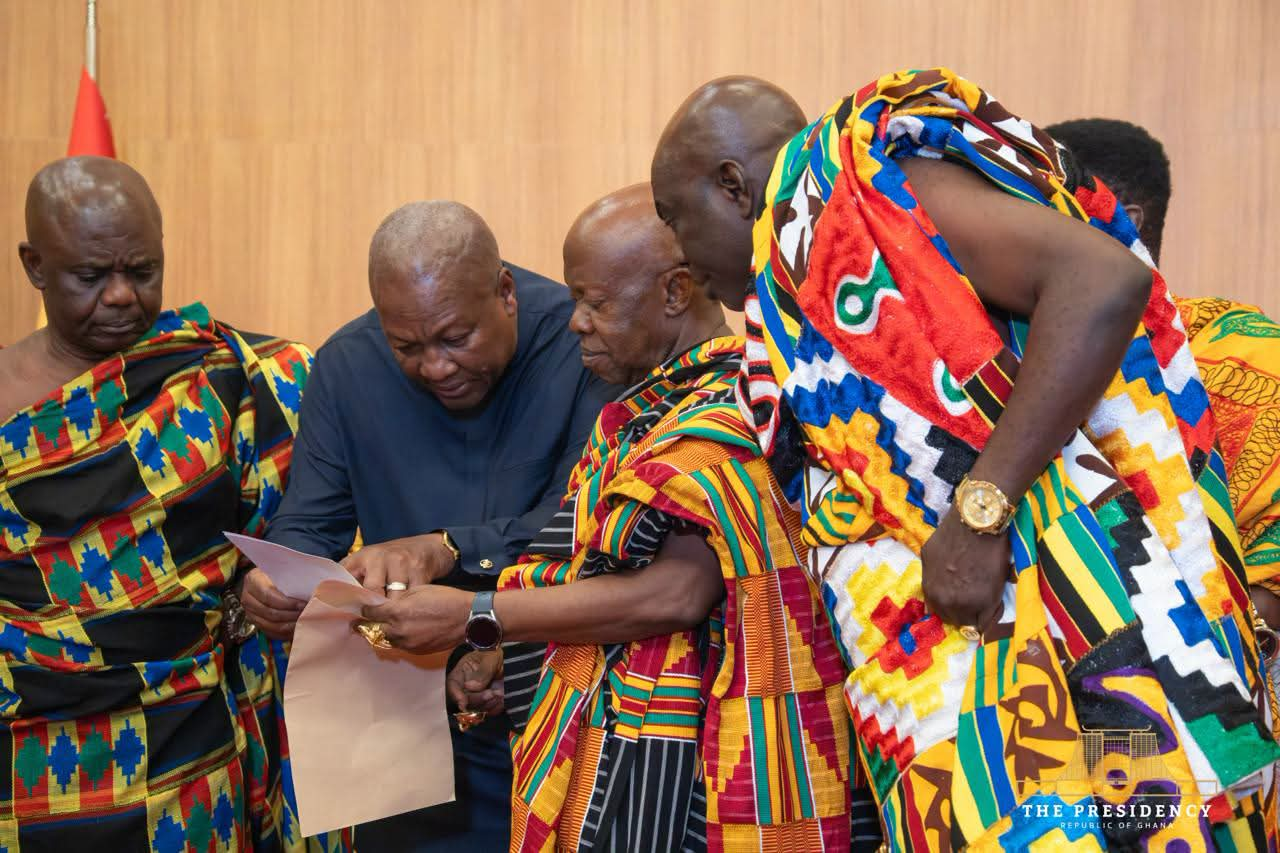
Mahama disclosed the plan during a courtesy call by chiefs from the Western North Region, where he outlined the government’s economic recovery agenda and its strategy to create employment through industrialisation, infrastructure development and private-sector expansion.
He said details of the initiative would be presented by the Finance Minister during the presentation of the 2027 Budget, describing the proposed investment programme as a central component of the government’s plan to build a more productive economy.
“When the Minister presents the 2027 Budget, he is going to announce what we call the New Economy Policy. The policy has selected nine areas, or nine pillars, in which the government is going to invest about US$2 billion every year for five years. That is a total of US$10 billion,” the President said.
“As I have said, this is our own money. We are not going to borrow money for the New Economy Policy.”
Strangely, the president never mentioned the 24-hour economy which the current government anchored its economic program on.
However, the details of the nine pillars, the funding arrangements and the mechanisms for distributing the proposed investments are expected to become clearer when the 2027 Budget is presented.
President Mahama said the New Economy Policy would focus on sectors with the potential to generate employment while strengthening Ghana’s productive capacity.
Among the areas identified were textiles and garments, agriculture and agribusiness, pharmaceuticals and tourism. The President used the engagement with the Western North chiefs to defend the government’s economic management, saying Ghana was recovering from the debt default and economic crisis that confronted the administration when it assumed office on January 7, 2025.
He pointed to economic growth projections and improvements in financial conditions as signs of recovery.
According to Mahama, the International Monetary Fund had projected Ghana’s economic growth at 5.7 per cent, above the average forecast of approximately four per cent for sub-Saharan Africa.
The President added that Ghana’s economic performance had remained encouraging despite external pressures, including rising petroleum prices associated with tensions between Iran and Israel.
His comments reflect the government’s position that fiscal discipline and efforts to stabilise the macroeconomy are helping to create conditions for renewed investment and employment growth.
However, economic growth projections do not automatically translate into jobs or improved living conditions for all households. The distribution of growth across sectors, the cost of living and the availability of decent employment will remain important measures of the recovery’s impact.
The proposed New Economy Policy is intended to connect the government’s broader economic programme more directly to production, business expansion and job creation.
President Mahama also attributed improving business conditions to the government’s fiscal measures, particularly its stated reduction in reliance on domestic borrowing.
He said the government was financing its expenditure from tax revenue and other funds accruing to the public purse rather than competing with businesses for credit in domestic financial markets.
“Today, the government is living within its means, and everything we are financing is being financed from our taxes and what the government brings into the Exchequer,” he said.
According to the President, reduced government borrowing from domestic banks had created room for financial institutions to extend more credit to private companies.
He cited a decline in Treasury bill rates from approximately 29 per cent to around seven per cent, arguing that the change had altered the incentives facing banks and other financial institutions.
Mahama said banks could find lending to private businesses at interest rates of approximately 13 per cent more attractive than investing in Treasury bills, potentially allowing companies to secure financing for expansion.
“It is better for them to lend at about 13 per cent to a private company. That is going to enable private companies to invest, expand their businesses and employ more people,” he said.
The government’s argument is that lower Treasury bill yields and reduced public-sector demand for credit can encourage lending to businesses, particularly those seeking to increase production or enter new markets.
However, actual lending rates and access to credit also depend on inflation expectations, borrowers’ creditworthiness, collateral requirements and the risks associated with individual sectors.
The President also pointed to the government’s Big Push infrastructure programme as a major source of employment, particularly in the construction industry.
He said road and building projects were creating opportunities for skilled and semi-skilled workers, including excavator operators, civil engineers, masons and steel benders.
“The construction industry alone has created hundreds of thousands of jobs because of the Big Push and the money the government is putting into infrastructure,” Mahama said.