BY ISSAH OLEGOR
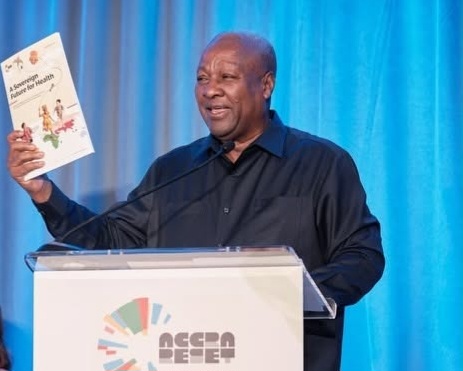
President John Dramani Mahama has launched a new High-Level Panel report under the Accra Reset initiative, calling for a fundamental rethink of how global health programmes are financed, governed and implemented across the Global South.
The report, titled “A Sovereign Future for Health,” was unveiled in New York on Monday, September 21, 2026, on the sidelines of the 81st United Nations General Assembly. The report proposes reforms aimed at strengthening national and regional health capabilities while reshaping relationships between developing countries, donors and international health institutions.
The initiative, championed by President Mahama, argues that countries should have greater control over decisions, financing and production capabilities that affect their health systems rather than simply being expected to take ownership of programmes largely designed and financed externally.
President Mahama argued that “there can be no ownership without control,” while stressing that greater sovereignty must also be matched by strong domestic accountability.
He said countries seeking greater control over their development priorities must demonstrate the ability to manage resources transparently and ensure that public funds are used for the benefit of citizens.
According to the report, the proposed new approach is built around five broad shifts: practical sovereignty, sovereign partnerships, stronger regional cooperation, a focus on functions rather than institutions, and independent accountability.
It also contains 10 recommendations, including country-led health plans, sustainable financing transitions, stronger regional institutions, locally led health innovation, regional pharmaceutical manufacturing, improved procurement systems and independent monitoring of commitments.
The Accra Reset High-Level Panel was established earlier in 2026 as an 18-member body tasked with developing concrete proposals for reforming global health architecture and governance. It was co-chaired by global health leaders including former UNAIDS Director-General Peter Piot, Kofi Annan Foundation Chair El Hadj As Sy, Brazil’s Nísia Trindade and Indonesia’s Budi Gunadi Sadikin.
President Mahama said Ghana’s own development agenda would form part of the broader push for greater self-reliance.
He pointed to efforts under the Resetting Ghana Agenda to strengthen fiscal management, fight corruption and build domestic productive capacity, including efforts to support local pharmaceutical manufacturing so that essential medicines can increasingly be produced locally.
The report’s proposals do not call for an immediate withdrawal of international assistance. Instead, it advocates a managed transition in which external support continues to protect essential services while countries gradually build stronger domestic and regional capabilities.
Mahama also identified maternal and child health as an immediate area in which the proposed approach should deliver measurable results.
Initiatives including Mother Africa and Business United for Mothers, Babies and Youth (BUMBY) are expected to form part of efforts to mobilise governments and the private sector around maternal and child health outcomes.