By Nadia Ntiamoah
The Mahama administration has announced plans to introduce a comprehensive State Assets Protection Bill aimed at preventing what government describes as the indiscriminate disposal of public assets by successive administrations, in a move expected to strengthen transparency and accountability in the management of state-owned properties.
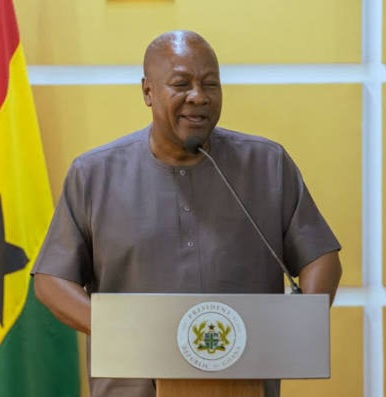
President John Dramani Mahama disclosed the decision while addressing participants at the Ghana Civil Society Forum 2026, revealing that Cabinet had formally directed the Attorney-General and Minister for Justice, Dr. Dominic Ayine, to begin drafting the proposed legislation.
According to the President, the proposed law will establish a clear legal framework governing how state lands, buildings, factories, industries and other public assets are managed, transferred or disposed of, ensuring that future governments cannot arbitrarily sell or alienate state property without following laid-down procedures.
“I’m also happy to announce to you that yesterday, Cabinet took a decision directing the Attorney-General to draft a bill for the protection of state assets. It’s called the State Assets Protection Bill. It shows the guidelines under which any state asset can be disposed of, including lands, buildings, state assets, factories, industries, so that no government just capriciously disposes of state assets,” President Mahama stated.
The announcement comes against the backdrop of longstanding national debate over the disposal of state-owned properties, with successive governments facing criticism over the sale, transfer and allocation of public assets to private entities.
Over the years, concerns have been raised by civil society organisations, anti-corruption campaigners and governance experts regarding the absence of a comprehensive legal framework to regulate the disposal of state assets and safeguard public interest.
Government believes the proposed legislation will close existing legal loopholes by introducing transparent procedures and stricter oversight over decisions involving valuable public property.
Beyond the proposed State Assets Protection Bill, President Mahama also announced another major governance initiative aimed at intensifying the fight against corruption.
He disclosed that Cabinet has approved the National Ethics and Anti-Corruption Plan (NEAP) 2026–2030, a five-year policy framework designed to coordinate national anti-corruption efforts, strengthen integrity within public institutions and improve accountability across government.
According to President Mahama, the approval of the new anti-corruption strategy demonstrates his administration’s commitment to promoting ethical governance, protecting public resources and rebuilding citizens’ confidence in state institutions.
The National Ethics and Anti-Corruption Plan is expected to provide strategic direction for anti-corruption agencies, public institutions and civil society organisations in tackling corruption, promoting transparency and improving institutional accountability over the next five years.
The twin decisions by Cabinet—introducing a State Assets Protection Bill and approving the National Ethics and Anti-Corruption Plan—form part of government’s broader governance reform agenda, which seeks to strengthen public financial management, enhance accountability and ensure that state resources are managed in the long-term interest of the Ghanaian people.